

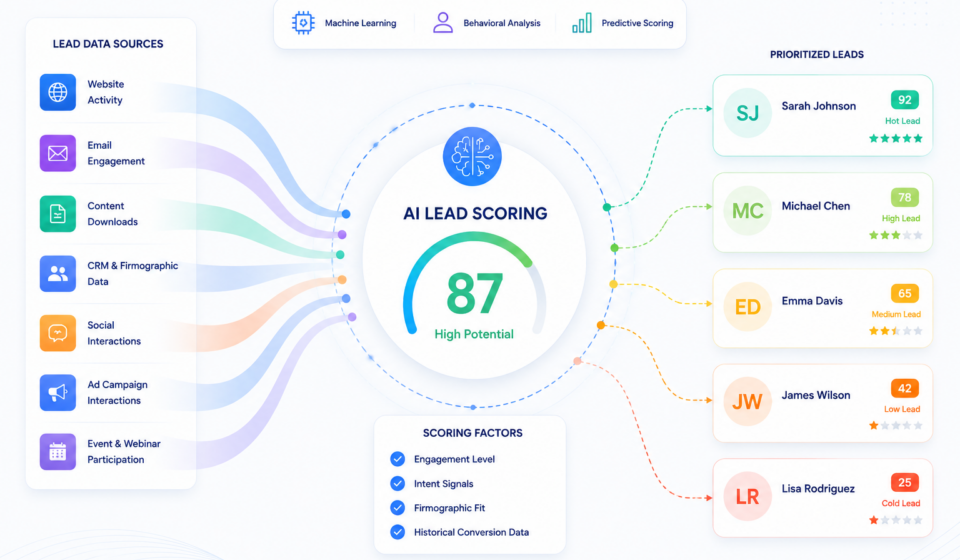

Most companies don’t have a lead problem. They have a prioritization problem — too many leads, too little sales capacity, and no reliable way to tell which ones deserve attention first.
Imagine a sales representative has 40 leads waiting in their pipeline but only has enough time to contact 12 of them today.
How do they decide which 12 to call?
Often, the decision comes down to instinct.
They might choose the person who filled out the longest form, used a company email address, visited the website several times, or responded to an email quickly.
These signals can be useful, but they don’t necessarily tell you who is most likely to become a customer.
This creates a common problem for growing businesses.
Marketing teams can generate hundreds or thousands of leads, but sales teams have limited time and resources. They cannot give every lead the same level of attention.
The result is that sales representatives have to decide which leads deserve priority.
When those decisions are based mainly on gut feeling, valuable opportunities can easily be missed.
A lead that was genuinely ready to buy might be ignored while the sales team spends time chasing leads that were never likely to convert.
This is the problem AI lead scoring is designed to solve.
Instead of relying only on manually created rules — such as giving a lead points for downloading an ebook or visiting a pricing page — AI lead scoring can analyze large amounts of historical sales data.
It can study thousands of previous leads and look for patterns across both successful and unsuccessful deals.
The system may analyze information such as:
- Website activity
- Pages visited
- Content downloaded
- Email engagement
- Company characteristics
- Previous interactions with sales
- Product interest
- Purchase history
- Lead source
- Conversion history
It then uses these patterns to estimate the likelihood that a new lead will become a customer.
Instead of simply saying:
“This lead has 80 points.”
an AI system can provide a more meaningful prediction:
“Based on the available data, this lead has a high probability of converting.”
And that prediction can change as the lead’s behavior changes.
If the lead suddenly visits the pricing page, attends a product demo, responds to a sales email, or shows other high-intent behavior, the model can update its assessment.
This is a major difference between traditional lead scoring and AI-powered lead scoring.
Why AI Lead Scoring Matters Now
The buying process has also changed.
B2B buyers increasingly research products and companies online before speaking with a salesperson.
By the time a prospect finally contacts sales, they may already have:
- Read several articles
- Compared competitors
- Watched product videos
- Visited pricing pages
- Downloaded resources
- Read customer reviews
- Discussed the product internally
That digital activity creates valuable signals about buying intent.
The problem is that traditional lead-scoring systems were usually built around a limited number of predefined rules.
For example:
Downloaded an ebook = +5 points
Visited pricing page = +10 points
Opened an email = +2 points
These rules can be useful, but they don’t necessarily capture the complex relationships between hundreds of different signals.
AI and machine learning can analyze those relationships much more effectively.
For example, the model might discover that a combination of:
Pricing-page visit + repeat website visits + product comparison + email engagement
is a much stronger indicator of purchase intent than any one of those actions on its own.
That’s where AI lead scoring becomes particularly valuable.
| Business Area | Impact of Poor Lead Prioritization | Impact of Effective Lead Scoring |
|---|---|---|
| Sales Productivity | Reps spend hours chasing low-intent leads | Reps focus on leads statistically likely to close |
| Marketing ROI | Budget spent on volume, not quality | Spend reallocated toward channels producing high-scoring leads |
| Customer Experience | Hot leads wait behind cold ones; slow follow-up | Fast, relevant follow-up when buying intent is highest |
| Conversion Rates | Diluted by low-fit leads in the funnel | Concentrated effort on leads with real fit and intent |
| Pipeline Efficiency | Pipeline bloated with unqualified opportunities | Cleaner pipeline, more accurate stage progression |
| Revenue Growth | Inconsistent, hard to forecast | Predictable, tied to measurable lead quality |
| Sales & Marketing Alignment | Marketing blamed for “bad leads,” sales blamed for “not following up” | Shared definition of a qualified lead, shared accountability |
Treevire Insight: The single biggest source of sales-marketing conflict isn’t lead volume — it’s the absence of a shared, evidence-based definition of what a “good lead” actually is. Lead scoring forces that definition into the open.
But the Algorithm Isn’t the Most Important Part
A sophisticated model is not enough.
The real measure of success is whether sales actually trusts and uses the score.
A company can spend thousands of dollars building an advanced lead-scoring system.
But if sales representatives don’t believe the predictions, they will ignore them and return to their old habits.
At that point, the company hasn’t solved anything.
It has simply built an expensive system that nobody uses.
That’s why this guide focuses on more than just the technology.
You’ll learn:
- How AI lead scoring works
- How it differs from traditional lead scoring
- Which data actually matters
- How to choose the right model
- How to evaluate lead-scoring tools
- How to connect scoring with your CRM
- How to get sales teams to trust the results
- How to measure whether the system is actually improving revenue
- How to implement AI lead scoring step by step
The ultimate goal isn’t to create the most complicated scoring model.
It’s to create a system that helps sales teams spend their limited time on the opportunities most likely to become valuable customers.
A lead score is only valuable when it improves a real sales decision.
Traditional Lead Scoring vs. AI Lead Scoring
There are two main approaches to lead scoring: traditional rule-based scoring and AI-powered scoring.
Both approaches can help sales teams prioritize leads, but they work very differently.
Rule-Based Models
Rule-based lead scoring assigns fixed points to specific customer characteristics or actions based on rules created by a marketing or sales team.
For example:
- Job title matches the target buyer → +10 points
- Visits the pricing page → +10 points
- Downloads an ebook → +5 points
- Unsubscribes from emails → -10 points
These systems are simple to create, easy to understand, and relatively inexpensive to maintain.
However, they are static.
The system only knows the rules that humans have created. It does not automatically learn from new sales outcomes or identify relationships between different signals.
For example, it may not recognize that a combination of three smaller behaviors is actually a much stronger buying signal than one high-value action.
Point-Based Systems
Point-based scoring is the most common structure used in traditional lead-scoring systems.
Positive actions or characteristics add points, while negative signals remove points.
For example:
Positive signals
- Target job title → +10
- Company matches ideal customer profile → +15
- Pricing-page visit → +10
- Product demo request → +20
Negative signals
- Personal email address → -5
- Unsubscribed → -10
- Competitor company → -20
Businesses can then create thresholds to determine when a lead becomes a Marketing Qualified Lead (MQL) or a Sales Qualified Lead (SQL).
The advantage is simplicity.
Everyone can understand why a lead received a particular score.
The limitation is that the scoring logic depends heavily on human assumptions about which signals matter and how much each signal should be worth.
Machine Learning Models
Machine learning takes a different approach.
Instead of asking a sales or marketing manager to decide how many points each behavior should receive, the model learns from historical sales data.
For example, a company could provide information about thousands of previous leads, including:
- Which leads became customers
- Which leads did not convert
- Company characteristics
- Website behavior
- Email engagement
- Sales interactions
- Product usage
- Deal size
- Time to conversion
The model then looks for statistical patterns that are associated with successful outcomes.
Common approaches include:
- Logistic regression
- Random forests
- Gradient-boosted trees
The model may discover relationships that humans wouldn’t have thought to include in a manual scoring system.
Instead of assuming:
“A pricing-page visit is worth 10 points.”
the model asks:
“How strongly does a pricing-page visit, combined with this customer’s other characteristics and behaviors, relate to the probability of conversion?”
That’s a fundamental difference.
Predictive Models
Predictive scoring is a broader concept.
Instead of simply asking:
“Is this a good lead?”
a predictive model can answer more specific questions such as:
“What is the probability that this lead will become a customer within the next 90 days?”
It can also estimate other outcomes, such as:
- Probability of conversion
- Expected time to conversion
- Expected deal value
- Probability of churn
- Customer lifetime value
This gives sales teams more information than a simple numerical score.
Behavioral Scoring
Behavioral scoring focuses primarily on what a lead does.
Signals can include:
- Website visits
- Pages viewed
- Email engagement
- Content downloads
- Product usage
- Demo attendance
- Pricing-page visits
- Search activity
The idea is that behavior can reveal buying intent.
For example, someone who repeatedly visits a pricing page and watches a product demo may be showing stronger purchase intent than someone who simply downloaded an introductory ebook.
Intent Scoring
Intent scoring goes a step further by looking for signals that indicate a company or individual may be actively researching a purchase.
These signals can come from sources beyond your own website.
For example, intent-data providers may identify that a company is researching topics related to your product across other websites and online sources.
This can help businesses identify potential buyers before they directly engage with the company’s website.
Traditional Lead Scoring vs. AI Lead Scoring
| Dimension | Traditional Lead Scoring | AI Lead Scoring |
|---|---|---|
| How scores are created | Manually assigned points based on predefined rules | Learned from historical sales and customer data |
| Adaptability | Remains largely unchanged until a human updates the rules | Can be retrained and updated as new outcome data becomes available |
| Signal complexity | Usually evaluates individual attributes separately | Can identify relationships, combinations, and sequences of signals |
| Data sources | Primarily CRM data and form information | Can combine CRM, CDP, product usage, intent, support, website, and other relevant data |
| Performance over time | Can become less effective as customer behavior changes | Can improve as more relevant outcome data becomes available, provided the model is properly maintained |
| Transparency | Highly transparent because humans define the rules | Requires explainability methods to understand why the model made a prediction |
| Implementation effort | Relatively low | Moderate to high, particularly when sufficient clean historical data is required |
| Best suited for | Small teams, early-stage companies, and businesses with limited historical sales data | Mid-market and enterprise organizations with sufficient historical data and sales volume |
How AI Lead Scoring Works
Think of AI lead scoring as a factory line with continuous quality control — data enters at one end, a probability score exits at the other, and the machinery recalibrates itself every time a deal closes or dies.
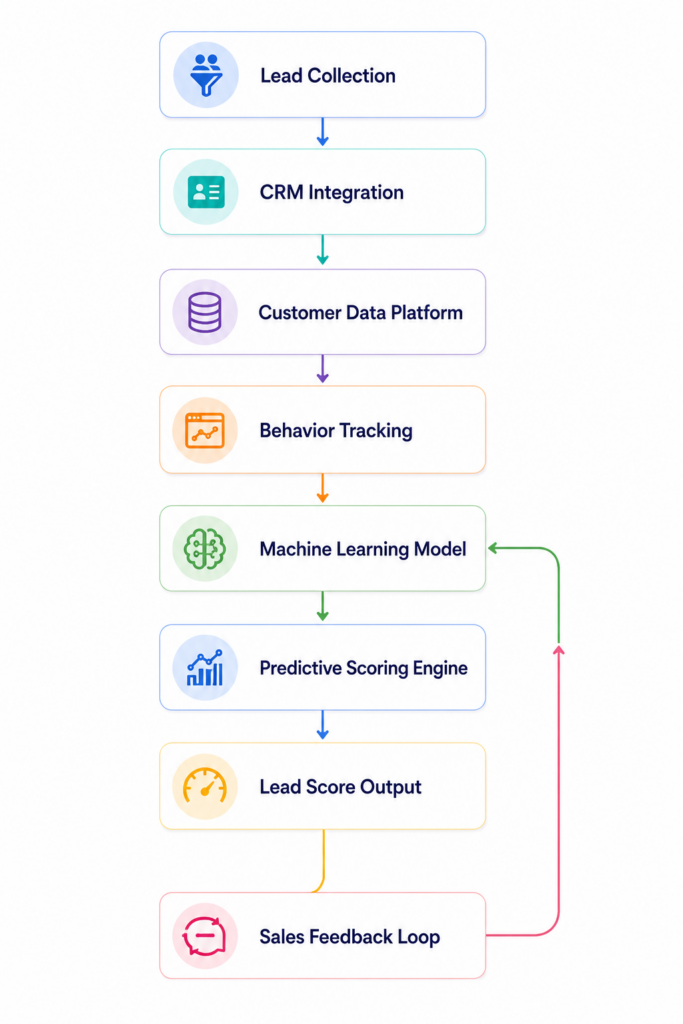
1. Lead Collection — Every lead source — including forms, website chat, events, advertisements, referrals, webinars, and other entry points — sends information into a central system. This includes basic identity information, where the lead came from, and the campaign or channel that generated the lead.
2. CRM Integration — The CRM becomes the central system of record for the sales process. Each lead is connected to the appropriate company, sales representative, opportunity, pipeline stage, and relevant sales activity, giving the scoring system the business context needed to evaluate the lead.
3. Customer Data Platform (CDP) — The CDP brings together customer information from marketing, product, sales, support, and other systems to create a unified customer profile. It can also resolve identities across devices and channels, helping the business understand that multiple interactions may belong to the same person.
4. Behavior Tracking — Customer activity is captured as individual, timestamped events. This can include website visits, pages viewed, content downloads, email opens and clicks, webinar attendance, form submissions, product usage, and other relevant interactions. Over time, these events create a behavioral history that can reveal changes in buying intent.
5. Machine Learning — Historical lead data is used to train a machine learning model. Leads are labeled according to their outcomes, such as closed-won, closed-lost, or still open. The model analyzes the differences between successful and unsuccessful leads to identify patterns and relationships that may predict future conversion.
6. Predictive Models — Once trained, the model is applied to new leads whose outcomes are not yet known. Instead of simply assigning points based on predefined rules, it generates a probability that each lead will convert based on the patterns it learned from historical data.
7. Scoring Engine — The predicted probability is converted into an operational score that sales and marketing teams can easily understand, such as a 0–100 score. The system may also classify leads into categories such as Hot, Warm, or Cold. The score and relevant insights are then pushed back into the CRM so sales representatives can use them when prioritizing their pipeline.
8. Continuous Learning — As leads move through the sales process, their actual outcomes become known. New closed-won and closed-lost outcomes are added to the historical dataset, allowing the model to be retrained periodically. This helps the scoring system adapt as customer behavior, markets, products, and buying processes change.
9. Sales Feedback Loop — Sales representatives can provide valuable feedback when a prediction does not match reality. For example, a representative might report that a lead with a very high score never responded, while another lead with a low score became a major customer. This information can be incorporated into future model training and evaluation. In many implementations, this is one of the most valuable and underused sources of improvement.
Treevire Insight: A lead-scoring model without a feedback loop eventually becomes a model frozen in time. The most effective AI lead-scoring systems treat sales feedback as valuable data that helps improve the model, rather than as an inconvenience or criticism of the system.
Lead Scoring Models
| Model | What It Measures | Example |
|---|---|---|
| Demographic Scoring | Characteristics of the individual lead | Job title, seniority, department, role |
| Firmographic Scoring | Characteristics of the lead’s company | Industry, company size, revenue, location |
| Behavioral Scoring | Actions the lead takes across the company’s owned channels | Pricing-page visits, email clicks, content downloads, webinar attendance |
| Engagement Scoring | The depth, frequency, and recency of interactions | Number of website visits, frequency of engagement, response time to outreach |
| Intent Data | Signals that indicate active research or purchase interest | Researching competitor or category-related topics across external sources |
| Predictive Scoring | Model-generated probability of conversion | 0–100 likelihood-to-convert score |
| Negative Scoring | Signals that reduce a lead’s fit or likelihood of conversion | Competitor email domain, unsubscribing, job-seeking activity |
| Fit Score | How closely the lead or account matches the ideal customer profile | Company size, industry, technology stack, and market match |
| Interest Score | How strongly the lead engages with marketing content | Content downloads, webinar registrations, product-page activity |
| Buying Readiness Score | A combined measure of near-term purchase intent | Pricing-page visit + demo request + engagement from multiple stakeholders |
Most mature lead-scoring programs don’t rely on a single scoring method. Instead, they combine fit and intent.
Fit answers:
“Is this the type of company or customer we want to sell to?”
Intent answers:
“Is this customer showing signs that they may be ready to buy now?”
A large enterprise may be a perfect fit for your product, but if there is no engagement or buying activity, it may not be a high-priority lead today.
On the other hand, a small company may show extremely strong buying signals, but lack the budget, authority, or characteristics required to become a valuable customer.
The combination of who the customer is and what the customer is doing provides a much stronger basis for predicting revenue.
AI Technologies Used
- Machine Learning — The core statistical technology behind AI lead scoring. Machine learning models analyze historical lead and sales data to identify patterns associated with successful and unsuccessful outcomes. These patterns are then used to evaluate new leads and estimate their likelihood of conversion.
- Deep Learning — Used when the data is large, complex, or contains long sequences of customer behavior. For example, deep learning can analyze extended sequences of website visits, product interactions, and other behavioral events to identify patterns that may be difficult for simpler models to detect.
- Natural Language Processing (NLP) — Allows AI systems to analyze text-based interactions such as email replies, chat conversations, sales notes, and support tickets. NLP can identify signals related to sentiment, intent, questions, objections, urgency, and buying interest that may not be captured by traditional numerical data.
- Predictive Analytics — Uses historical and current data to forecast future sales outcomes. Instead of only predicting whether a lead is likely to convert, predictive analytics can also estimate factors such as expected deal size, probability of closing, potential time-to-close, and other outcomes relevant to sales planning.
- Customer Intent Models — Combine behavioral signals from your own website and product with third-party research signals to identify when a company or individual may be actively considering a purchase. These models help identify potential buying activity before a lead explicitly tells the business that they are ready to buy.
- Recommendation Engines — Use lead information and historical sales patterns to recommend the next best action for a sales representative. This could include which lead to contact first, which communication channel to use, what content to share, or which follow-up action is most likely to move the opportunity forward.
- Generative AI — Uses a lead’s specific characteristics, behavior, interests, and score drivers to help create personalized sales and marketing content. For example, it can draft an outreach email that reflects the lead’s recent activity rather than sending the same generic message to every prospect.
- AI Agents — Increasingly used to perform multiple lead-management tasks with limited step-by-step human instruction. An AI agent can potentially research a lead, collect additional company information, enrich the customer profile, analyze buying signals, prepare personalized outreach, and initiate an appropriate first-touch action before a salesperson becomes directly involved.
Data Used for Lead Scoring
| Data Source | What It Contributes |
|---|---|
| CRM Data | Provides information about lead ownership, sales stage, lead source, account information, previous opportunities, and historical won or lost outcomes. |
| Website Activity | Shows which pages a lead visits, how frequently they return, how much time they spend on the website, and which products or topics they are interested in. |
| Email Engagement | Includes email opens, clicks, replies, response behavior, and unsubscribe activity, helping identify the level of interest and engagement. |
| Product Usage | Provides information about feature adoption, login frequency, product activity, and trial behavior, particularly useful for identifying Product Qualified Leads (PQLs). |
| Social Signals | Can provide information about company growth, hiring activity, business changes, and engagement with the company’s content or brand. |
| Support Tickets | Provides information about customer problems, satisfaction, product usage issues, and potential expansion opportunities for existing customers. |
| Purchase History | Shows previous buying behavior and can help identify opportunities for repeat purchases, cross-selling, and expansion. |
| Marketing Automation | Provides information about campaign engagement, form submissions, nurture sequences, content interactions, and progression through marketing workflows. |
| Third-Party Intent Data | Provides signals about research and buying activity taking place outside the company’s own website and digital properties. |
| CDP Data | Creates a unified, deduplicated customer profile by bringing together information from multiple systems and customer touchpoints. |
CRM Data vs. CDP Data
| Dimension | CRM | CDP |
|---|---|---|
| Primary purpose | Manage sales relationships, accounts, opportunities, and pipeline activity | Unify customer data from different touchpoints into a single customer profile |
| Data granularity | Primarily focused on accounts, contacts, opportunities, and sales activity | Can include detailed individual events such as clicks, page views, purchases, and interactions |
| Primary users | Sales teams and customer-facing teams | Marketing, data, analytics, and growth teams |
| Update frequency | Often updated manually or through integrations | Typically designed for continuous and automated data updates |
| Best use in lead scoring | Provides outcome labels, sales context, ownership, and pipeline information | Provides detailed behavioral, engagement, and cross-channel signals |
Lead Scoring Workflow
Visitor → Lead Data Collection → Profile Enrichment → AI Analysis → Lead Score → Sales Qualification → Pipeline → Closed Won
Each stage of the workflow should have a clearly defined owner and a measurable exit criterion.
A lead should not automatically move from Lead to Sales Qualification simply because its score crosses a predefined number.
The score should be evaluated together with other important factors, particularly lead fit.
For example, a lead may have very high engagement but still be a poor fit for the company’s product. Another lead may be an excellent fit but show very little buying activity.
A lead should move into sales qualification when its predicted buying potential, customer fit, and current level of intent indicate that it is worth a salesperson’s time at that point in the buying journey.
Benefits of AI Lead Scoring
- Higher Conversion Rates — Sales teams can focus more of their time on leads that the model identifies as having a higher probability of becoming customers.
- Better Sales Efficiency — Representatives spend less time manually reviewing and contacting leads that are unlikely to convert, allowing them to focus on higher-value opportunities.
- Improved Marketing ROI — Marketing teams can identify which channels, campaigns, and sources consistently generate high-quality leads and allocate budget accordingly.
- Better Forecasting — Probability-based lead scores can provide additional signals for pipeline forecasting and help sales teams build more informed revenue projections.
- More Personalized Outreach — Understanding which behaviors and characteristics contributed to a lead’s score can help sales representatives determine what topics, offers, or messages are most relevant to that lead.
- Reduced Manual Work — AI can automatically analyze large numbers of leads, reducing the need for sales and marketing teams to manually review spreadsheets or assign scores.
- Higher Revenue Potential — When better lead prioritization, improved sales efficiency, stronger marketing allocation, and more relevant outreach work together, the combined effect can contribute to higher revenue.
- Shorter Sales Cycles — Identifying high-intent leads earlier can help sales representatives engage prospects closer to the point of purchase, potentially reducing the time between initial engagement and closed deal.
- Better Customer Experience — Leads can receive more relevant and appropriately timed communication instead of generic outreach that doesn’t reflect their interests or stage in the buying process.
- Scalability — An AI scoring system can evaluate significantly larger numbers of leads without requiring a proportional increase in the number of people manually reviewing and prioritizing them.
Real Business Examples
Leading CRM and marketing platforms have increasingly built predictive lead scoring directly into their products. This reflects how important AI-powered lead prioritization has become within modern sales and revenue operations.
- Salesforce offers Einstein Lead Scoring, which uses a company’s own historical CRM data to build predictive models rather than depending entirely on generic industry benchmarks. This allows the scoring system to learn from the organization’s previous lead and sales outcomes.
- HubSpot provides predictive lead scoring within its Sales and Marketing Hubs. It can combine behavioral engagement signals with firmographic and CRM data to estimate which leads are more likely to convert.
- Microsoft Dynamics 365 provides predictive scoring through its AI-powered sales capabilities. Its scoring can benefit from the broader Microsoft ecosystem, including information from tools such as email, calendars, and Teams activity.
- Adobe provides predictive capabilities within Experience Cloud, making it particularly relevant for larger organizations managing complex customer journeys and data across multiple marketing channels.
- 6sense and Demandbase focus heavily on account-based marketing and intent data. Their platforms can identify companies that appear to be actively researching a product category or solution before those companies submit a form or directly contact a sales team.
Treevire Insight: The most important factor across all of these platforms isn’t the sophistication of the algorithm — it’s the quality of the data behind it. A predictive model trained on incomplete, duplicated, or inaccurate CRM data can perform worse than a simple rule-based system built on clean and reliable information. Improve your data quality before investing heavily in AI scoring.
Best AI Lead Scoring Tools
HubSpot
Overview: HubSpot is an all-in-one CRM and marketing platform that includes native predictive lead-scoring capabilities.
AI Capabilities: Predictive scoring uses historical conversion and customer data within the HubSpot CRM to identify patterns associated with successful conversions.
Pros: Easy to set up, strong integration between marketing and sales data, and particularly accessible for small and mid-sized businesses.
Cons: Predictive scoring becomes more useful when there is enough historical data available. It also provides less modeling flexibility than specialized machine learning platforms.
Best For: SMB and mid-market companies that already use HubSpot as their primary CRM and want predictive scoring without building a separate AI infrastructure.
Salesforce Einstein
Overview: Salesforce Einstein is the AI layer integrated into Salesforce’s CRM ecosystem.
AI Capabilities: Einstein Lead Scoring and Einstein Opportunity Scoring use an organization’s historical data to predict which leads and opportunities are more likely to convert or close.
Pros: Deep integration with Salesforce CRM, enterprise-grade capabilities, and extensive configuration options.
Cons: The quality of the predictions depends heavily on CRM data quality. Setting up and managing the system effectively can also require more technical and operational expertise.
Best For: Enterprise organizations that have standardized their sales and revenue operations around Salesforce.
Microsoft Dynamics 365
Overview: Microsoft Dynamics 365 combines CRM capabilities with Microsoft’s broader business and productivity ecosystem.
AI Capabilities: Its AI-powered sales capabilities can provide predictive scoring and use engagement signals from the broader Microsoft environment, including email and calendar activity.
Pros: Strong integration with Microsoft 365 and useful for organizations already operating extensively within Microsoft’s ecosystem.
Cons: The platform provides the greatest value when the organization is already using a broader Microsoft technology stack.
Best For: Mid-market and enterprise organizations that have standardized on Microsoft 365 and Dynamics 365.
Zoho CRM
Overview: Zoho CRM is a cost-effective CRM platform that includes AI capabilities through its Zia assistant.
AI Capabilities: Zia can support predictive lead scoring and estimate conversion probabilities using available customer and engagement information.
Pros: Affordable, relatively accessible, and suitable for growing businesses that want AI capabilities without the complexity of an enterprise platform.
Cons: Its predictive modeling capabilities are generally less extensive than those offered by larger enterprise-focused platforms.
Best For: SMBs looking for affordable CRM-based predictive lead scoring.
Freshsales
Overview: Freshsales is a CRM platform from Freshworks with AI capabilities provided through Freddy AI.
AI Capabilities: Freddy AI can evaluate contact and deal information using engagement and profile signals to help identify higher-priority opportunities.
Pros: User-friendly interface, relatively quick deployment, and straightforward sales workflows.
Cons: Its surrounding data ecosystem is smaller than platforms such as Salesforce and Microsoft Dynamics.
Best For: Small and mid-sized sales teams that want AI-assisted scoring without a highly complex implementation.
Pipedrive
Overview: Pipedrive is a sales-focused CRM designed around pipeline and deal management.
AI Capabilities: Its AI-powered capabilities can provide insights into leads and deals using sales activity and historical patterns.
Pros: Simple and intuitive pipeline management makes it easy for sales representatives to understand and act on lead information.
Cons: It is less suited to organizations that need highly complex, multi-touch B2B marketing data and sophisticated predictive modeling.
Best For: Sales-led SMBs and teams with relatively simple sales funnels.
6sense
Overview: 6sense is an account-based marketing, intent-data, and predictive analytics platform focused primarily on B2B organizations.
AI Capabilities: It uses intent signals and predictive analytics to identify companies that may be actively researching a particular category or solution, including activity that occurs before a company submits a form.
Pros: Particularly strong for enterprise B2B organizations using account-based sales and marketing strategies.
Cons: Higher cost and greater implementation complexity compared with CRM-native scoring tools.
Best For: Enterprise B2B organizations with sophisticated account-based sales and marketing programs.
Demandbase
Overview: Demandbase is an account-based marketing and sales intelligence platform designed for enterprise B2B organizations.
AI Capabilities: Its predictive scoring combines signals such as account fit, engagement, and buying intent to identify accounts that may represent stronger opportunities.
Pros: Strong ABM-focused scoring and the ability to connect scoring with broader account-based marketing and sales workflows.
Cons: The platform is most valuable for organizations with a genuine ABM strategy rather than businesses primarily focused on high-volume inbound lead generation.
Best For: Enterprise organizations running mature account-based marketing programs.
MadKudu
Overview: MadKudu is a specialized predictive scoring platform focused on lead scoring and Product Qualified Lead (PQL) scoring.
AI Capabilities: It provides purpose-built predictive models that can incorporate product usage and behavioral data, making it particularly relevant for product-led growth companies.
Pros: Strong specialization in predictive scoring and particularly useful for SaaS businesses where product usage is an important indicator of buying intent.
Cons: It typically adds another specialized platform to the technology stack rather than providing scoring entirely within the CRM.
Best For: Product-led growth (PLG) SaaS companies that need sophisticated lead and PQL scoring.
Leadspace
Overview: Leadspace is a B2B data and predictive scoring platform focused on account and contact intelligence.
AI Capabilities: It can combine firmographic, technographic, and intent signals to create more comprehensive account and lead scores.
Pros: Strong data enrichment and intelligence capabilities alongside predictive scoring.
Cons: Primarily positioned as an enterprise-level solution, making it less suitable for smaller businesses with limited data requirements or budgets.
Best For: Enterprise organizations that need both unified B2B data and predictive scoring capabilities.
Comparison Table
| Tool | Best For | AI Scoring Strength | Setup Complexity |
|---|---|---|---|
| HubSpot | SMB–Mid-Market | Moderate | Low |
| Salesforce Einstein | Enterprise | Strong | High |
| Microsoft Dynamics 365 | Enterprise using the Microsoft stack | Strong | High |
| Zoho CRM | SMB | Moderate | Low |
| Freshsales | Small and mid-sized teams | Light–Moderate | Low |
| Pipedrive | Sales-led SMBs | Light | Low |
| 6sense | Enterprise ABM | Very Strong | High |
| Demandbase | Enterprise ABM | Very Strong | High |
| MadKudu | PLG SaaS | Strong, particularly for PQL scoring | Moderate |
| Leadspace | Enterprise data and predictive scoring | Strong | Moderate–High |
Pricing varies by vendor, plan, number of users, data volume, and required features. Always confirm current pricing and capabilities directly with the vendor before making a purchasing decision.
How to Build an AI Lead Scoring System
- Define Business Goals — What outcome are you optimizing for: SQL volume, pipeline value, win rate, or sales cycle length? The model’s target variable follows from this.
- Define Your Ideal Customer Profile (ICP) — Without a clear ICP, “fit” scoring has nothing to measure against.
- Collect Data — Consolidate CRM, marketing automation, product usage, and (if available) intent data into one accessible store.
- Clean Data — Deduplicate records, standardize fields (job titles, industries), and fix missing or inconsistent historical outcome labels. This is the step most teams underestimate and most models depend on.
- Train Models — Use historical closed-won/closed-lost data to train an initial model; validate against a held-out set of past deals.
- Define Scoring Thresholds — Translate probability output into operational tiers (e.g., 80+ = Hot, 50–79 = Warm, below 50 = Nurture).
- CRM Integration — Push scores back into the CRM in real time so reps see them where they already work.
- Automation — Trigger routing, alerts, and nurture sequences automatically based on score tier changes.
- Testing — Run the AI score alongside existing processes before fully replacing them; compare outcomes.
- Optimization — Adjust thresholds and inputs based on real conversion data, not assumptions.
- Monitoring — Track model accuracy and drift over time; retrain on a regular cadence.
The Treevire Intelligent Lead Qualification Framework
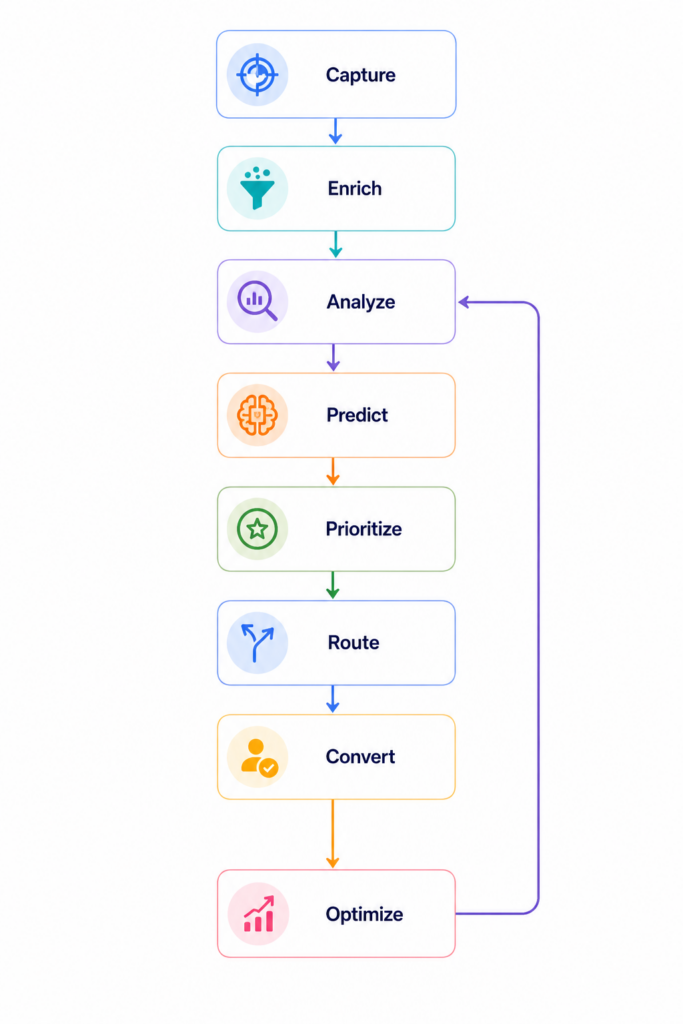
An original, eight-stage framework developed to give teams a practical structure for building and operating an AI lead scoring system — not just a model, but a full operating discipline.
1. Capture — Every lead-generating touchpoint (forms, chat, events, referrals, product signups) feeds into one system of record. No lead is invisible.
2. Enrich — Raw contact and company data is enhanced with firmographic, technographic, and intent data so the model has more than a name and an email to work with.
3. Analyze — Behavioral and engagement data is processed to understand what a lead has actually done, not just who they claim to be.
4. Predict — A trained model converts the enriched, analyzed profile into a probability of conversion.
5. Prioritize — Probabilities are translated into tiers and ranked so sales knows exactly where to spend the next hour.
6. Route — Leads are automatically assigned to the right rep, team, or sequence based on score, territory, and fit — with no manual triage delay.
7. Convert — Sales engages with context: the specific signals driving the score inform the opening message and the offer.
8. Optimize — Outcomes (won, lost, stalled) feed back into the model, and thresholds are recalibrated on a defined cadence, closing the loop back into Analyze.
Treevire Insight: Most lead scoring failures happen at Route and Convert, not at Predict. A perfectly accurate model that routes to the wrong rep or produces a generic follow-up message still loses the deal.
KPIs to Track
| KPI | What It Tells You | How to Measure |
|---|---|---|
| Lead Quality | Whether scored leads actually convert at the rate predicted | Compare predicted score tiers against actual close rates |
| Conversion Rate | Overall funnel efficiency | Closed-won ÷ total qualified leads |
| Sales Velocity | Speed of revenue generation | (Opportunities × Win Rate × Deal Size) ÷ Sales Cycle Length |
| Pipeline Value | Total potential revenue in motion | Sum of open opportunity values |
| Revenue | Ultimate business outcome | Closed-won revenue over a period |
| CAC (Customer Acquisition Cost) | Efficiency of acquisition spend | Total sales & marketing cost ÷ new customers acquired |
| SQL Rate | How many MQLs convert to SQLs | SQLs ÷ MQLs |
| MQL Rate | Top-of-funnel qualification efficiency | MQLs ÷ total leads |
| Win Rate | Sales execution effectiveness | Closed-won ÷ (closed-won + closed-lost) |
| Average Deal Size | Revenue per closed deal | Total revenue ÷ number of deals |
| Forecast Accuracy | Reliability of pipeline predictions | Predicted revenue vs. actual revenue, per period |
Common Mistakes
- Scoring Too Early — Building a model before enough historical outcome data exists produces unreliable predictions.
- Poor CRM Data — Garbage in, garbage out; incomplete or inconsistent fields undermine everything downstream.
- Ignoring Negative Signals — Failing to penalize disqualifying attributes (competitors, job seekers, wrong company size) inflates scores artificially.
- No Model Retraining — Buyer behavior shifts; a model trained once and never updated drifts out of accuracy.
- Overweighting Demographics — Job title and company size are easy to measure but often weaker predictors than behavior and intent.
- Ignoring Intent Data — Missing the researching-but-not-yet-engaged stage of the buyer journey.
- Lack of Sales Feedback — Not capturing when reps disagree with a score, losing a valuable correction signal.
- Tool Overload — Stacking multiple scoring tools that contradict each other instead of consolidating into one trusted source of truth.
Future of AI Lead Scoring
- AI Agents conducting autonomous research and first-touch qualification before a human rep is looped in.
- Autonomous Sales workflows where routine follow-up, scheduling, and even initial negotiation are agent-driven.
- Real-Time Scoring that updates the moment a new behavioral signal occurs, rather than on a daily batch cycle.
- Buyer Digital Twins — simulated models of an account’s likely buying committee and decision process.
- Multimodal AI incorporating voice (call sentiment), video engagement, and text signals into a single score.
- Predictive Revenue Intelligence extending scoring beyond the lead level to forecast whole-portfolio revenue outcomes.
- Hyper-Personalization where the score doesn’t just rank a lead but generates the specific next message tailored to their signals.
Analysts including Gartner and Forrester have repeatedly pointed toward AI-driven, real-time revenue intelligence as a defining shift in B2B go-to-market through the rest of this decade — moving lead scoring from a periodic marketing exercise into a continuous, always-on layer of the revenue engine.
Key Takeaways
- Lead scoring exists to solve a resource problem: finite sales capacity against unlimited lead volume.
- AI lead scoring differs from traditional scoring because it learns predictive patterns from historical outcomes instead of relying on manually assigned point values.
- The best systems blend fit (should we sell to this account) with intent (are they ready now).
- Data quality is the single biggest determinant of model accuracy — invest there before investing in algorithms.
- A feedback loop from sales back into the model is what keeps a scoring system accurate over time.
- Tool choice should follow your existing CRM ecosystem and go-to-market motion, not the other way around.
- The organizations getting the most value treat lead scoring as an operating discipline (capture → route → convert → optimize), not a one-time model deployment.
1. What is AI lead scoring?
AI lead scoring is the use of machine learning models, trained on historical deal outcomes, to predict the likelihood that a given lead will convert into a customer.
2. How is AI lead scoring different from traditional lead scoring?
Traditional scoring uses manually assigned point values for attributes and actions. AI lead scoring learns the actual statistical relationship between lead characteristics/behavior and real outcomes from historical data.
3. What data is needed to build an AI lead scoring model?
At minimum, historical CRM data with labeled outcomes (won/lost), plus behavioral data such as website activity, email engagement, and, where available, product usage and intent data.
4. How much historical data do I need before AI scoring works well?
There’s no universal number, but most teams need at least several hundred closed (won and lost) deals with consistent data to train a reasonably reliable model. Smaller data sets tend to overfit.
5. What is a good lead score threshold?
It depends entirely on your business and historical conversion rates. Thresholds should be set by analyzing where conversion probability meaningfully jumps in your own data, not copied from another company.
6. What’s the difference between an MQL and an SQL?
An MQL (Marketing Qualified Lead) has shown enough engagement to be considered a potential fit; an SQL (Sales Qualified Lead) has been vetted further and is considered ready for direct sales engagement.
7. Can small businesses use AI lead scoring?
Yes, though smaller businesses with lower deal volume often get more reliable results starting with a well-designed rule-based system and layering in predictive scoring as historical data accumulates.
8. What is negative scoring?
Negative scoring subtracts points (or lowers probability) for signals that indicate poor fit or low intent, such as a competitor’s email domain, job title mismatches, or disengagement signals like unsubscribing.
9. What is intent data?
Intent data captures research activity — often from third-party sources across the web — indicating a company is actively researching a category or solution, even before it visits your website.
10. How often should a lead scoring model be retrained?
Cadence varies, but most active B2B programs retrain quarterly at minimum, or immediately after a significant shift in buyer behavior, product, or market conditions.
11. What’s a product-qualified lead (PQL)?
A PQL is a lead — often from a free trial or freemium product — whose in-product usage behavior indicates a high likelihood of converting to a paid customer.
12. Does AI lead scoring replace human judgment?
No. It’s designed to inform prioritization, not replace rep judgment entirely. Reps should still be able to override or flag scores that don’t match what they’re seeing.
13. What’s the role of a Customer Data Platform (CDP) in lead scoring?
A CDP unifies behavioral and identity data across every touchpoint into a single customer profile, providing richer, more complete input for the scoring model than CRM data alone.
14. How does firmographic data differ from demographic data?
Demographic data describes the individual lead (job title, seniority); firmographic data describes their company (industry, size, revenue, location).
15. What machine learning models are commonly used for lead scoring?
Logistic regression, gradient-boosted decision trees (e.g., XGBoost), and random forests are common due to their balance of accuracy and interpretability.
16. Is AI lead scoring accurate?
Accuracy depends heavily on data quality and volume. A well-trained model on clean, sufficient historical data can meaningfully outperform manual scoring, but no model is perfect — it’s a probability, not a guarantee.
17. How do I explain an AI lead score to my sales team?
Use explainability tools that show the top factors driving a specific score (e.g., “high score driven by pricing page visits and multiple stakeholders engaged”), not just the raw number.
18. What industries benefit most from AI lead scoring?
B2B industries with longer, multi-stakeholder sales cycles and substantial historical deal data — such as SaaS, enterprise technology, financial services, and manufacturing — tend to see the strongest returns.
19. Can AI lead scoring work without a CRM?
It’s difficult. A CRM (or equivalent system of record) is typically the source of the historical outcome labels the model needs to learn from.
20. What’s the difference between lead scoring and lead grading?
Lead scoring typically measures behavior and intent (are they engaged and ready); lead grading typically measures fit (do they match your ideal customer profile). Many systems combine both into a single composite score.
21. How does AI lead scoring affect sales cycle length?
By surfacing high-intent leads earlier and reducing time spent on unqualified prospects, it typically shortens the average time from first contact to close.
22. What is model drift, and why does it matter for lead scoring?
Model drift is the gradual decline in a model’s accuracy as real-world patterns change (new buyer behaviors, market shifts, product changes). It matters because an unmonitored model quietly becomes less reliable over time.
23. Should marketing or sales own the lead scoring system?
It should be jointly owned. Marketing typically owns the data and model inputs; sales owns the feedback loop and outcome validation. Neither function alone has the full picture.
24. What’s the biggest risk of implementing AI lead scoring poorly?
Sales teams losing trust in the score and reverting to gut instinct — which erases the entire value of the system. This usually stems from poor data quality or lack of transparency into why a score was assigned.
25. How do I measure ROI from an AI lead scoring implementation?
Compare conversion rates, sales cycle length, and revenue per rep before and after implementation, ideally using a controlled pilot group against a baseline group during rollout.
26. What’s the difference between real-time and batch lead scoring?
Batch scoring updates scores on a fixed schedule (e.g., nightly); real-time scoring updates the moment new behavioral data arrives, allowing faster response to buying signals.
27. Can AI lead scoring help with account-based marketing (ABM)?
Yes — account-level scoring aggregates signals across every contact at a target account, which is central to how ABM platforms like 6sense and Demandbase prioritize outreach.