

Customer Data Platform
Every business collects customer data.
The problem is that most businesses struggle to actually use that data effectively.
Customer information may be spread across a CRM, website analytics, email platform, advertising accounts, customer support software, e-commerce platform, and spreadsheets. Each system sees only one part of the customer.
So a business might have plenty of data but still struggle to answer simple questions:
- Who is this customer?
- What have they purchased before?
- What are they interested in?
- Which marketing campaigns have they interacted with?
- Are they likely to buy again?
- Are they at risk of leaving?
- What should we show or offer them next?
Getting these answers may require exporting data from several systems, combining spreadsheets, and asking a data or engineering team to make sense of it.
This creates a major problem:
Having customer data is not the same as being able to use customer data.
That gap is one of the biggest challenges modern marketing teams face.
This is where a Customer Data Platform, or CDP, comes in.
The Rise of Customer Data Platforms
The CDP market has grown rapidly as businesses have realized that customer data needs to be connected before it can be used effectively.
The reason is simple: businesses are collecting more data than ever before.
At the same time, that data is becoming increasingly fragmented.
A customer might interact with a company through:
- A website
- Mobile app
- Social media
- Online advertisements
- Physical stores
- Customer support
- E-commerce platforms
- Loyalty programs
Each interaction creates information.
The challenge is connecting all of those interactions to the same customer.
CDPs are becoming an important part of solving this problem.
They are increasingly becoming marketing infrastructure in much the same way that CRM systems became essential for sales teams.
Why Is the CDP Market Growing?
There are three major reasons.
1. Customer data is everywhere
Modern businesses use many different software platforms.
A company might use one system for sales, another for email marketing, another for advertising, another for customer support, and another for analytics.
This creates data silos.
Each system contains useful information, but the information isn’t always connected.
Marketing teams may therefore have to spend significant time moving and combining data before they can actually use it.
A CDP is designed to bring these different data sources together.
2. First-party data is becoming more important
Businesses are also becoming more dependent on first-party data.
First-party data is information that a company collects directly from its customers or users, such as:
- Purchases
- Website activity
- Email interactions
- App usage
- Customer preferences
- Support conversations
- Loyalty activity
Privacy regulations and changes in online tracking have made businesses more careful about how customer information is collected and used.
As a result, companies increasingly need to build strong relationships with their own customer data rather than relying heavily on external tracking systems.
A CDP can help businesses organize and activate this first-party data more effectively.
3. AI makes good data even more important
This is becoming particularly important as companies adopt AI.
AI systems depend heavily on data.
If you give an AI model clean, accurate, well-organized customer information, it has a much better chance of producing useful results.
But what happens when the underlying data is:
- Duplicated?
- Incomplete?
- Outdated?
- Incorrect?
- Stored in different systems?
- Connected to the wrong customer?
The AI may make poor decisions.
And because AI can operate at a very large scale, a small data problem can potentially become a very large business problem.
For example, imagine an AI system incorrectly identifies 100,000 customers as potential new buyers because it doesn’t know they have already purchased from the company.
The system could then:
- Send them the wrong offers
- Waste advertising budget
- Recommend products they already own
- Miscalculate customer value
- Produce inaccurate forecasts
This leads to an important principle:
Better AI starts with better data.
For many companies, the problem isn’t that their AI model is not powerful enough.
The problem is that the data underneath the model isn’t organized properly.
A Common Mistake: Buying a CDP Is Not the Same as Using One
There is an important distinction businesses need to understand.
Buying a CDP doesn’t automatically create a unified customer-data strategy.
A company can purchase an expensive CDP and still have:
- Poor data quality
- Incomplete integrations
- Duplicate customer records
- Incorrect identity matching
- Unclear data ownership
- Weak activation processes
- Teams that don’t know how to use the platform
In other words:
Installing a CDP is easy. Operationalizing a CDP is the real challenge.
The goal shouldn’t be to simply own a CDP.
The goal should be to turn scattered customer information into usable intelligence and action.
What Is a Customer Data Platform?
The Simple Definition
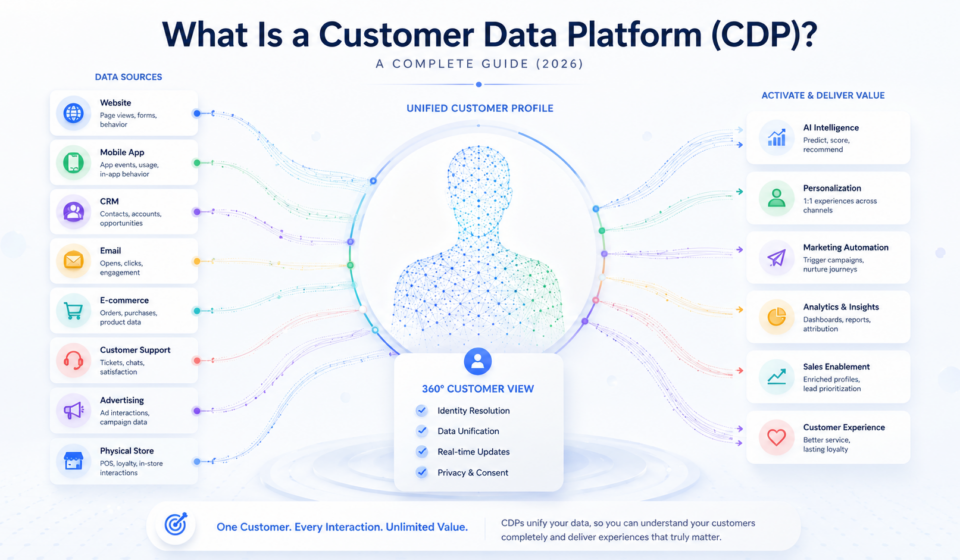
A Customer Data Platform (CDP) is software that collects customer information from different systems and combines it into a unified customer profile.
It can collect information from places such as:
- Your website
- Mobile application
- CRM
- Email platform
- E-commerce system
- Point-of-sale system
- Customer support software
- Advertising platforms
- Loyalty programs
The CDP then connects this information and creates a more complete picture of each customer.
Think of it this way
Imagine your business has four different systems.
Your email platform knows:
“Sarah opened three emails.”
Your website analytics knows:
“Sarah visited the pricing page.”
Your e-commerce platform knows:
“Sarah purchased a product.”
Your customer support system knows:
“Sarah contacted support last week.”
Without a CDP, these systems may treat these interactions as separate pieces of information.
A CDP attempts to connect them.
Instead of four disconnected pieces of data, the business can build a more complete picture:
Sarah visited the website, opened three emails, purchased a product, and recently contacted customer support.
That unified view is much more valuable.
The Business Definition
For a CMO, founder, marketing leader, or RevOps professional, a more precise definition would be:
A Customer Data Platform collects customer information from multiple sources, connects that information to a persistent customer identity, creates a unified customer profile, and makes that information available to marketing, sales, customer service, analytics, and AI systems.
The important part is what happens after the data is collected.
A CDP isn’t simply a place where data sits.
The data should be usable.
A marketer should be able to use the unified customer information to create a segment, personalize an experience, launch a campaign, or send information to another marketing system without needing an engineer to manually rebuild the data every time.
That ability to collect, unify, and activate customer data is one of the defining characteristics of a CDP.
The Building Blocks of a CDP
To understand CDPs properly, it helps to break the concept into four parts.
1. Customer Data
This is all the information a business collects about its customers.
It can include:
- What customers clicked
- What they searched for
- What they purchased
- What they returned
- Which emails they opened
- Which advertisements they interacted with
- What they asked customer support
- What products they viewed
- What they added to their cart
- What they abandoned
Think of customer data as the raw material.
2. The Platform
A CDP isn’t simply a database.
It is a collection of systems working together to:
- Collect data
- Store data
- Clean data
- Match identities
- Build customer profiles
- Create segments
- Send data to other systems
- Activate customer information
The platform is what turns raw data into something a business can actually use.
3. Unified Customer Profile
This is one of the most important concepts in a CDP.
A unified profile attempts to create one customer record from many different interactions.
For example, a business might initially have:
Customer A — website
Customer B — mobile app
Customer C — email
Customer D — purchase
The CDP may determine that all four records belong to the same person.
It can then combine them into one profile.
This reduces duplicate records and gives the business a much clearer view of the customer.
4. Persistent Identity
The system also needs a way to recognize the same person across different situations.
For example, a customer might:
- Browse on their laptop today
- Use their phone tomorrow
- Visit a physical store next week
- Contact customer support next month
The business needs a way to connect these interactions when it is appropriate and permitted.
This is called identity resolution.
It helps the company maintain the customer’s journey instead of treating every interaction as if it came from a completely different person.
CDP vs. CRM: Why Are They Different?
CDPs and CRMs are often confused because both contain customer information.
But their main purposes are different.
A CRM is primarily designed to manage customer relationships, sales activities, accounts, opportunities, and interaction history.
A CDP is primarily designed to bring customer data from different sources together into a unified profile.
A simple way to remember it is:
The CRM manages the relationship. The CDP connects the data.
For example, a salesperson might use a CRM to see:
“This company has an open sales opportunity worth $50,000.”
A marketing team might use a CDP to understand:
“This person visited our website five times, opened three emails, viewed two products, attended a webinar, and recently contacted support.”
Both systems are valuable.
They simply solve different problems.
Why Businesses Need a CDP
The Data Silo Problem
Most businesses don’t have a shortage of customer data.
They have a shortage of connected customer data.
Consider a typical e-commerce company.
It might have:
Shopify → Purchase information
Klaviyo → Email activity
Zendesk → Customer support
Google Analytics → Website behavior
Meta Ads → Advertising interactions
CRM → Sales and customer information
Each platform has part of the customer’s story.
But the company needs the whole story to make better decisions.
This is the data silo problem.
A Real-World Example: The Invisible Repeat Customer
Imagine a customer named Rahul.
Rahul discovers your company through an Instagram advertisement.
He purchases a product using his work email.
Three months later, Rahul returns to your website.
This time, he uses his phone and signs up for your newsletter using his personal email address.
Without proper identity resolution, your systems might see:
Customer 1: Rahul — work email — purchased before
Customer 2: Rahul — personal email — new subscriber
The company may incorrectly think these are two different people.
That creates several problems.
The marketing team might send Rahul a new-customer discount, even though he has already purchased.
The advertising team might treat him as a new prospect.
The analytics team might attribute his second purchase incorrectly.
The CRM might contain one record while the email platform contains another.
The business has the data.
But it doesn’t have the connection between the data.
A CDP can help solve this by using identity resolution to recognize that the different interactions belong to the same customer.
The result is a much more complete profile.
What Happens When You Don’t Solve the Problem?
The consequences can be much bigger than simply having messy databases.
1. Duplicate Customer Records
The same customer may appear as two or three different people.
This can lead to:
- Duplicate marketing messages
- Incorrect customer counts
- Poor segmentation
- Inaccurate reporting
2. Poor Customer Experience
Imagine a customer has just complained about a product through customer support.
An hour later, your marketing system sends them an advertisement promoting that exact product.
From the company’s perspective, the campaign may look normal.
From the customer’s perspective, it looks like the company doesn’t understand them at all.
A connected customer profile can help prevent situations like this.
3. Wasted Marketing Spend
Without a unified customer view, businesses may continue advertising to people who have already purchased.
They may also fail to exclude existing customers from acquisition campaigns.
That can result in unnecessary advertising costs.
4. Lost Revenue Opportunities
Disconnected data can also hide valuable opportunities.
Imagine a customer:
- Has purchased several times
- Has recently visited your pricing page
- Has contacted support
- Has added another product to their cart
Each signal tells part of the story.
Together, they might reveal a strong opportunity for an upsell — or a potential risk of churn.
Without connected data, these signals may remain isolated.
5. Privacy and Compliance Problems
Customer information scattered across many systems can also make privacy management more difficult.
For example, if a customer requests that their personal information be deleted, a company may need to identify where that information exists across its different systems.
A centralized and well-designed customer-data architecture can make this process easier to manage.
Of course, a CDP does not automatically make a company compliant. Businesses still need proper consent management, governance, security, retention policies, and processes appropriate to the regulations that apply to them.
The Evolution of Customer Data Platforms
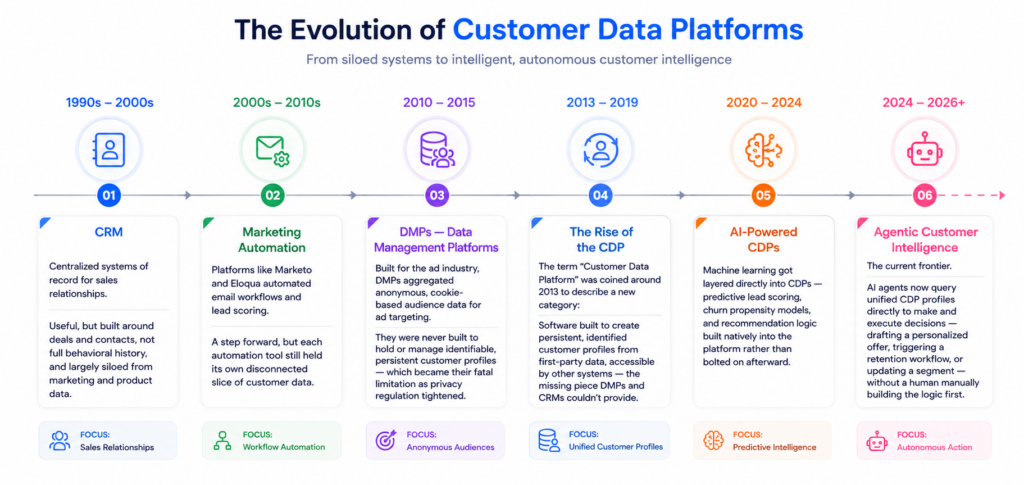
Customer Data Platforms didn’t appear overnight.
They emerged because businesses kept running into the same problem: customer information was becoming more valuable, but it was scattered across too many systems.
Over time, different technologies tried to solve different parts of this problem. CRM systems organized sales information. Marketing automation handled campaigns. DMPs helped advertisers target audiences. But none of these systems provided a complete, persistent view of the customer.
The CDP emerged to fill that gap.
And now, with AI and AI agents becoming more capable, CDPs are evolving again.
Here’s how we got here.
1. CRM — The 1990s and 2000s
The first major step was the rise of Customer Relationship Management (CRM) systems.
CRM platforms gave businesses a central place to manage sales relationships and customer records.
Instead of keeping information in spreadsheets, notebooks, emails, and individual salespeople’s systems, companies could store important information in one platform.
A CRM could track things such as:
- Customer and company information
- Sales opportunities
- Deals
- Sales calls
- Emails
- Follow-ups
- Account history
- Sales pipeline
This was a major improvement.
But CRMs were primarily designed around sales relationships.
They weren’t necessarily designed to capture every customer interaction across the entire business.
For example, a CRM might know:
“John is a customer with a $25,000 sales opportunity.”
But it might not automatically know:
“John visited our website six times, watched three product videos, opened four marketing emails, downloaded an ebook, and contacted customer support yesterday.”
Those behavioral signals often lived somewhere else.
So CRM systems solved an important problem — organizing customer relationships — but they didn’t create a complete picture of everything a customer was doing across the business.
2. Marketing Automation — The 2000s and 2010s
The next major development was marketing automation.
Platforms such as Marketo and Eloqua allowed marketers to automate repetitive marketing activities.
For example:
If a prospect downloads an ebook → send a welcome email.
Then:
If they open the email → send another email.
And:
If they visit the pricing page → increase their lead score and notify sales.
This allowed marketing teams to run much larger campaigns without manually sending every message.
Marketing automation also introduced lead scoring, segmentation, email workflows, and campaign tracking.
But there was still a major problem.
The data remained fragmented.
The marketing automation platform had its own customer information.
The CRM had its own information.
The website had another set of data.
The advertising platforms had another.
The product system had another.
So while marketing automation improved what companies could do with customer data, it didn’t completely solve the problem of bringing all customer data together.
3. DMPs — Data Management Platforms, 2010–2015
The advertising industry took a different approach with Data Management Platforms (DMPs).
DMPs were primarily built to help advertisers understand and target audiences at scale.
They collected large amounts of audience information, particularly from cookies and other advertising signals.
For example, an advertiser might want to target:
People interested in cars
or:
People who recently visited automotive websites.
DMPs were useful for advertising because they could help advertisers build audiences and target them across digital channels.
But there was a fundamental limitation.
DMPs were primarily built around anonymous audience data.
They weren’t designed to maintain a detailed, permanent customer profile tied to a known individual.
That became increasingly important as privacy expectations, regulations, and browser restrictions changed.
The advertising industry was moving toward a world where businesses needed stronger relationships with their own first-party customer data.
DMPs were not designed for that job.
4. The Rise of the CDP — 2013–2019
This created an opening for a new category of technology:
The Customer Data Platform.
The term Customer Data Platform emerged around 2013 to describe software designed to solve a specific problem that existing systems struggled with.
The goal was to create a:
Persistent, unified, identifiable customer profile.
Instead of keeping customer information in separate systems, a CDP could collect information from multiple sources and connect it to the same customer.
For example:
Website activity
Email engagement
Purchase history
Customer support
Mobile app activity
=
One unified customer profile
This was the missing piece.
CRM systems were good at managing relationships.
Marketing automation systems were good at executing campaigns.
DMPs were good at managing anonymous advertising audiences.
But CDPs were designed to connect customer data across the business.
And, importantly, that unified data could then be made available to other systems.
That meant the CDP could become a central data layer connecting:
Customer → Data → Marketing → Sales → Service → Analytics
5. AI-Powered CDPs — 2020–2024
The next major evolution happened when machine learning began moving directly into CDP platforms.
Previously, a business might collect customer data in one system and then send that data somewhere else to build predictive models.
Increasingly, CDPs began incorporating these capabilities directly.
This allowed businesses to use their unified customer data for things such as:
- Predictive lead scoring
- Churn prediction
- Customer lifetime value prediction
- Product recommendations
- Purchase propensity
- Audience discovery
- Next-best-action recommendations
For example, instead of simply knowing:
“This customer hasn’t purchased in 90 days.”
An AI-powered CDP could potentially identify:
“This customer shows several behavioral patterns associated with customers who are likely to churn.”
That is a significant change.
The CDP was no longer simply a place to organize customer information.
It was increasingly becoming a system that could understand and predict customer behavior.
6. Agentic Customer Intelligence — 2024–2026
We are now entering another stage.
The next evolution is the combination of unified customer data + AI agents.
Traditional AI might analyze a customer profile and produce a recommendation.
An AI agent can potentially go further.
It can use the information to take action across connected systems.
For example, imagine an AI agent identifies a high-value customer who appears to be at risk of leaving.
Instead of simply displaying:
“High churn risk: 82%”
the agent could potentially:
- Analyze the customer’s history.
- Identify why the customer may be at risk.
- Determine an appropriate retention strategy.
- Create a personalized offer.
- Trigger a retention campaign.
- Update the customer’s segment.
- Monitor the customer’s response.
- Adjust the strategy based on what happens next.
The human doesn’t necessarily need to manually create every rule.
The AI agent can work through the process based on predefined goals, permissions, and business rules.
This represents a major shift.
We’re moving from:
“Here is the customer data.”
to:
“Here is what the data tells us.”
And increasingly toward:
“Here is what should happen next — and the system can help make it happen.”
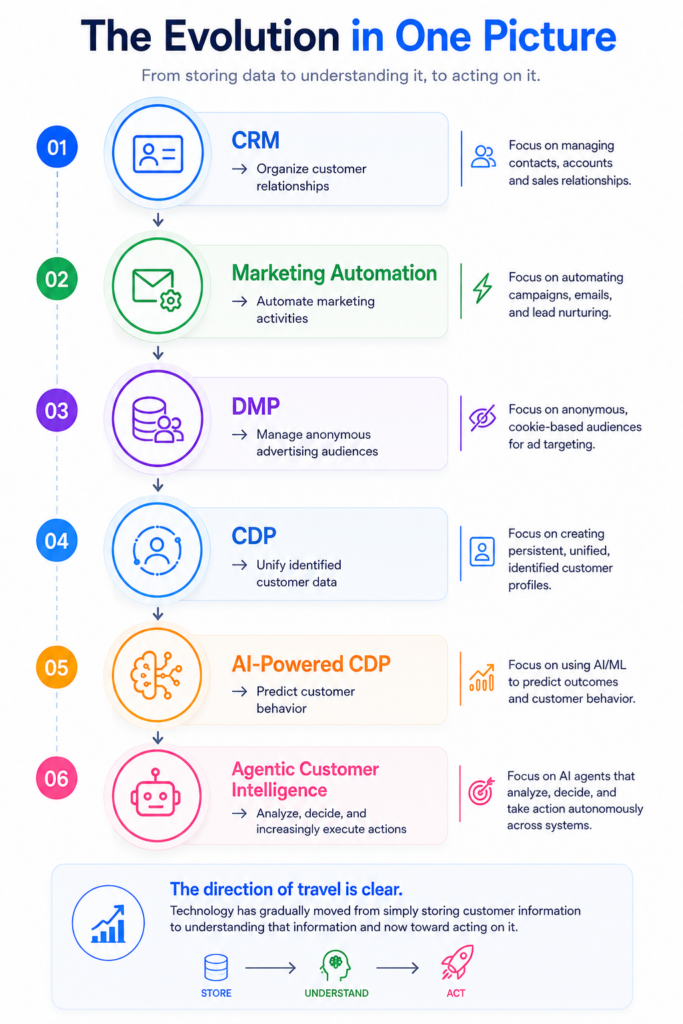
That is what makes modern CDPs particularly important in the AI era.
The CDP is no longer just a customer database.
It can become the data and intelligence layer connecting customer information with AI-powered decisions and actions.
How Does a Customer Data Platform Actually Work?
A CDP may sound complicated at first, but the basic idea is actually quite simple:
A CDP collects customer data from different places, figures out which data belongs to the same person, creates one complete customer profile, and then makes that information available to the systems that need it.
And it doesn’t happen just once.
A good CDP continuously updates customer profiles as new interactions happen.
The process can be broken down into seven major steps.
1. Data Collection
Everything starts with collecting customer data.
A CDP connects to the different systems where customer interactions happen and continuously brings that information together.
For example, it might collect data from:
- Your website
- Mobile app
- CRM
- E-commerce platform
- Email marketing system
- Customer support software
- Physical stores
- Point-of-sale systems
- Advertising platforms
- Loyalty programs
For example, imagine a customer visits your website and views three products.
The CDP can receive those website events.
Later, the same customer purchases one of those products.
The purchase information can also flow into the CDP.
Then the customer opens an email.
That interaction can be added as well.
The important thing is that this isn’t supposed to be a one-time data import.
The data keeps flowing.
Every new interaction can become another piece of information about the customer.
Think of this stage as the data collection layer of the CDP.
2. Identity Resolution
This is one of the most important — and technically challenging — parts of a CDP.
The problem is simple:
How do you know that different records actually belong to the same person?
Consider what can happen when one customer interacts with a business.
On Monday, they visit the website without logging in.
On Tuesday, they download an ebook using their email address.
On Wednesday, they use the company’s mobile app.
On Friday, they purchase something in a physical store using their loyalty card.
The business now has several different records:
Anonymous website visitor
↓
Email subscriber
↓
Mobile app user
↓
In-store customer
But these may all be the same person.
Identity resolution is the process of connecting these records.
The CDP can use identifiers such as:
- Email address
- Phone number
- Customer ID
- Loyalty ID
- Account ID
- Login information
- Hashed identifiers
- Device information, where appropriate
- Other permitted signals
The goal is to determine which identifiers belong to the same customer.
Think of it like detective work
Imagine a detective is trying to determine whether three records belong to the same person.
One record says:
J. Smith
Another says:
Another says:
Loyalty Member #45821
The system looks for reliable connections between those records.
When there is enough evidence, it can connect them to one customer profile.
This network of connections is often called an identity graph.
The identity graph essentially maps the different identifiers associated with a customer.
However, identity resolution should not be treated as simple guesswork. A good system needs confidence rules, data governance, and appropriate privacy controls to avoid incorrectly merging two different people.
3. Profile Unification
Once the CDP determines that multiple records belong to the same customer, it can bring those pieces of information together.
This creates a unified customer profile.
For example, instead of having:
Website data
- Viewed running shoes
Email data
- Opened three emails
E-commerce data
- Purchased two products
Support data
- Contacted customer service
The CDP can combine them into one profile:
Customer: Sarah
Purchases: 2
Products viewed: Running shoes
Email engagement: High
Support interactions: 1
Last purchase: 30 days ago
Website activity: High
The profile can also contain information calculated from the customer’s behavior.
For example:
- Predicted churn risk
- Customer lifetime value
- Purchase probability
- Customer segment
- Product preferences
- Engagement score
This gives the business a much more complete understanding of the customer.
4. Customer Segmentation
Once customer profiles have been unified, marketers can create much more useful customer segments.
Traditional segmentation might look like:
Customers in London
or:
Customers who purchased something.
A CDP allows marketers to combine many different conditions.
For example:
Customers who purchased in the last 90 days AND opened the last three emails AND haven’t visited the pricing page.
Or:
Customers who have spent more than $500 AND visited the website at least five times AND haven’t purchased in the last 60 days.
These segments become much more powerful because the conditions can use information from different parts of the customer’s journey.
Without a CDP, that information might exist in three or four different systems.
A marketer would have to manually combine the data.
With a unified profile, the segment can be created from the combined customer information.
Segments can also change automatically
Customer behavior is constantly changing.
A customer who was once a new prospect can become a buyer.
A buyer can become a repeat customer.
A highly engaged customer can become inactive.
A previously loyal customer can become a potential churn risk.
A CDP can update segments as customer behavior changes.
This makes segmentation dynamic rather than static.
5. Activation
Collecting and organizing customer data is useful.
But the real value appears when the business can do something with it.
This is called activation.
Activation means sending unified customer data or audience segments from the CDP to the systems that need to use them.
For example, a CDP might send a customer segment to:
Advertising platforms
To create a retargeting audience or exclude existing customers from acquisition campaigns.
Email platforms
To trigger a personalized email campaign.
Website personalization systems
To show different content or recommendations to different customers.
Sales systems
To give sales representatives more complete customer information.
Customer support systems
To provide support agents with additional customer context.
AI systems
To provide AI models or agents with a more complete customer profile for analysis and decision-making.
This is why a CDP isn’t simply a database.
It is designed to help turn customer information into action.
6. Analytics
A CDP also needs to help businesses understand what is happening with their customer data and the campaigns built from it.
Analytics can answer questions such as:
- How many customers are in a particular segment?
- Is the segment growing or shrinking?
- How many profiles have been successfully matched?
- Which channels are generating the most engagement?
- How are activated audiences performing?
- Are campaigns producing more conversions?
- Is customer data becoming more complete over time?
For example, a marketing team might discover:
“Our high-value customer segment increased by 12% this quarter.”
Or:
“Customers receiving personalized recommendations convert 18% more often than the control group.”
Analytics therefore provides the measurement layer needed to understand whether the data and activation strategies are actually producing business results.
7. The Feedback Loop
This is what makes a CDP fundamentally different from simply exporting customer data into a spreadsheet.
The customer profile keeps changing.
Imagine a customer receives a personalized offer.
They click the email.
Then they visit the website.
They purchase a product.
Later, they contact customer support.
Each of these interactions creates new information.
That information flows back into the CDP.
The customer’s profile is updated.
The customer may move into a different segment.
A recommendation may change.
A predictive score may change.
A new campaign may be triggered.
And the process continues.
You can think of it as:
Customer Interaction
↓
New Data
↓
Updated Customer Profile
↓
New Segment / Prediction
↓
Marketing Action
↓
Customer Response
↓
New Data
↓
Updated Profile
And the cycle repeats.
A CDP is not valuable simply because it stores a lot of customer information.
Its real value comes from continuously connecting customer data and making that information usable.
The process can be summarized in one line:
Collect → Connect → Understand → Segment → Activate → Measure → Learn → Repeat
That’s the fundamental operating cycle of a Customer Data Platform.
And as AI becomes more deeply integrated with CDPs, this cycle becomes even more powerful.
The CDP provides the connected customer data.
AI provides the intelligence.
Marketing automation provides the execution.
Analytics provides the feedback.
Together, they create the foundation for a modern, data-driven marketing system.
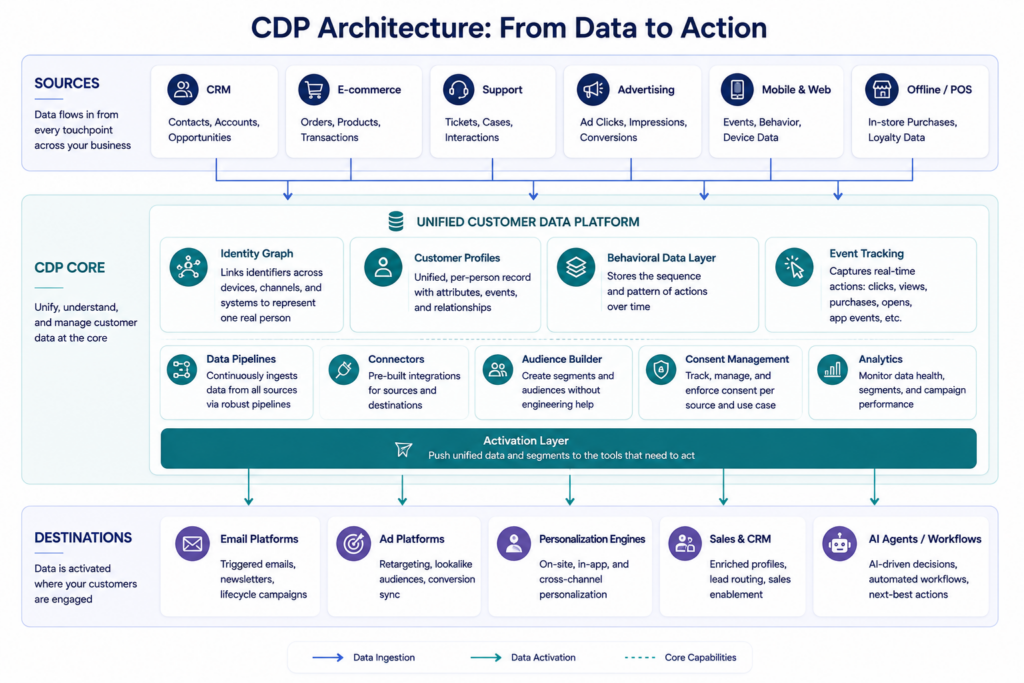
Core Components of a CDP
| Component | What It Does |
|---|---|
| Customer Profiles | The unified, per-person record combining every known attribute and event |
| Identity Graph | The map of linked identifiers (email, device ID, loyalty ID) that proves multiple touchpoints belong to one person |
| Event Tracking | Captures individual actions — page views, clicks, purchases, app opens — as they happen |
| Behavioral Data Layer | Stores the sequence and pattern of a customer’s actions over time, not just static attributes |
| Data Pipelines | The ingestion infrastructure that moves data from source systems into the CDP continuously |
| Connectors | Pre-built integrations to source systems (CRM, e-commerce, ad platforms) and destination systems (email, ads, personalization tools) |
| Audience Builder | The interface marketers use to define and export segments without engineering help |
| Consent Management | Tracks and enforces what each customer has consented to, per data source and per use case |
| Analytics | Reporting on data health, segment performance, and campaign outcomes |
| Activation Layer | The mechanism that pushes unified data or segments out to the tools that act on it |
Types of Customer Data
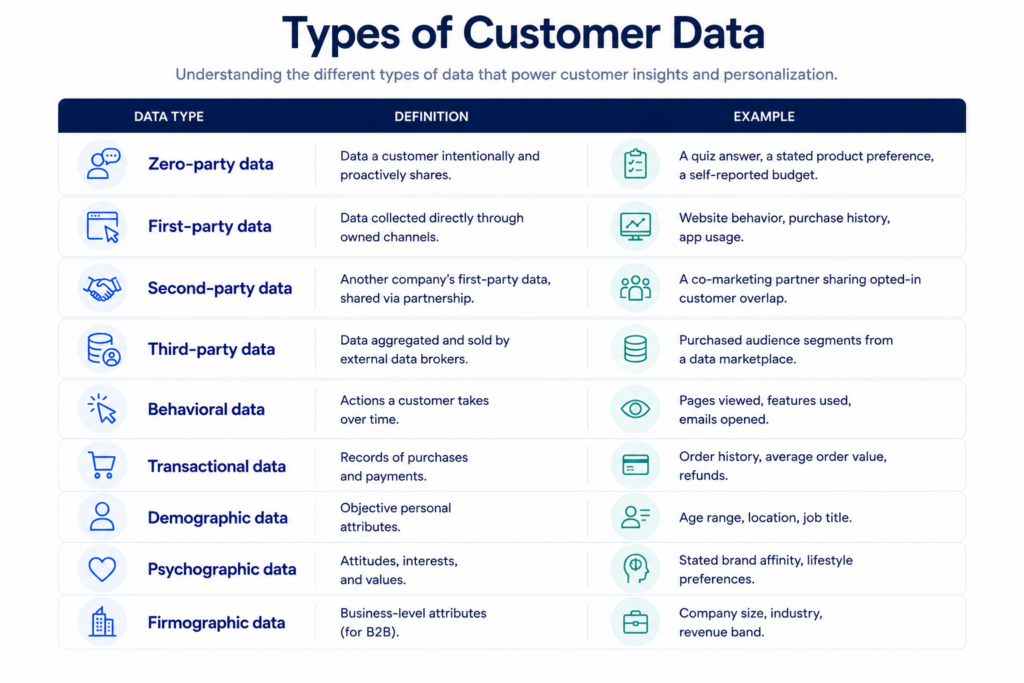
Key Insight: With third-party data becoming both less reliable and more regulated, zero-party and first-party data are now the highest-value inputs a CDP can hold — they’re consented, accurate, and directly tied to your own customer relationship rather than borrowed from someone else’s.
Benefits of Using a CDP
1. Personalization at Scale
Personalization becomes much more powerful when you understand the whole customer, rather than just one interaction.
Without a CDP, your email platform might only know that someone opened an email.
Your website might only know what they browsed.
Your e-commerce platform might only know what they purchased.
A CDP can bring these signals together.
This allows businesses to personalize:
- Emails
- Product recommendations
- Offers
- Website experiences
- Advertisements
- SMS messages
- App notifications
For example, instead of sending a generic promotion to everyone, a business could recognize that a customer has purchased running shoes before, frequently browses sports products, and has recently viewed a particular product.
The next marketing message can then be much more relevant.
The more complete the customer profile, the more useful personalization becomes.
2. Better Marketing Attribution
One of the biggest problems in marketing is figuring out what actually caused a customer to buy.
A customer might:
- See an Instagram advertisement.
- Search for the company on Google.
- Read a blog post.
- Open an email.
- Visit the website several times.
- Finally make a purchase.
If you only look at the last interaction, you might give all the credit to email or Google.
But the customer’s actual journey was much longer.
By connecting interactions across channels, a CDP can help marketers build a more complete picture of the customer journey.
This can lead to better attribution and better decisions about where marketing budgets should be invested.
3. Better Customer Experience
Customers don’t think about your company’s software systems.
They don’t care that marketing uses one platform, sales uses another, and customer support uses a third.
They simply expect the company to know who they are and understand their history.
Imagine explaining a problem to customer support and then being asked to explain the same problem again by another department.
It’s frustrating.
A connected customer profile can help sales, marketing, and support work from the same information.
That means teams can better understand:
- What the customer purchased
- Previous conversations
- Recent problems
- Marketing interactions
- Account history
- Preferences
- Current activity
The result is a smoother and more consistent customer experience.
4. Omnichannel Marketing
Customers interact with brands through many channels.
They might receive:
- An email
- An SMS
- An advertisement
- A push notification
- A website message
- An in-app recommendation
The problem is that these channels often operate independently.
A customer might purchase a product and then continue seeing advertisements for that same product.
Or they might unsubscribe from email but continue receiving promotional messages through another channel.
A unified customer profile helps businesses coordinate these interactions.
Instead of each channel operating independently, the business can build a more consistent customer journey across:
Email + Advertising + SMS + Website + App + Sales + Support
This is the foundation of effective omnichannel marketing.
5. Revenue Growth
Better customer data can create new revenue opportunities.
When businesses understand customers more accurately, they can make better decisions about:
- Who to target
- What to offer
- When to communicate
- Which products to recommend
- Which customers need attention
- Which customers are ready for an upsell
For example, a company may identify customers who have purchased one product and frequently view a complementary product.
Instead of sending the same promotion to everyone, the business can target those customers with a relevant cross-sell offer.
Similarly, identifying customers at risk of leaving can help the company take action before revenue is lost.
The CDP itself doesn’t magically create revenue.
It gives the business better information to make revenue-generating decisions.
6. Lower Marketing Costs
Disconnected customer data can waste money.
For example, imagine someone purchases a product today.
If your advertising platform doesn’t know about the purchase, it may continue showing that person advertisements for the product they just bought.
You’re paying to advertise to someone who has already converted.
A unified customer profile can help businesses:
- Exclude existing customers from acquisition campaigns
- Reduce duplicate marketing messages
- Avoid unnecessary retargeting
- Improve audience targeting
- Reduce wasted advertising spend
- Focus budgets on higher-value prospects
The result can be more efficient marketing and a lower customer acquisition cost (CAC).
7. AI Readiness
This is becoming one of the most important benefits of a CDP.
AI needs good data.
If your customer information is scattered across different systems, contains duplicate records, or has inconsistent customer identities, AI models may struggle to produce reliable results.
Imagine asking an AI system:
“Which customers are most likely to leave?”
But the system only has access to purchase history.
It doesn’t know about:
- Support complaints
- Website behavior
- Email engagement
- App usage
- Advertising interactions
Its prediction will naturally be limited.
A unified customer profile gives AI access to a much broader set of signals.
That’s why a modern CDP can serve as more than marketing infrastructure.
It can become part of the data foundation for AI.
Better-connected data gives AI a better foundation for making decisions.
8. Predictive Analytics
A CDP can also provide the historical customer information needed for predictive models.
Instead of only asking:
“What has this customer done?”
Businesses can begin asking:
“What is this customer likely to do next?”
For example, predictive models can estimate:
- Churn probability
- Customer lifetime value
- Purchase probability
- Conversion likelihood
- Next-best product
- Likelihood of responding to an offer
The more complete the customer history, the more useful these predictions can become — assuming the data is accurate and the model is properly designed and maintained.
This allows businesses to move from simply reporting the past to planning for the future.
9. Increasing Customer Lifetime Value
Customer acquisition is only one part of growth.
A business also needs to increase the value it receives from the customers it already has.
A unified customer profile can help businesses identify opportunities for:
- Cross-selling
- Upselling
- Repeat purchases
- Personalized offers
- Loyalty campaigns
- Retention programs
For example, imagine a customer purchased a laptop six months ago.
The company knows:
- What laptop they purchased
- When they purchased it
- Which accessories they viewed
- Which emails they opened
- Which products they searched for afterward
That information can help the business recommend products that are actually relevant to the customer.
Over time, better retention and more relevant cross-selling can increase Customer Lifetime Value (LTV).
10. Better Customer Retention
One of the most valuable uses of a CDP is identifying customers who may be about to leave.
The problem is that customer churn rarely happens because of one single event.
A customer might:
- Stop opening emails
- Visit the website less often
- Stop using the product
- Contact support repeatedly
- Browse cancellation information
- Reduce their purchases
Individually, each signal may not mean much.
Together, they can tell a very different story.
A unified CDP can bring these signals together and help identify customers who may be at risk.
The business can then take action before the customer leaves.
For example:
Detect risk → Understand the customer → Personalize the response → Take action → Measure the result
That’s much more effective than waiting until the customer has already cancelled.
How AI Is Transforming CDPs
AI hasn’t just been added on top of CDPs — it’s changing what the category fundamentally does.
- Machine learning: Native ML models inside modern CDPs continuously score customers on churn risk, purchase propensity, and engagement likelihood, updating as new data arrives rather than requiring a manual re-analysis.
- Predictive audiences: Instead of a marketer manually defining “people who might churn,” predictive audiences are generated automatically by models trained on the platform’s own historical data.
- Lead scoring: B2B teams use AI-enhanced CDP data to rank leads by conversion likelihood using far more behavioral signal than manual scoring rules ever could.
- Recommendations: Product and content recommendation engines increasingly query the CDP’s unified profile directly, rather than working from a single system’s partial data.
- Generative AI: Some CDPs now let marketers describe a segment or campaign in plain language (“customers likely to churn who haven’t opened an email in 30 days”) and have the platform generate the corresponding query and audience automatically.
- AI agents: The newest layer — autonomous agents that can query the CDP, identify an opportunity (like a high-value customer showing churn signals), and trigger a response workflow without a human building that specific rule in advance.
- Real-time decision engines: Increasingly, CDPs feed “next-best-action” engines that decide, in the moment a customer is active on a website or app, what offer or content to show — powered directly by the unified profile.
Key Insight: Industry analysts describe this clearly — AI is reinforcing the difference between integrated, packaged CDPs and warehouse-native architectures, not erasing the category. In other words, AI is making the quality of your underlying customer data more important, not less, because every AI system built on top of it is only as good as the data feeding it.
Real Business Examples
Netflix relies on a unified view of viewing behavior, ratings, search activity, and device usage to power both content recommendations and the personalized artwork shown for each title — a direct example of unified, identity-resolved data driving both product and marketing decisions from the same source.
Amazon builds a single customer profile spanning browsing history, purchases, wish lists, and even voice assistant interactions (through Alexa), enabling recommendations and marketing that follow a customer seamlessly across devices.
Nike uses unified membership data across its app, SNKRS platform, and retail stores to personalize product drops and training content to each member’s specific behavior and purchase history, rather than treating app users and in-store shoppers as separate audiences.
Spotify connects listening behavior, playlist activity, and even social sharing into a unified profile that powers both personalized playlists and targeted marketing campaigns for new releases and features.
Starbucks built its loyalty and mobile ordering data into a unified customer view that powers its “Deep Brew” AI system, personalizing which offer a specific rewards member sees based on their complete order and engagement history.
Adobe uses its own Real-Time CDP internally and as a product, unifying data across Adobe Experience Cloud to power personalization for its enterprise customers’ campaigns.
Salesforce built Data Cloud specifically to unify data across its Customer 360 ecosystem, giving sales, service, and marketing teams a shared, real-time customer view rather than three separate partial ones.
Airbnb unifies host and guest behavioral data across search, booking, and messaging to personalize search results and recommendations for both sides of its marketplace simultaneously.
Uber connects rider app behavior, driver supply data, and support interactions into a unified operational picture that informs both marketing (personalized promotions) and product decisions (surge pricing, ETA accuracy).
Sephora unifies in-store purchase data (via its loyalty program), app behavior, and online purchase history to power personalized product recommendations across both digital and physical retail experiences.
Disney connects park visit data, streaming behavior (Disney+), and merchandise purchases into a unified guest profile that powers personalization across its famously broad ecosystem of physical and digital touchpoints.
Case Study: Mid-Market Retailer Churn Reduction
Problem: A mid-market e-commerce retailer had customer data split across Shopify, Klaviyo, Zendesk, and a legacy loyalty program database. Marketing couldn’t tell which “new” signups were actually returning customers using a different email, and retention campaigns were being sent to customers who had already churned weeks earlier based on stale data.
Implementation: The company deployed a CDP to ingest data from all four systems, using email and loyalty ID as the primary identity resolution keys, with phone number as a secondary match signal.
Technology: A packaged, cloud-based CDP with pre-built Shopify and Klaviyo connectors, native identity resolution, and a predictive churn-scoring model trained on 18 months of historical purchase and engagement data.
Results: Within two quarters of full deployment, the retailer reported a measurable reduction in duplicate customer records, more accurate channel attribution for returning customers, and the ability to trigger retention offers based on a real-time churn score rather than a static “hasn’t purchased in 90 days” rule.
Business impact: Retention campaigns became meaningfully more targeted, reducing wasted discount spend on customers who weren’t actually at risk, while catching genuinely at-risk customers earlier in their disengagement pattern.
Lessons learned: The retailer’s team noted that the biggest early time investment wasn’t the platform setup — it was cleaning up inconsistent data formatting (multiple ways the same product category was labeled across systems) before identity resolution could work reliably. This is a near-universal lesson across CDP implementations: the platform can’t fix bad data hygiene; it can only make the consequences of bad data hygiene more visible.
Top Customer Data Platform Software (2026)
Pricing and feature sets in this category change quickly and are typically quote-based for enterprise deployments — treat the notes below as directional starting points for your own evaluation, not final pricing.
Segment (Twilio Segment)
Overview: One of the original and most widely adopted CDPs, known for developer-friendly data collection and a large connector ecosystem. Features: Broad source/destination connector library, real-time event streaming, strong developer tooling. Pros: Mature ecosystem, strong documentation, flexible for technical teams. Cons: Less approachable for non-technical marketers without engineering support. Pricing: Usage-based, scaling with monthly tracked users; free tier available for small-scale use. Best for: Product-led and engineering-forward companies needing flexible event tracking.
Salesforce Data Cloud
Overview: Salesforce’s native CDP, built to unify data across the broader Customer 360 ecosystem (Sales, Service, Marketing Cloud). Features: Deep native integration with Salesforce products, AI (Einstein) built directly on top of unified data. Pros: Seamless for existing Salesforce customers, strong enterprise governance features. Cons: Highest value is realized primarily by businesses already deep in the Salesforce ecosystem. Pricing: Enterprise, quote-based. Best for: Enterprises already standardized on Salesforce.
Adobe Real-Time CDP
Overview: Adobe’s CDP, tightly integrated with Adobe Experience Cloud and Adobe’s broader marketing and analytics suite. Features: Real-time profile updates, strong integration with Adobe Analytics and Adobe Target for personalization. Pros: Deep personalization and testing capability when paired with the rest of the Adobe stack. Cons: Complexity and cost scale up quickly outside the Adobe ecosystem. Pricing: Enterprise, quote-based. Best for: Large enterprises already invested in Adobe Experience Cloud.
Treasure Data
Overview: An enterprise-focused CDP known for handling very large, complex data volumes, particularly in retail and automotive. Features: Strong data pipeline and warehouse integration, robust identity resolution at scale. Pros: Built for high-volume, complex enterprise data environments. Cons: Steeper implementation curve suited to organizations with dedicated data teams. Pricing: Enterprise, quote-based. Best for: Large enterprises with complex, high-volume data needs.
Tealium
Overview: A long-established CDP known for strong tag management heritage and real-time data collection. Features: Real-time customer data hub (AudienceStream), strong data governance and consent tooling. Pros: Mature governance and privacy tooling, flexible real-time activation. Cons: Interface and setup can feel more technical than newer entrants. Pricing: Enterprise, quote-based. Best for: Enterprises prioritizing governance and real-time activation together.
Bloomreach
Overview: A CDP with strong roots in e-commerce personalization and search/merchandising. Features: Native e-commerce personalization tools, product discovery and search integration. Pros: Purpose-built strengths for retail and e-commerce use cases. Cons: Less general-purpose outside of commerce-heavy businesses. Pricing: Mid-market to enterprise, quote-based. Best for: E-commerce and retail brands prioritizing on-site personalization.
mParticle
Overview: A CDP known for strong mobile app data collection alongside web and server-side sources. Features: Robust mobile SDKs, flexible identity resolution, strong data quality tooling. Pros: Particularly strong for app-first and mobile-heavy businesses. Cons: Like Segment, benefits from a technical team to fully leverage. Pricing: Usage-based, quote-based at scale. Best for: Mobile-first companies with significant app engagement data.
Insider
Overview: A growth-marketing-focused CDP that bundles unified customer data with built-in personalization and messaging channels. Features: Built-in omnichannel messaging (push, SMS, email, WhatsApp) layered directly on the unified profile. Pros: Faster time-to-activation since messaging channels are native, not just connectors. Cons: Businesses with an existing best-of-breed stack may find some native channels redundant. Pricing: Mid-market, quote-based. Best for: Growth teams wanting unified data and activation in a single platform.
BlueConic
Overview: A CDP built around a strong first-party and zero-party data collection philosophy. Features: Native tools for capturing zero-party data (preference centers, interactive content), strong profile unification. Pros: Particularly strong fit for privacy-first, consent-forward data strategies. Cons: Smaller connector ecosystem than the largest incumbents. Pricing: Mid-market to enterprise, quote-based. Best for: Brands prioritizing zero-party data collection as a core strategy.
Quick comparison
| Platform | Best For | Technical Skill Required |
|---|---|---|
| Segment | Developer-forward, flexible event tracking | High |
| Salesforce Data Cloud | Existing Salesforce enterprises | Medium |
| Adobe Real-Time CDP | Adobe Experience Cloud enterprises | Medium-High |
| Treasure Data | Very large, complex data volumes | High |
| Tealium | Governance and real-time activation | Medium-High |
| Bloomreach | E-commerce personalization | Medium |
| mParticle | Mobile/app-first businesses | High |
| Insider | Growth teams wanting native messaging | Low-Medium |
| BlueConic | Zero-party, privacy-first strategies | Low-Medium |
How to Implement a CDP
- Define business goals first. Identity resolution and unified profiles are means, not ends — start with the specific business outcome (reduce churn, improve attribution, personalize onboarding) you’re trying to achieve.
- Identify stakeholders early. A CDP implementation touches marketing, data/engineering, legal/privacy, and often sales — bring them in before vendor selection, not after.
- Audit data sources. Map every system holding customer data today, and assess data quality and consistency in each before assuming they’ll connect cleanly.
- Plan integrations. Prioritize connecting the highest-value, highest-volume sources first (typically your e-commerce/CRM system and your primary engagement channel).
- Design identity resolution rules. Decide which identifiers (email, phone, loyalty ID) will serve as primary and secondary match keys, and set clear rules for how conflicting or ambiguous matches get handled.
- Build initial segmentation. Start with two or three high-value segments tied directly to your original business goals, rather than trying to model your entire customer base at once.
- Set up activation. Connect the CDP to the specific destination tools (email platform, ad accounts, personalization engine) needed for your initial use cases.
- Measure against a baseline. Compare performance of CDP-powered campaigns against your prior approach using the same KPIs, not new ones invented after the fact.
- Optimize continuously. Treat the CDP as a living system — revisit identity resolution accuracy, segment performance, and data quality on a recurring schedule, not as a one-time setup task.
Common Mistakes
- Buying before defining goals — selecting a vendor based on features rather than a specific business problem.
- Ignoring data quality — assuming the CDP will “clean up” inconsistent data automatically rather than treating hygiene as a prerequisite.
- Poor integrations — connecting sources without validating that the data mapping is actually accurate.
- Duplicate identities — under-investing in identity resolution rules, leaving the same customer represented as multiple profiles.
- No governance — failing to define who owns segment creation, data definitions, and consent rules, leading to conflicting or untrusted data.
- Privacy violations — activating data in ways that exceed what a customer actually consented to, creating legal and trust risk.
- Lack of executive support — treating the CDP as a marketing-only tool rather than cross-functional infrastructure, which starves it of the stakeholder alignment it needs to succeed.