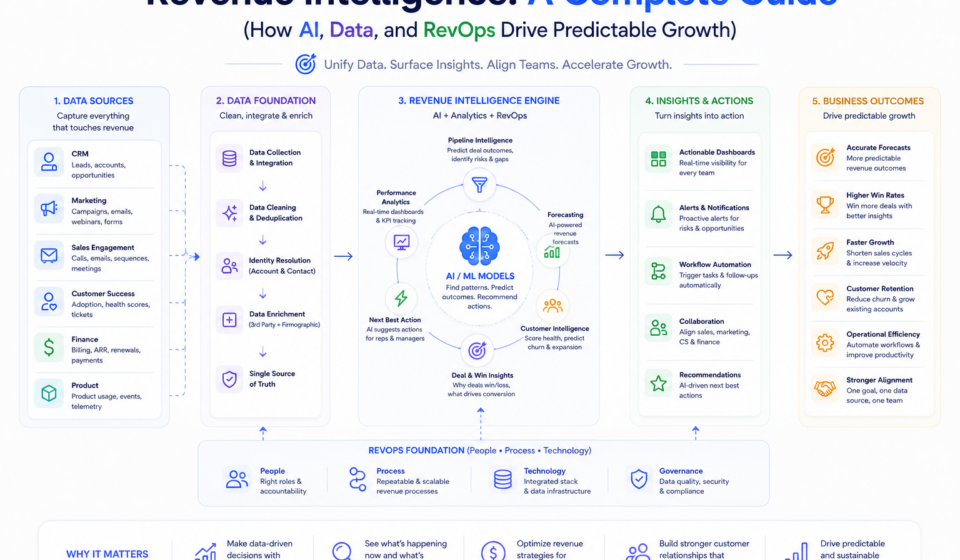
Revenue Intelligence: A Complete Guide (How AI, Data, and RevOps Drive Predictable Growth)

Two companies sell almost the same products. Their sales teams are about the same size, their prices are similar, and they target many of the same customers.
But every quarter, one company struggles to hit its revenue target. Sometimes it misses by a small amount. Other times, the gap is huge. The frustrating part is that the team usually doesn’t know what’s going wrong until it’s too late to do anything about it.
The other company works differently.
Three weeks before the quarter ends, it already has a good idea of where revenue will land. It can identify the five deals most likely to get delayed before those deals actually become problems. It can spot customers who are showing early signs of leaving. It can also identify customers who are likely to buy more — sometimes before the customer has even considered it.
What’s different?
It’s not luck. And it doesn’t necessarily have a better sales team.
The difference is that one company uses Revenue Intelligence to make better decisions, while the other is still relying heavily on gut instinct, spreadsheets, and a CRM filled with data that isn’t always reliable.
This difference is becoming increasingly important for modern businesses.
Revenue teams today have access to enormous amounts of information: sales calls, emails, CRM activity, customer behavior, marketing interactions, product usage, support conversations, and financial data. The challenge isn’t collecting the data anymore. The challenge is turning all that data into useful decisions.
That’s where Revenue Intelligence comes in.
Revenue Intelligence brings together data, analytics, automation, and AI to help a company understand what’s happening across its revenue engine — and, more importantly, what is likely to happen next.
Instead of asking:
“What happened last quarter?”
a revenue team can start asking:
“What is likely to happen next quarter, and what can we do about it now?”
That shift — from looking backward to predicting and acting — is what makes Revenue Intelligence so powerful.
In this guide, we’ll break down Revenue Intelligence in simple, practical language. You don’t need a technical background or experience with AI to understand it.
In this guide, you’ll learn:
- What Revenue Intelligence actually means — without the confusing jargon
- How data moves through a revenue organization, from customer interactions to business decisions
- How Revenue Intelligence differs from CRM reporting and Business Intelligence
- How AI is used to forecast revenue, identify risky deals, predict churn, and find growth opportunities
- Which metrics actually matter and what they mean in everyday business language
- How to build a Revenue Intelligence system step by step
- Where tools such as Gong, Clari, and Salesforce fit into the picture
- How Revenue Intelligence is likely to evolve as AI becomes a bigger part of sales and revenue operations
By the end, you’ll have a clear understanding of not only what Revenue Intelligence is, but also how businesses use it to make smarter revenue decisions.
1. What Is Revenue Intelligence?
The simple definition
Revenue Intelligence is a way for businesses to use data, analytics, and AI to understand what’s happening across their revenue process and make better decisions about what to do next.
That data can come from almost everywhere — marketing campaigns, sales calls, emails, CRM activity, customer support, product usage, renewals, and finance.
A CRM mainly tells you what people recorded.
Revenue Intelligence tries to tell you what is actually happening and, more importantly, what is likely to happen next.
For example, your CRM might show that a sales rep marked a deal as “likely to close.”
Revenue Intelligence can look at the customer’s recent emails, meeting activity, call conversations, engagement, deal history, and other signals and say:
“This deal looks less likely to close this quarter than the CRM stage suggests.”
That’s a much more useful answer for a sales leader.
A simple way to think about it
Think about your business like a car.
A traditional sales report is like looking at the fuel gauge. It tells you what’s happening with one important thing, but it doesn’t tell you much about the health of the entire car.
Revenue Intelligence is more like having the full dashboard and diagnostic system.
It can show you what’s happening right now, warn you when something looks wrong, and sometimes help you predict a problem before it happens.
For example, it might tell you:
- A large deal is showing signs of slipping.
- A sales rep has several opportunities that aren’t progressing.
- A customer is becoming less engaged and may be at risk of churning.
- A group of customers is showing signs that they may be ready to upgrade.
- Your current pipeline probably isn’t enough to hit this quarter’s target.
The difference is simple:
Traditional reporting tells you what happened. Revenue Intelligence helps you understand what is happening and what might happen next.
The building blocks of Revenue Intelligence
Before we go deeper, let’s quickly clarify some of the terms you’ll see throughout this guide.
Revenue Intelligence
The process of using revenue-related data, analytics, and AI to understand performance, identify problems, predict outcomes, and find opportunities for growth.
Revenue Operations (RevOps)
The business function that brings sales, marketing, customer success, and sometimes finance together around a shared revenue process. Revenue Intelligence provides much of the data and insight that helps RevOps make that process work better.
Revenue Data
All the information created throughout the customer journey. This can include website visits, marketing interactions, emails, sales calls, CRM records, product usage, support conversations, invoices, renewals, and more.
AI-Powered Revenue Insights
Useful conclusions or predictions generated from revenue data using AI and machine learning. For example:
“This opportunity has a high probability of slipping into next quarter.”
Instead of a manager manually reviewing hundreds of deals, the system can identify the ones that deserve attention.
Revenue Forecasting
Estimating how much revenue the company is likely to generate in the future based on things such as current pipeline, historical performance, deal activity, customer behavior, and other signals.
Revenue Decision-Making
Actually using those insights to make a business decision. For example, a sales manager might move resources toward a high-value deal that is at risk, or a customer success team might contact an account showing early signs of churn.
Treevire Insight: Revenue Intelligence isn’t simply a prettier dashboard. A dashboard shows you the numbers. Revenue Intelligence helps you understand what those numbers mean, what could happen next, and where you should focus your attention.
2. Why Do Businesses Need Revenue Intelligence?
Most companies don’t have a shortage of data.
They have the opposite problem.
They have too much data and not enough useful insight.
Sales teams have CRM records. Marketing has campaign data. Customer success has support and product-usage information. Finance has revenue and billing data.
The problem is that these pieces often sit in different systems, and nobody has a complete picture of what’s happening.
By the time someone notices a problem in a monthly report or quarterly meeting, it may already be too late to fix it.
Revenue Intelligence helps businesses move from simply collecting information to using that information to make decisions earlier.
Here’s what that looks like in practice:
| Problem | What’s usually happening | How Revenue Intelligence helps |
|---|---|---|
| Inaccurate sales forecasts | Forecasts often depend heavily on what sales reps believe will close. | AI looks at actual deal activity, customer engagement, past patterns, and other signals to produce a more objective forecast. |
| Revenue leakage | Deals slip, discounts aren’t tracked properly, and renewals can get overlooked. | The system can monitor revenue activity and flag potential problems before they become significant losses. |
| Poor CRM adoption | Sales reps don’t always update the CRM because they see data entry as extra work. | Emails, calls, meetings, and other activities can be captured automatically, reducing manual data entry. |
| Data silos | Marketing, sales, and customer success often have different information about the same customer. | Data from different teams can be brought together to create a more complete customer view. |
| Sales and marketing misalignment | Marketing may focus on leads while sales focuses on opportunities, with neither team having a clear picture of what actually produces revenue. | Shared revenue metrics help both teams understand which activities are contributing to real business results. |
| Low conversion rates | Sales teams don’t always know which leads or opportunities deserve the most attention. | Lead and deal scoring can help prioritize opportunities based on their likelihood of converting. |
| Missed upsell opportunities | Existing customers may be ready to buy more, but nobody notices the signals. | Customer behavior and usage patterns can identify accounts that may be ready for expansion. |
| Long sales cycles | Opportunities can sit in the pipeline for weeks or months without anyone understanding why they’re stuck. | Pipeline analytics can identify stalled deals and patterns that commonly cause delays. |
| Customer churn | Companies often realize a customer is unhappy only after the customer decides to leave. | Churn models can identify warning signs earlier, giving the team time to intervene. |
| Poor pipeline visibility | Leadership may discover a revenue problem during a weekly or quarterly review. | Continuous monitoring provides a more up-to-date view of pipeline health and potential problems. |
The bigger idea
The real value of Revenue Intelligence isn’t that it gives a company more data.
Most companies already have plenty of data.
The value comes from turning that data into better decisions, earlier.
Instead of discovering at the end of the quarter that you’re going to miss your revenue target, you want to know while there’s still time to do something about it.
That’s ultimately what Revenue Intelligence is trying to achieve:
See what’s happening → understand why → predict what’s likely to happen → take action.
3. How Revenue Intelligence Works
Revenue Intelligence isn’t one piece of software — it’s a connected system that data flows through, stage by stage.
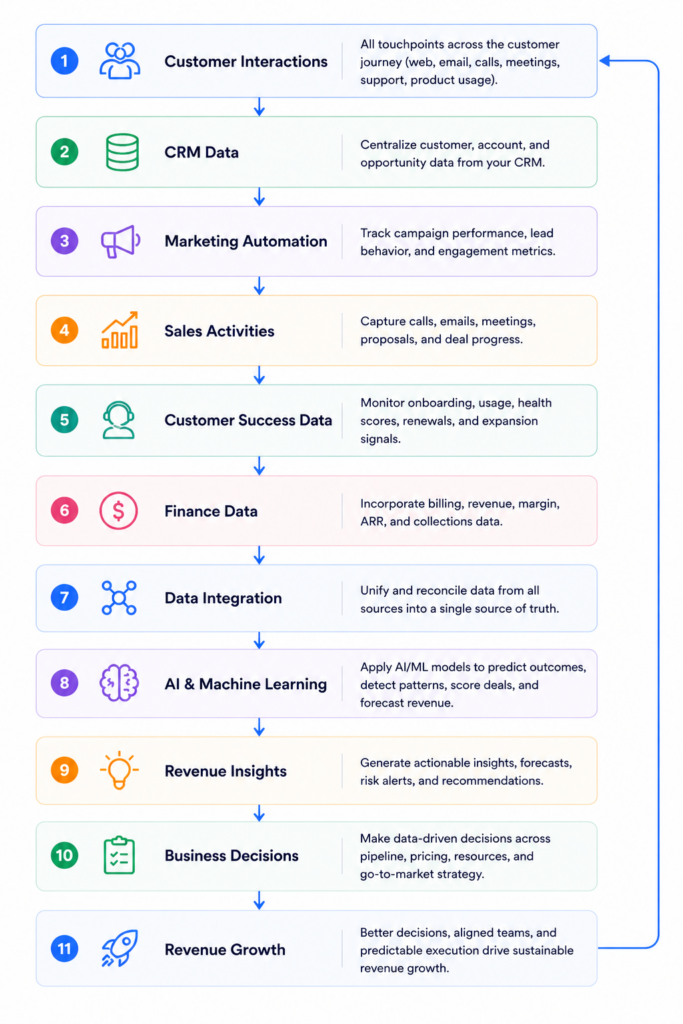
Customer interactions: Every touchpoint a prospect or customer has with your business — a website visit, an email open, a sales call, a support ticket — generates a data point. This is the raw material everything downstream depends on.
CRM data: Sales reps (and increasingly, automated systems) log this activity into a customer relationship management system — the record of who’s talking to whom, and about what.
Marketing automation: Marketing platforms track which campaigns, content, and channels are driving engagement, adding another layer of context about how a prospect found you and what they responded to.
Sales activities: Calls, meetings, proposals, and follow-ups — the day-to-day work of moving a deal forward — get captured, often automatically through call-recording and email-tracking tools.
Customer success data: Once a deal closes, product usage, support tickets, and satisfaction scores start telling the story of whether the customer is getting value — and whether they’re a renewal or a churn risk.
Finance data: Billing, invoicing, and payment data close the loop, connecting everything back to actual dollars recognized as revenue.
Data integration: All of this — often sitting in five, ten, or more separate systems — gets connected into one unified view. Without this step, none of what follows is possible; this is usually the hardest and most underestimated part of building Revenue Intelligence.
AI and machine learning: Models trained on this unified, historical data start finding patterns no human could spot manually — which deal characteristics predict a win, which usage patterns predict churn, which lead sources predict long-term value.
Revenue insights: The models’ output — a forecast, a risk flag, a recommended next action — gets surfaced to the people who need it, in the tools they already use, not buried in a report nobody opens.
Business decisions: A sales manager reprioritizes coaching. A customer success rep reaches out to an at-risk account. A marketing leader shifts budget toward a channel producing higher-quality pipeline.
Revenue growth: The result of consistently better decisions, made earlier, compounding over time — and the results themselves become new data, restarting the loop.
4. Core Components of Revenue Intelligence
Revenue Intelligence isn’t a single tool that you install and suddenly have everything figured out.
It’s a combination of different systems, data sources, analytics, and AI working together. Each part has a different job, but the real value comes when they are connected.
Here are the main components:
| Component | What it does |
|---|---|
| CRM | Stores important information about customers, leads, contacts, opportunities, and deals. It’s usually the main system where sales data is recorded. |
| Revenue Operations (RevOps) | Brings sales, marketing, and customer success together around common processes, data, and revenue goals. |
| Customer Data | Contains the history of how customers interact with the business, including purchases, website activity, product usage, support requests, and other interactions. |
| Sales Intelligence | Helps sales teams understand which deals are healthy, which ones are at risk, how buyers are engaging, and where sales reps may need support. |
| Marketing Analytics | Shows which marketing campaigns, channels, and activities are actually contributing to revenue rather than simply generating leads. |
| Customer Success Analytics | Tracks things such as product usage, customer engagement, support activity, and other signals that can indicate whether a customer is healthy or at risk. |
| AI Models | Analyze historical and current data to make predictions, such as revenue forecasts, deal scores, churn risk, and expansion opportunities. |
| Revenue Dashboards | Turn complex data into easy-to-understand views that sales leaders, executives, and other teams can use to make decisions. |
| Revenue Forecasting | Estimates how much revenue the business is likely to generate based on current pipeline, historical results, customer behavior, and other signals. |
| Pipeline Analytics | Helps teams understand how deals are moving through the sales pipeline, where deals are getting stuck, and how quickly opportunities are progressing. |
| Conversation Intelligence | Uses AI to analyze sales calls and conversations to identify things like customer concerns, objections, buying signals, and common patterns. |
| Attribution Models | Help businesses understand which marketing and sales activities contributed to generating actual revenue. |
| Performance Analytics | Measures how individual employees, teams, and departments are performing against their revenue goals. |
How these components work together
The important thing to understand is that these components aren’t supposed to operate independently.
They continuously feed information into one another.
For example, imagine a sales call is recorded.
Conversation Intelligence analyzes the call and detects that the customer has concerns about pricing.
That information can become a signal for the deal scoring system.
The deal score changes because the customer’s buying signals have weakened.
That information then affects the revenue forecast.
The sales manager sees that the deal is now less likely to close this quarter and decides to step in.
That’s the real power of Revenue Intelligence.
It’s not about having thirteen different tools.
It’s about connecting the information so that one piece of data can improve the next decision.
A company can have a CRM, dashboards, AI tools, forecasting software, and analytics platforms and still not have true Revenue Intelligence if all those systems operate separately.
Treevire Insight: Revenue Intelligence becomes valuable when data flows between systems and leads to action. The goal isn’t to collect more information. The goal is to connect the information you already have and use it to make better decisions.
5. Revenue Intelligence vs. Traditional Reporting
This is one of the easiest areas to get confused about.
A company might already have a CRM, several dashboards, and a Business Intelligence platform and think:
“Don’t we already have Revenue Intelligence?”
Not necessarily.
The difference is mainly what these systems are designed to help you understand and do.
Here’s the simplest way to think about it
Traditional reporting:
“What happened?”
Business Intelligence:
“What happened, and can we understand it in more detail?”
CRM reporting:
“What information has been recorded about our customers and deals?”
Revenue Intelligence:
“What’s likely to happen next, and what should we do about it?”
Here’s how they compare:
| Traditional Reporting | Business Intelligence (BI) | CRM Reporting | Revenue Intelligence | |
|---|---|---|---|---|
| Data freshness | Usually updated weekly or monthly | Often updated daily or on a scheduled basis | Can be close to real-time, but depends on what users enter | Continuously updated using both recorded and automatically captured data |
| Predictive capability | Very limited | Possible, but often requires additional data science or AI tools | Usually limited | Prediction is a core part of the system |
| Automation | Reports often need to be created or updated manually | Dashboards can be automated | Still depends heavily on people entering accurate information | Can automatically capture activity and generate insights |
| AI | Usually little or none | May be added as an additional capability | Usually limited | AI is often central to forecasting, scoring, and risk detection |
| Main question answered | What happened? | What happened and why? | What was recorded? | What’s likely to happen next, and what should we do? |
| Main purpose | Historical reporting | Understanding business performance | Managing customers and deals | Improving and predicting revenue performance |
| Typical data sources | Often one or a few systems | Multiple business systems | Primarily CRM data | Sales, marketing, customer success, finance, product, and other revenue-related data |
A simple example
Imagine your company has a $500,000 sales target for the quarter.
A traditional report might tell you:
“We’ve generated $340,000 so far.”
That’s useful, but it doesn’t tell you whether you’re going to reach $500,000.
A BI dashboard might go further:
“Here’s how revenue compares with previous quarters, which regions are performing best, and which products are generating the most revenue.”
That’s even more useful.
Your CRM might show:
“There are 25 open opportunities worth $300,000.”
But there’s still a problem.
How many of those deals are actually going to close?
Revenue Intelligence tries to answer that question.
It might analyze the opportunity history, emails, meetings, customer engagement, deal velocity, previous similar deals, and other signals and conclude:
“Based on current activity, only about $110,000 of this pipeline is likely to close this quarter.”
Now the sales leader has something actionable.
Instead of discovering at the end of the quarter that the company is going to miss its target, the team has time to react.
They might:
- Focus on the highest-probability deals.
- Bring managers into at-risk opportunities.
- Increase outreach to specific accounts.
- Adjust sales resources.
- Create a strategy for stalled deals.
- Revisit the forecast with leadership.
That’s the fundamental difference.
Reporting helps you understand the past.
Revenue Intelligence helps you use the past and present to make better decisions about the future.
And that’s why Revenue Intelligence is becoming an important part of modern revenue teams.
6. Types of Revenue Intelligence
Revenue Intelligence isn’t just one thing. Different types focus on different parts of the customer and revenue journey.
A company might use several of them at the same time, depending on what it needs to improve.
| Type | What it focuses on | How it helps generate revenue |
|---|---|---|
| Sales Intelligence | Looks at individual sales reps, deals, and buyer activity. | Helps sales reps spend more time on the right opportunities and improve how they sell. |
| Pipeline Intelligence | Looks at the overall health and movement of the sales pipeline. | Identifies deals that are stuck, slowing down, or likely to be lost. |
| Forecast Intelligence | Uses current and historical data to estimate future revenue. | Helps leadership and finance plan with greater confidence. |
| Customer Intelligence | Looks at customer behavior, engagement, and relationships. | Helps businesses personalize experiences, retain customers, and find expansion opportunities. |
| Marketing Intelligence | Connects marketing campaigns and channels to actual revenue. | Helps companies spend more money on the marketing activities that produce results. |
| Product Intelligence | Looks at how customers actually use a product. | Helps identify which features and behaviors are connected to retention, upgrades, and growth. |
| Customer Success Intelligence | Tracks customer health, satisfaction, engagement, and product usage after the sale. | Helps teams identify customers who may leave and take action before they churn. |
| Pricing Intelligence | Analyzes prices, discounts, deals, and customer buying patterns. | Helps companies identify unnecessary discounts and protect profit margins. |
| Competitive Intelligence | Looks at why customers choose the company or a competitor. | Helps sales teams improve their messaging, positioning, and competitive strategy. |
| Financial Intelligence | Connects revenue operations with billing, financial, and accounting information. | Gives the business a clearer picture of how operational activity translates into actual revenue. |
Why these different types matter
Imagine a company notices that revenue is falling.
Sales Intelligence might show that several sales reps are struggling to convert opportunities.
Pipeline Intelligence might reveal that many deals are getting stuck at the proposal stage.
Customer Intelligence might show that existing customers are becoming less engaged.
Marketing Intelligence could reveal that the company is spending heavily on a channel that produces plenty of leads but very little revenue.
Each type of intelligence answers a different question.
When you bring them together, leadership gets a much more complete picture of what’s happening across the entire revenue engine.
7. How AI Is Used in Revenue Intelligence
AI is what takes Revenue Intelligence beyond simply reporting numbers.
Without AI, a company can look at its data and understand what happened.
With AI, it can start looking for patterns and making predictions about what is likely to happen next.
Here are some of the most common ways AI is used.
Revenue forecasting
AI can analyze historical deals, current pipeline activity, customer behavior, and other signals to estimate how much revenue the company is likely to generate.
Instead of relying entirely on a sales rep saying:
“I’m pretty sure this deal will close.”
the system can look at what has actually happened with similar deals in the past.
And because new information is constantly coming in, the forecast can change as the situation changes.
Deal scoring
AI can give each open deal a score based on its likelihood of closing.
It might consider things such as:
- How often the customer is engaging
- How quickly the deal is moving
- Who is involved in the buying process
- Whether important meetings have happened
- How similar deals performed in the past
This helps sales managers identify which deals deserve attention.
Lead scoring
Not every lead is equally valuable.
AI can analyze incoming leads and estimate which ones are more likely to become customers.
That allows sales teams to focus their time on the leads with the strongest potential instead of simply working through leads in the order they arrived.
Opportunity scoring
Opportunity scoring is similar to lead scoring, but it focuses on opportunities that are further along in the buying process.
The goal is to answer a simple question:
“Is this opportunity worth investing our sales time and resources into?”
Customer health scoring
AI can combine different signals — such as product usage, support activity, engagement, and account activity — to estimate the health of a customer relationship.
For example, a customer who used your product every day six months ago but barely uses it now might receive a lower health score.
Churn prediction
One of the most valuable applications is predicting which customers may leave.
AI can look for patterns that historically appeared before customers churned.
For example:
Lower product usage + fewer logins + more support problems + declining engagement
could indicate that a customer is becoming unhappy.
The system can flag the account before the customer actually cancels.
That gives the customer success team time to do something about it.
Upsell and expansion prediction
AI can also look for customers who may be ready to buy more.
For example, a customer might be:
- Using the product heavily
- Reaching usage limits
- Adding more employees
- Using advanced features
- Asking about additional capabilities
When similar behavior has historically led to an upgrade, AI can identify that pattern and flag the account as a potential expansion opportunity.
Next-best-action recommendations
Instead of simply telling a sales rep that a deal is at risk, AI can sometimes recommend what to do next.
For example:
“Schedule a meeting with the economic buyer.”
or:
“Follow up on the pricing objection discussed during the last call.”
The goal isn’t to replace the salesperson. It’s to help them decide what action is most likely to move the opportunity forward.
Sales coaching
AI can analyze sales conversations and identify patterns that managers may not have time to notice themselves.
It can highlight things such as:
- How much the salesperson talks
- How often customers raise objections
- Whether important questions were asked
- How pricing discussions were handled
- Which topics appeared in successful deals
- Whether competitors were mentioned
Managers can then use these insights to coach their teams.
Conversation analysis
Sales teams can have hundreds or thousands of calls.
No manager can realistically listen to every conversation.
AI can analyze those conversations and identify common themes, customer concerns, buying signals, competitors, objections, and sentiment.
This turns conversations into usable business data.
Pipeline risk detection
AI can also watch the pipeline for early warning signs.
For example:
No customer response → missed follow-up → fewer meetings → deal sitting in the same stage → declining engagement
Individually, each signal might not mean much.
Together, they could indicate that the deal is in trouble.
Revenue optimization
At a broader level, AI can help leadership decide where to put resources.
For example:
- Which customer segments should we focus on?
- Which channels generate the best customers?
- Which products have the strongest expansion potential?
- Where should we add sales capacity?
- Which markets are becoming more attractive?
The goal is to use data to make better resource-allocation decisions.
Treevire Insight: AI doesn’t eliminate the need for human judgment. It helps reduce the amount of guessing involved in making decisions. A sales manager will still decide which deal to prioritize or how to coach a salesperson. AI simply gives that manager more evidence to work with.
8. Where Does Revenue Intelligence Get Its Data?
Revenue Intelligence is only as useful as the information behind it.
Think about it like this:
Good data → better analysis → better predictions → better decisions.
But if the underlying data is incomplete, outdated, duplicated, or incorrect, even the most sophisticated AI model can produce a bad answer.
A typical Revenue Intelligence system can pull information from many different places:
| Data Source | What it provides |
|---|---|
| CRM | Information about leads, contacts, accounts, opportunities, and deals. |
| ERP | Financial, operational, purchasing, inventory, and other business information. |
| Marketing platforms | Campaign performance, lead sources, advertising activity, and engagement data. |
| Website analytics | Information about what visitors do on the website and which pages or content they interact with. |
| Customer support systems | Support tickets, response times, resolution history, and customer issues. |
| Email platforms | Email activity, responses, engagement, and communication history. |
| Call recordings | Sales conversations, customer questions, objections, buying signals, and other conversation data. |
| Product usage data | How customers use the product, which features they use, and how frequently they use them. |
| Billing systems | Payments, invoices, revenue, outstanding balances, and other financial activity. |
| Subscription platforms | Renewals, upgrades, downgrades, cancellations, and subscription changes. |
| Customer surveys | Direct feedback about customer satisfaction, experience, and sentiment. |
| Third-party data | Additional information about companies and customers, such as industry, company size, buying intent, and other business attributes. |
Why data quality matters so much
Imagine you have an AI system predicting whether a deal will close.
But your CRM contains:
- Duplicate customer records
- Old contact information
- Deals that were never updated
- Incorrect sales stages
- Missing activities
- Different teams using different definitions
- Revenue numbers that don’t match the finance system
The AI doesn’t magically know which information is correct.
It learns from the data you give it.
So you could end up with a prediction that looks extremely sophisticated but is based on bad information.
That’s why data quality is one of the most important parts of any Revenue Intelligence project.
A simple rule is worth remembering:
AI doesn’t fix bad data. It can make the consequences of bad data happen faster.
Before investing heavily in sophisticated AI models, companies should make sure their core data is accurate, consistent, connected, and regularly maintained.
That foundation is what allows Revenue Intelligence to become genuinely useful rather than just another layer of technology sitting on top of messy business data
9. Revenue Intelligence Metrics
Revenue Intelligence involves a lot of numbers, but you don’t need to be a finance expert to understand them. These metrics are simply different ways of answering questions like:
How much are we making? How fast are we growing? How healthy is our pipeline? Are customers staying? And can we trust our forecast?
Here are the most important metrics in simple language:
| Metric | What it means in simple terms | Why it matters |
|---|---|---|
| ARR (Annual Recurring Revenue) | The recurring revenue a subscription business expects to generate over a year. | Gives you a clear picture of the size and health of a recurring-revenue business. |
| MRR (Monthly Recurring Revenue) | Recurring revenue expected every month. | Helps businesses track growth and changes in revenue more frequently. |
| Pipeline Coverage | The amount of potential revenue sitting in your sales pipeline compared with your target. For example, $3 million in pipeline against a $1 million target means 3× coverage. | Shows whether you have enough opportunities to realistically reach your target. |
| Win Rate | The percentage of sales opportunities that end up becoming customers. | Helps you understand how effectively your sales team converts opportunities into revenue. |
| Sales Velocity | How quickly opportunities move through the sales process and become revenue. | Faster-moving deals generally allow a company to generate revenue more efficiently. |
| Customer Acquisition Cost (CAC) | How much it costs the company, on average, to acquire one new customer. | Helps determine whether customer growth is financially sustainable. |
| Customer Lifetime Value (CLV) | The amount of revenue a business expects to generate from a customer throughout the relationship. | Comparing CLV with CAC helps determine whether acquiring customers is worthwhile. |
| Churn Rate | The percentage of customers or revenue lost during a specific period. | Shows how well the business is retaining its customers. |
| Expansion Revenue | Additional revenue generated when existing customers upgrade, add products, or increase their usage. | Allows a company to grow revenue without having to find completely new customers. |
| Net Revenue Retention (NRR) | How much revenue the company keeps and expands from its existing customers after accounting for churn, downgrades, and upgrades. | An NRR above 100% means existing customers are generating more revenue than they were before. |
| Gross Revenue Retention (GRR) | The percentage of existing revenue that remains after churn and downgrades, without counting expansion revenue. | Shows the underlying strength of customer retention. |
| Average Deal Size | The typical amount of revenue generated from a closed deal. | Helps with sales planning, forecasting, and understanding how much business each opportunity is worth. |
| Forecast Accuracy | How close your predicted revenue was to the revenue you actually generated. | Tells you whether leadership can trust the company’s forecasts. |
| Sales Cycle Length | The average amount of time it takes to turn a prospect into a paying customer. | A shorter sales cycle can mean the company is converting opportunities more efficiently. |
Don’t just track the numbers
One of the biggest mistakes companies make is looking at these metrics individually.
For example, a company might have a strong win rate but still struggle to grow because its deals are too small.
Another company might have excellent revenue growth but poor retention because customers are leaving almost as quickly as new ones arrive.
The real value comes from looking at these metrics together.
For example:
CAC + CLV + Churn + NRR + Expansion Revenue
can tell you much more about the health of a subscription business than any one metric on its own.
10. Business Benefits of Revenue Intelligence
So what does a company actually get from all of this?
The goal isn’t to create more dashboards or give executives another set of numbers to look at.
The goal is to make better decisions and act earlier.
Here are some of the biggest benefits.
Better revenue forecasts
Instead of relying primarily on sales reps’ opinions, companies can use actual customer and deal behavior to improve their forecasts.
The result is a better understanding of how much revenue is likely to come in.
Faster revenue growth
When teams know which customers, deals, markets, and channels are most valuable, they can put more resources behind the opportunities that matter.
More productive sales teams
Sales reps don’t have unlimited time.
Revenue Intelligence can help them prioritize the leads and deals that are most likely to turn into revenue instead of treating every opportunity the same.
Faster decision-making
Without real-time information, leadership may have to wait for a weekly meeting or quarterly review before discovering a problem.
With connected revenue data, problems can become visible much earlier.
Better customer experiences
Suppose a customer suddenly stops using an important feature.
Instead of waiting for that customer to complain or cancel, the company can identify the change and reach out.
Done properly, that feels less like a sales pitch and more like good customer service.
Better marketing ROI
Marketing teams often know how many leads a campaign generated.
But leads aren’t the same thing as revenue.
Revenue Intelligence can help connect marketing activity with actual customers and revenue, making it easier to see which campaigns are genuinely producing business results.
Better teamwork across departments
Sales, marketing, and customer success often have different goals and different reports.
A shared revenue view gives everyone a common set of numbers to work from.
Instead of arguing about whose numbers are correct, teams can focus on what needs to change.
Less revenue leakage
Revenue can disappear in ways that aren’t always obvious.
A renewal might be missed. A discount might be larger than necessary. A promising deal might quietly stall.
Continuous monitoring can help identify these problems earlier.
Better sales coaching
Managers don’t have to rely entirely on their personal impressions of how a salesperson is performing.
Conversation and deal data can show specific areas where a rep is doing well and where they may need help.
Better customer retention
If a company can identify early signs that a customer may leave, it has a chance to intervene before the customer makes the final decision.
More predictable growth
Ultimately, all of these benefits lead to the same thing:
The business becomes more predictable.
Instead of constantly asking:
“What do we think is going to happen?”
leadership can increasingly ask:
“What does the data suggest is likely to happen, and what should we do about it?”
That’s the real business value of Revenue Intelligence.
11. Revenue Intelligence Across Different Industries
Revenue Intelligence isn’t limited to SaaS or technology companies.
Any business that has customers, sales, recurring revenue, complex transactions, or customer relationships can potentially use these ideas.
The exact use case, however, will look different from one industry to another.
SaaS
The challenge:
SaaS companies can lose customers gradually. A customer might use the product less and less for months before finally cancelling.
How Revenue Intelligence helps:
Product usage, login activity, support interactions, and engagement data can be combined to identify customers showing early signs of churn.
Business impact:
Customer success teams can reach out before the customer decides to leave.
Potential benefit:
Better retention and higher Net Revenue Retention.
Manufacturing
The challenge:
Manufacturing sales can involve long sales cycles, large contracts, multiple decision-makers, and complicated purchasing processes.
That makes forecasting difficult.
How Revenue Intelligence helps:
Deal scoring can consider factors such as stakeholder engagement, deal activity, previous sales cycles, and the amount of time an opportunity has spent in each stage.
Business impact:
Sales and operations teams get a clearer picture of which deals are genuinely progressing.
Potential benefit:
Better production, inventory, and resource planning.
E-commerce
The challenge:
E-commerce companies may have thousands or millions of customers, making it difficult to decide which customers deserve additional marketing attention.
How Revenue Intelligence helps:
Customer behavior and purchase history can be used to identify high-value customers and estimate future customer value.
Business impact:
Marketing teams can target retention campaigns toward customers who are most likely to respond.
Potential benefit:
Better marketing efficiency and customer lifetime value.
Financial Services
The challenge:
Financial services businesses often have long customer relationships and multiple products, but identifying the right time to offer another product isn’t always easy.
How Revenue Intelligence helps:
Customer engagement, product usage, and relationship data can be combined to identify potential cross-selling or expansion opportunities.
Business impact:
Teams can approach customers when there is a genuine indication of interest or need.
Potential benefit:
Higher revenue from existing customer relationships.
Healthcare
The challenge:
Healthcare sales often involve multiple decision-makers, including clinical, financial, procurement, and administrative stakeholders.
Deals can also take a long time to close.
How Revenue Intelligence helps:
Teams can track engagement across different members of the buying group and identify whether an opportunity is actually progressing.
Business impact:
Sales leaders get a clearer picture of which opportunities are healthy and which ones may be stalled.
Potential benefit:
More reliable forecasting and fewer unexpected deal losses.
Retail
The challenge:
Retail demand can change dramatically because of seasons, holidays, promotions, weather, trends, and other factors.
Simply looking at last year’s numbers isn’t always enough.
How Revenue Intelligence helps:
Predictive models can combine historical patterns with current demand signals to estimate what customers are likely to buy.
Business impact:
Retailers can make better decisions about inventory, staffing, and promotions.
Potential benefit:
Fewer stockouts and less excess inventory.
Telecommunications
The challenge:
Telecom companies manage huge numbers of customers across multiple services, and even a small change in churn can have a major impact on revenue.
How Revenue Intelligence helps:
Models can combine usage, billing, customer support, and engagement data to identify customers who may be considering leaving.
Business impact:
Retention teams can focus their efforts on customers with the highest risk rather than sending the same offer to everyone.
Potential benefit:
Lower churn and reduced revenue loss.
Logistics
The challenge:
Logistics companies often have complicated contracts, different pricing structures, fuel costs, service requirements, and changing margins.
How Revenue Intelligence helps:
Pricing and contract data can be analyzed to identify where margins are being squeezed.
Business impact:
Teams can make more informed pricing and renewal decisions.
Potential benefit:
Better margins and less revenue leakage.
Education
The challenge:
Education and ed-tech businesses often operate around specific enrollment periods, academic calendars, and institutional budgets.
How Revenue Intelligence helps:
Pipeline and engagement data can show which prospects are progressing and when decision-makers are most likely to be ready to act.
Business impact:
Sales and marketing teams can time their outreach around important enrollment and budget periods.
Potential benefit:
Better conversion rates during critical enrollment windows.
Professional Services
The challenge:
Professional services companies have to balance two things at the same time: winning new business and having enough people available to deliver that work.
Winning too much business without enough delivery capacity can create another problem.
How Revenue Intelligence helps:
Pipeline information can be combined with staffing and delivery-capacity data.
Business impact:
Sales and delivery teams can plan around the same expected revenue and workload.
Potential benefit:
Less over-selling and better resource planning.
Hospitality
The challenge:
Hotels and other hospitality businesses deal with constantly changing demand caused by seasons, holidays, events, travel patterns, and local conditions.
How Revenue Intelligence helps:
Predictive models can analyze booking pace, historical demand, current reservations, and other signals to estimate future demand.
Business impact:
Hotels can make better decisions about pricing, staffing, and availability.
Potential benefit:
Higher revenue from available rooms or units and better resource utilization.
Real Estate
The challenge:
Real estate transactions can take months or even years, and much of the process depends on relationships and buyer intent.
How Revenue Intelligence helps:
Engagement data can help agents identify which prospects are actively moving toward a transaction and which relationships are unlikely to progress soon.
Business impact:
Agents can spend more of their limited time on the prospects with the strongest potential.
Potential benefit:
Better use of sales time and improved conversion of qualified opportunities.
The common thread
The industries are very different, but the underlying idea is the same.
Collect the right data → identify meaningful patterns → predict what is likely to happen → take action before the opportunity is lost.
That’s what makes Revenue Intelligence useful across so many different types of businesses.
12. Revenue Intelligence Implementation Framework
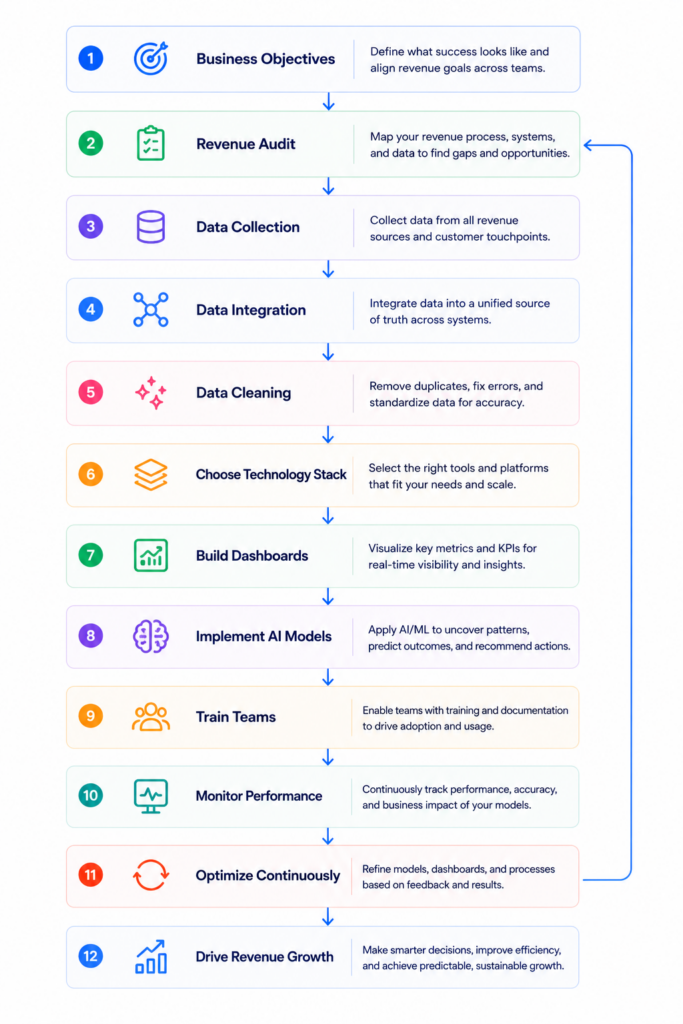
- Business objectives. Start by deciding exactly what you want to improve. It could be forecast accuracy, reducing churn, improving sales productivity, increasing win rates, or something else. Having a clear goal gives the entire Revenue Intelligence initiative a direction. Without one, it’s easy to end up with a collection of dashboards that look impressive but don’t actually help the business.
- Revenue audit. Look at your entire revenue process from beginning to end. Identify what data you already have, where that data is stored, which systems are being used, and where your biggest gaps in visibility are. This gives you a clear picture of where you are starting from.
- Data collection. Identify the data sources that are actually relevant to your objective. These could include CRM data, marketing activity, customer behavior, product usage, support information, or financial data. Start with the most important sources rather than trying to connect everything at once.
- Data integration. Connect your CRM, marketing, customer success, finance, and other relevant systems so information can move between them automatically. The goal is to create a reliable flow of data instead of depending on spreadsheets and manual exports and imports.
- Data cleaning. Clean up duplicate records, missing information, inconsistent formats, outdated data, and other problems. This may not be the most exciting part of the project, but it has a huge impact on everything that comes after it. Poor-quality data leads to poor-quality insights.
- Choose your technology stack. Select the platforms and tools that make sense for your company. Consider your existing systems, budget, technical capabilities, data requirements, and long-term plans instead of simply choosing the most popular or most expensive tools.
- Build dashboards. Create dashboards around the decisions people actually need to make. A sales manager may need pipeline and deal-risk information, while a CFO may care more about revenue forecasts, retention, and financial performance. Don’t try to give everyone the same dashboard.
- Implement AI models. Introduce AI where it can create the most value. This could mean revenue forecasting, deal scoring, lead scoring, or churn prediction. Start with one high-value use case, prove that it works, and then expand rather than trying to implement every AI capability at the same time.
- Train teams. Make sure the people using the system understand what the insights mean, where they come from, and how they should act on them. Just as importantly, they need to trust the system. A technically successful implementation can still fail if employees don’t actually use or believe the insights.
- Monitor performance. Measure whether Revenue Intelligence is actually improving the business objective you identified in step 1. If your goal was better forecast accuracy, measure forecast accuracy. If your goal was reducing churn, measure churn. Don’t judge success simply by how often people open the dashboards.
- Optimize continuously. Revenue Intelligence should continue to evolve as the business grows. Improve your models, add useful data sources, update dashboards, and introduce new use cases based on what is actually producing results. Treat it as an ongoing business capability rather than a project that ends when the software is installed.D
13. Common Challenges
Revenue Intelligence sounds straightforward on paper: bring your data together, add analytics and AI, and use the insights to make better decisions.
In practice, it’s not always that simple.
Most problems don’t come from the AI itself. They come from messy data, disconnected systems, poor adoption, or teams that aren’t sure how to use the information they’re getting.
Here are some of the most common challenges businesses run into:
| Challenge | What you can do about it |
|---|---|
| Poor CRM adoption | Make the CRM easier to use and reduce manual data entry wherever possible. Automatically capturing calls, emails, and meetings can help. It’s also important to give sales reps something useful in return, such as better deal insights or AI-assisted recommendations. |
| Inconsistent data | Decide how important information should be recorded before building advanced analytics on top of it. Everyone should follow the same definitions and processes. |
| Data silos | Connect the most important systems early. It may not be the most exciting part of the project, but good integrations are what allow everything else to work properly. |
| Resistance to change | Don’t make the implementation a decision made only by executives or IT. Involve the people who will actually use the system, especially sales reps and customer success teams. |
| Poor data quality | Put checks into the data pipeline so bad or incomplete information gets caught early instead of trying to clean everything up months later. |
| Integration complexity | Don’t try to connect every system at once. Start with the two or three systems that contain the most valuable revenue data and expand from there. |
| AI bias | Regularly check whether the models are producing unfair or unexplained differences between customer or employee groups. Important decisions should also have human review. |
| Privacy requirements | Decide what data you actually need, who should have access to it, how consent is handled, and how long the information should be kept. Build these rules into the system from the beginning. |
| Lack of executive support | Connect the project to a business problem leadership already cares about, such as forecast accuracy, churn, sales productivity, or revenue growth. |
| Too many dashboards and not enough action | Every important insight should lead to a clear next step and have someone responsible for taking it. A perfect dashboard is useless if nobody does anything with it. |
The biggest lesson
A company doesn’t become data-driven simply because it buys more software.
You can have an expensive CRM, advanced analytics, AI models, and dozens of dashboards and still make decisions based on someone’s gut feeling.
The technology matters, but process and adoption matter just as much.
14. Revenue Intelligence Tools
There isn’t one tool that does everything for every company.
Some platforms focus on sales conversations. Others focus on forecasting, CRM, customer data, business intelligence, or the underlying data infrastructure.
The right choice depends on the size of the company, the systems it already uses, the problems it is trying to solve, and how much it wants to build itself.
Also keep in mind that features and pricing change frequently, especially in this category. The tools below are best viewed as a starting point for understanding the market rather than a permanent ranking.
| Tool | Main focus | Where it fits |
|---|---|---|
| Gong | Conversation intelligence and sales coaching | Analyzes sales conversations to identify patterns, objections, customer signals, and coaching opportunities. |
| Clari | Revenue forecasting and pipeline management | Focuses heavily on forecasting, pipeline visibility, and revenue management. |
| Salesforce Revenue Intelligence | CRM-based revenue analytics | A natural option for companies already using Salesforce and wanting revenue insights closely connected to their CRM data. |
| HubSpot | CRM, marketing, sales, and reporting | A practical option for smaller and mid-sized companies that want many revenue functions in one platform. |
| Microsoft Dynamics 365 | Enterprise CRM and business applications | A strong fit for organizations already heavily invested in the Microsoft ecosystem. |
| Oracle CX | Enterprise customer and revenue management | Designed for larger organizations with complex customer and revenue operations. |
| SAP | ERP, finance, and business operations | Particularly useful when revenue data needs to be closely connected to financial and operational systems. |
| ZoomInfo | Sales intelligence and company data | Useful for prospecting, account research, and enriching revenue data with information about potential customers. |
| 6sense | Account intelligence and buying intent | Helps businesses identify companies that may be researching or showing interest in their products before they actively reach out. |
| Apollo | Prospecting and sales engagement | Often attractive to smaller sales teams looking for prospecting and sales engagement capabilities without a highly complex setup. |
| Power BI | Business intelligence and visualization | Often used to turn data from CRM, ERP, warehouses, and other systems into dashboards and reports. |
| Tableau | Data visualization and analytics | Similar to Power BI, it can serve as the visualization layer on top of a company’s broader revenue data. |
| Snowflake | Cloud data warehouse | Provides the infrastructure for bringing revenue data from multiple systems into one central location. |
| Databricks | Data engineering and machine learning | More useful for technical teams that want to build custom analytics and AI models using their own data. |
| Google BigQuery | Cloud data warehouse | Another option for centralizing large amounts of revenue and business data for analytics and AI. |
Don’t assume you need all of these
A common mistake is thinking that building a Revenue Intelligence system means buying ten or fifteen different platforms.
It doesn’t.
A smaller company might start with:
CRM + data warehouse + BI + a few AI capabilities
and gradually add specialized tools when there is a clear business reason to do so.
For example, a company with a large sales team might eventually add conversation intelligence. A SaaS company might prioritize product analytics and churn prediction.
The technology should follow the business problem, not the other way around.
Treevire Insight: Revenue Intelligence works best when technology and RevOps processes are built together. A tool can identify a problem, but someone still needs to decide what to do about it. If nobody owns the action, even an accurate insight has very little business value.
15. Best Practices for Revenue Intelligence
Building Revenue Intelligence isn’t a one-time software implementation. It is an ongoing process of improving how the company collects data, analyzes it, and acts on what it learns.
A few principles make a big difference.
Start with clean data
Don’t rush into advanced AI before fixing the basics.
If customer records are duplicated, sales stages are inconsistent, or important fields are regularly left blank, your predictions won’t be very reliable.
Good AI starts with good data.
Give teams one shared view of revenue
Sales, marketing, and customer success shouldn’t each have completely different versions of what is happening.
Create shared definitions and metrics so everyone is working from the same underlying information.
Standardize your CRM processes
If one salesperson uses “Proposal” for one type of opportunity and another uses it for something completely different, your reports won’t mean much.
Define your sales stages, fields, ownership rules, and processes clearly.
Treat AI as decision support
AI can provide a useful recommendation, but it shouldn’t automatically be treated as the final answer.
A model might say:
“This customer has a high churn risk.”
The team should still ask:
“Why does the model think that, and does the account team see the same thing?”
Human judgment remains important, especially when decisions have significant consequences.
Watch your important metrics regularly
Don’t wait until the end of the quarter to discover that something has gone wrong.
Monitor important metrics continuously so teams have time to respond.
Compare forecasts with reality
A forecast isn’t useful simply because it sounds convincing.
Track what the system predicted and compare it with what actually happened.
Over time, this helps you understand where the model performs well and where it needs improvement.
Train the people using the system
Even a great Revenue Intelligence platform won’t help if employees don’t understand it or don’t trust it.
Teams should know:
- Where the data comes from
- What the scores mean
- What the system can and cannot predict
- When they should question an AI recommendation
- What action they are expected to take
Keep improving the process
The best Revenue Intelligence systems evolve over time.
If the data shows that a particular sales stage is causing delays, change the process.
If a churn signal turns out to be unreliable, improve the model.
If a dashboard isn’t being used, simplify it.
The point isn’t to build a perfect system once.
The point is to keep learning and improving how the revenue organization operates.
16. Ethical AI and Governance
As AI becomes more involved in revenue decisions, companies have to think carefully about how those systems are used.
An AI model might influence which leads receive attention, which deals salespeople prioritize, or which customers receive retention offers.
Those decisions can have real consequences.
That’s why governance isn’t something to add later. It should be part of the system from the beginning.
Protect customer data
Revenue Intelligence systems can bring together a large amount of customer information, including behavioral, financial, communication, and product-usage data.
Not everyone in the company needs access to all of it.
Access should be based on what each person actually needs to do their job.
Understand privacy requirements
Depending on where your customers are located and what data you’re processing, privacy laws and regulations may apply.
For example, businesses handling personal information relating to people in the European Union or California may have obligations under frameworks such as GDPR or CCPA/CPRA.
The important point is that privacy shouldn’t be treated as a separate project.
It should be considered when collecting, storing, analyzing, and sharing revenue data.
Be clear about consent
If customer behavior is being used to personalize marketing, retention campaigns, or other communications, businesses need to understand what consent or other legal basis is required for that activity.
Collecting data simply because it is technically possible doesn’t mean you should automatically use it for every purpose.
Make AI recommendations understandable
Imagine a system tells a customer success manager:
“This customer has a 78% probability of churning.”
The obvious question is:
“Why?”
If the system can point to understandable signals — declining usage, fewer logins, unresolved support issues, or reduced engagement — the recommendation becomes much easier to evaluate.
An unexplained score is harder to trust and harder to challenge.
Keep humans involved
AI should generally help people make decisions rather than quietly making every important decision on its own.
This becomes especially important when an AI recommendation could significantly affect a customer, employee, salesperson, pricing decision, or commercial relationship.
Check for bias
AI models learn from historical data.
If historical decisions contain bias, the model can potentially reproduce or amplify it.
Companies should regularly test whether models behave differently across customer groups, employee groups, or other segments without a legitimate business reason.
Assign responsibility
Someone needs to own the system.
If an AI model makes an important recommendation and that recommendation turns out to be wrong, there should be a clear answer to:
Who reviews the model? Who can challenge it? Who is responsible for fixing it?
AI governance isn’t just about creating policies.
It’s about creating clear accountability.
Treevire Insight: Good governance isn’t only about avoiding legal problems. It’s also about maintaining trust. If sales and customer success teams discover that an AI system regularly produces inaccurate or unfair recommendations, they will eventually stop using it. Once people stop trusting the system, even technically impressive AI becomes almost useless.
17. Where Revenue Intelligence Is Heading
Revenue Intelligence is still evolving, and AI is likely to change how these systems work over the next several years.
The biggest shift is from AI that tells you something toward AI that helps you do something about it.
Here are some of the trends worth watching.
Agentic AI in Revenue Operations
Today’s AI might tell a sales rep:
“This customer hasn’t responded in 10 days.”
Future systems may go further.
An AI agent could identify the problem, draft a follow-up email, update the CRM, and ask the salesperson for approval before sending it.
The important change is that AI moves from insight generation to action.
Continuously updated forecasting
Traditional forecasting often happens on a schedule — weekly, monthly, or quarterly.
As more revenue data becomes available in real time, forecasts can increasingly update themselves as new information arrives.
A deal changes → the forecast changes.
A major customer churns → the forecast changes.
A new large opportunity enters the pipeline → the forecast changes.
The forecast becomes a continuously changing picture rather than a report created once a week.
Generative AI sales assistants
Salespeople spend a surprising amount of time on administrative work.
AI can increasingly handle tasks such as:
- Summarizing calls
- Writing follow-up emails
- Preparing meeting notes
- Updating CRM records
- Researching accounts
- Preparing sales briefs
- Creating personalized outreach
The goal isn’t simply to make salespeople work faster.
It’s to give them more time to actually sell and build relationships.
Digital revenue models
Another emerging idea is the digital revenue twin — a continuously updated model of a company’s revenue engine.
Instead of simply showing current pipeline numbers, the model could allow leadership to explore scenarios:
“What happens if our win rate drops by 10%?”
“What if we increase sales capacity by five reps?”
“What happens if churn increases by 2%?”
This type of simulation is still developing, but it points toward a future where leaders can test potential decisions before making them.
Real-time revenue decision systems
The next step beyond identifying a problem is recommending the best response.
Instead of:
“This account is at high risk.”
the system might say:
“Usage has dropped significantly over the last 30 days. Contact the account this week and schedule a product review.”
Eventually, some of these recommendations may be carried out automatically, with humans involved when approval is necessary.
More personalized revenue workflows
AI will make it easier to tailor sales and customer success interactions to individual customers.
Different customers may receive different messages, offers, recommendations, and follow-up timing based on their behavior and needs.
But greater personalization also means greater responsibility around privacy and data use.
Predictive revenue optimization
Forecasting answers:
“What is likely to happen?”
The next generation of Revenue Intelligence will increasingly try to answer:
“What can we change to improve the outcome?”
For example, instead of simply predicting that revenue will fall short, an AI system might compare different actions and estimate which combination of sales resources, pricing changes, campaigns, or customer interventions has the best chance of closing the gap.
AI-powered sales coaching
Sales coaching is also likely to become more personalized.
Instead of giving every salesperson the same training, AI can analyze individual conversations and identify specific areas where each person can improve.
One rep might need help handling pricing objections.
Another might need to ask better discovery questions.
Another might need to improve follow-up consistency.
That makes coaching much more specific than traditional one-size-fits-all sales training.
More unified revenue platforms
The revenue technology market is also moving toward greater consolidation.
Instead of using completely separate tools for forecasting, sales engagement, conversation intelligence, customer data, and pipeline management, companies increasingly want platforms that connect more of the revenue process in one place.
The exact shape of that market is still evolving, but the direction is clear:
More connected data, more AI, and fewer disconnected systems.
Treevire Insight: The most important change isn’t that AI will produce more reports. It’s that Revenue Intelligence is gradually moving from “Here is what is happening” toward “Here is what is likely to happen, here is why, and here is what you can do about it.”
That shift is what could make Revenue Intelligence one of the most important parts of modern revenue operations
What is Revenue Intelligence in simple terms?
Revenue Intelligence is the practice of using AI and data from across sales, marketing, and customer success to understand what’s actually happening with your revenue and predict what’s likely to happen next.
How is Revenue Intelligence different from a CRM?
A CRM is a system of record that stores information reps and systems enter about deals and customers. Revenue Intelligence analyzes that data — plus data from other systems — to generate predictions and recommendations, which a CRM alone doesn’t do.
Do small businesses need Revenue Intelligence?
Not necessarily at the earliest stage, but the need typically arrives faster than founders expect — once a company has more than a handful of reps or enough customer volume that gut-feel forecasting stops being reliable.
What’s the difference between Revenue Intelligence and Business Intelligence (BI)?
BI is a general-purpose approach to analyzing business data across any function. Revenue Intelligence is specifically focused on revenue-generating activities and typically includes AI-driven prediction as a core feature, not an add-on.
How accurate is AI-powered revenue forecasting?
Accuracy depends heavily on data quality and volume, but well-implemented AI forecasting models consistently outperform purely rep-driven, confidence-based forecasting because they’re grounded in actual historical patterns rather than individual optimism or pessimism.
What data do I need to get started with Revenue Intelligence?
At minimum: clean CRM data on deals and contacts, and some record of customer engagement (email, calls, or product usage). More data sources improve accuracy, but you don’t need every source in Section 8 to start.
Is Revenue Intelligence only for sales teams?
No — it’s explicitly cross-functional, spanning marketing (attribution), sales (forecasting and deal scoring), and customer success (churn and expansion prediction).
What is churn prediction, and how accurate is it?
Churn prediction uses machine learning to identify patterns in customer behavior that historically preceded cancellation, flagging similar patterns in current customers. Accuracy varies by business and data quality, but even directionally useful churn scores allow earlier intervention than waiting for a cancellation notice.
How does AI actually generate a deal score?
Models are trained on historical deal data — which characteristics (engagement level, deal size, stakeholder count, velocity) were present in deals that won versus deals that were
What’s the single biggest risk in implementing Revenue Intelligence?
Poor data quality. A sophisticated AI model built on inconsistent or incomplete data will produce confident but inaccurate predictions, which can be more damaging than having no prediction at all.
How long does it take to implement Revenue Intelligence?
It varies widely by company size and data complexity — a focused, single-use-case implementation (like deal scoring on existing CRM data) can take weeks, while a full cross-functional rollout spanning multiple data sources can take several months.
What is Net Revenue Retention, and why does it matter so much?
NRR measures how much revenue you retain and expand from existing customers, expressed as a percentage. Above 100% means expansion revenue outweighs churn — widely considered one of the strongest indicators of a healthy, sustainable business.
Can Revenue Intelligence replace a sales team?
No — it’s built to make sales teams more effective by directing their time and attention, not to replace the relationship-building and judgment that closing complex deals still requires.
What’s the difference between lead scoring and deal scoring?
Lead scoring ranks incoming leads by likelihood to convert into a real opportunity. Deal scoring ranks already-open opportunities by likelihood to close — they address different stages of the same funnel.
Do I need a data science team to implement Revenue Intelligence?
Not necessarily — many platforms (Gong, Clari, HubSpot, Salesforce) provide built-in AI models that don’t require custom data science work. A dedicated data science function becomes more relevant for large enterprises building highly customized models.
What is conversation intelligence?
AI analysis of sales call recordings and transcripts to extract patterns like talk-time ratio, objection handling, and buyer sentiment — turning conversations that were previously unmeasured into structured, analyzable data.
How does Revenue Intelligence help reduce revenue leakage?
By continuously monitoring for signals like unauthorized discounting, deals stalling without follow-up, or renewals approaching without engagement — catching these issues while there’s still time to address them, rather than discovering them after the fact.
What’s the relationship between Revenue Intelligence and RevOps?
RevOps is the organizational function and process discipline; Revenue Intelligence is the data and AI layer that RevOps depends on to actually see what’s happening across the revenue process. They’re complementary, not interchangeable.
Can Revenue Intelligence help with pricing decisions?
Yes — pricing intelligence, a specific type of Revenue Intelligence, analyzes discounting patterns and win/loss data to identify where pricing strategy may be leaving margin on the table or losing winnable deals.
What industries benefit most from Revenue Intelligence?
B2B SaaS and other subscription-based businesses see some of the clearest documented benefit, given the direct connection between usage data, churn prediction, and recurring revenue metrics — but the discipline applies broadly across nearly every industry with a defined sales and revenue process.
How does AI bias affect Revenue Intelligence, and how is it managed?
Models trained on historical data can inherit past biases — for example, systematically deprioritizing certain lead sources or customer segments. Regular auditing of model outcomes across segments, combined with human review for high-stakes decisions, is the standard mitigation approach.
What’s the best first step for a company new to Revenue Intelligence?
Start with a revenue audit — understanding what data you already have and where your biggest visibility gap is — before evaluating any specific tool. The right starting use case depends entirely on your specific problem.