
The Ethics of AI Personalization: Where Should Marketers Draw the Line? (2026 Guide)

Ethics of AI Personalization:
AI has changed personalization dramatically.
Businesses can now use customer data, machine learning, and generative AI to create highly personalized experiences for individual customers. Instead of showing everyone the same advertisement, email, product recommendation, or offer, companies can tailor these experiences based on a person’s behavior and preferences.
The technology is becoming faster, cheaper, and more accessible.
But this creates an important question:
Just because marketers can personalize something, does that mean they should?
There isn’t one simple answer.
Personalization can be extremely useful when it makes a customer’s experience easier and more relevant. For example, remembering a customer’s preferred size, recommending products based on previous purchases, or showing content that matches their interests can save time and improve the customer experience.
But personalization can also go too far.
When businesses collect information customers wouldn’t reasonably expect them to have, make sensitive assumptions about their personal lives, or use psychological vulnerabilities to increase conversions, personalization can start to feel less like helpful service and more like manipulation.
The technology itself doesn’t decide where that line is.
Marketers and businesses do.
AI personalization is the use of customer data and artificial intelligence to create experiences that are tailored to individual people rather than broad groups.
AI can personalize things such as:
- Website content
- Product recommendations
- Email messages
- Advertising
- Offers
- Content
- Communication timing
- Search results
- Customer support
- In-app experiences
For example, instead of sending the same email to 100,000 customers, an AI system might determine which product, message, image, and send time is most relevant to each individual customer.
This can create a much better experience.
But greater personalization also means businesses can learn much more about their customers.
And that’s where the ethical questions begin.
What Is AI Personalization?
Personalization has existed for decades; what’s changed is the mechanism generating it.
| Type | How It Works | Example |
|---|---|---|
| Traditional personalization | Human-defined rules based on stated preferences | “Dear [First Name]” mail merge |
| Rule-based personalization | Static if/then logic set by a marketer | “If customer bought running shoes, show running socks” |
| Behavioral personalization | Reflects observed actions, not stated preferences | “You recently viewed these items” |
| Predictive personalization | Machine learning forecasts future behavior | “Customers like you often buy this next” |
| AI-powered personalization | Continuously learning models adjust in real time across many signals at once | Dynamic homepage layout unique to each visitor |
| Generative personalization | AI creates unique content (copy, images) per individual, not just selects from existing options | A uniquely worded email generated for one recipient |
| Agentic personalization | An AI agent makes multi-step decisions — audience, offer, timing, channel — with minimal human involvement per decision | An autonomous system that decides who sees what, when, without a human approving each instance |
Why Is AI Personalization Creating Ethical Challenges?
Personalization exists on a spectrum.
At the simpler end, it might mean:
“Welcome back. Here’s the product you looked at yesterday.”
Most people would consider this fairly harmless.
At the more advanced end, an AI system might analyze hundreds of signals to infer:
- What someone is interested in
- When they’re most likely to buy
- How price-sensitive they are
- What type of messaging influences them
- When they are most active
- What products they may need next
- Whether they appear likely to cancel
- Which offer is most likely to change their decision
Some of this can be useful.
But some uses can become uncomfortable or even harmful.
The technology itself doesn’t automatically know the difference between helping someone make a better decision and using someone’s weaknesses to influence that decision.
That distinction depends on how businesses design and govern their systems.
When Does Personalization Become Problematic?
There isn’t one specific point where personalization suddenly becomes unethical.
Instead, there are several warning signs.
Personalization becomes more ethically questionable when it:
1. Uses information customers wouldn’t reasonably expect
A customer may expect a retailer to remember their purchase history.
They may not expect the company to infer highly personal information from hundreds of behavioral signals.
The more unexpected or sensitive the information, the greater the responsibility to use it carefully.
2. Targets psychological vulnerability
There’s an important difference between understanding what a customer likes and identifying when they are most vulnerable to persuasion.
For example, an AI system might discover that a particular customer is more likely to make impulse purchases late at night.
If the company then deliberately targets that person during those hours because it knows their resistance is lower, the ethical situation changes.
The system is no longer simply making the experience more relevant.
It may be exploiting a behavioral vulnerability.
3. Removes meaningful customer choice
Personalization should not make customers feel trapped.
Customers should have reasonable ways to:
- Understand what information is being used
- Control certain personalization settings
- Opt out where appropriate
- Correct inaccurate information
- Question important decisions
A system becomes much more concerning when customers have no meaningful way to understand or challenge how it treats them.
4. Optimizes for conversion without considering consequences
AI systems usually optimize for the objective they’re given.
If the only goal is:
“Maximize conversions.”
the system may discover strategies that increase conversions without considering whether those strategies are good for the customer.
This is one of the most important issues with AI personalization.
The AI doesn’t inherently understand:
- Fairness
- Customer well-being
- Long-term trust
- Ethical boundaries
- Brand reputation
It optimizes according to the objectives and constraints humans provide.
That’s why governance matters.
Personalization vs. Manipulation
Personalization and manipulation are not the same thing.
Personalization generally tries to make an experience more relevant.
Manipulation tries to influence someone’s behavior in a way that may work against their interests.
Consider two examples.
Example 1: Helpful personalization
A customer previously purchased size M.
The website remembers their size and shows products available in that size first.
That’s personalization.
It saves the customer time.
Example 2: Potentially manipulative personalization
An AI system identifies that a customer tends to make expensive impulse purchases when they are stressed or browsing late at night.
The company deliberately sends aggressive promotions during those periods because the customer is more likely to buy.
That’s much more difficult to justify.
The difference isn’t simply the amount of data being used.
It’s how that knowledge is being used and who benefits from the decision.
A Real-World Thought Experiment
Consider an online fashion retailer.
The company knows that a particular customer:
- Frequently buys clothing
- Usually shops late at night
- Responds strongly to limited-time offers
- Often purchases after receiving personalized recommendations
The company’s AI system learns that this customer is particularly likely to make an impulse purchase around midnight.
The marketing team could use this information in several ways.
Approach A
Show the customer products they have previously expressed interest in.
Likely purpose: Make discovery easier.
Approach B
Send a personalized recommendation when the customer is normally active.
Likely purpose: Improve relevance and convenience.
Approach C
Create an artificial sense of urgency specifically because the system knows the customer is more likely to make an impulse purchase at that time.
Potential concern: The system may be exploiting a behavioral pattern rather than simply helping the customer.
The technology behind all three approaches could be similar.
The difference is the objective and the context.
Why Businesses Use AI Personalization
The business benefits of AI personalization are real and well proven. Before discussing the ethical concerns, it’s important to understand why so many companies invest in it. A balanced conversation starts by recognizing its genuine value rather than ignoring it.
- Higher conversions: Personalized offers are more relevant to customers, so they usually perform much better than generic promotions.
- Better customer experience: Showing people content, products, or recommendations that match their interests reduces irrelevant messages and helps them find what they need faster.
- Improved customer retention: Personalized communication can reconnect with customers before they lose interest or stop buying, helping businesses keep them engaged.
- Higher customer lifetime value: Relevant product recommendations encourage customers to make additional purchases that genuinely meet their needs, increasing long-term value.
- More efficient advertising: Targeting the right audience reduces wasted advertising spend and helps businesses reach people who are more likely to become customers.
- Better customer support: Personalized service allows support teams to access a customer’s history, so customers don’t have to explain the same issue repeatedly, creating a smoother experience.
- Revenue growth: Together, these benefits can significantly increase business revenue, which is why companies across almost every industry continue investing in AI personalization.
Treevire Insight: This report is not against AI personalization. Instead, it highlights that the same technology that creates better customer experiences can also cause harm if used irresponsibly. That’s why strong governance, transparency, and ethical decision-making are essential when implementing AI personalization.
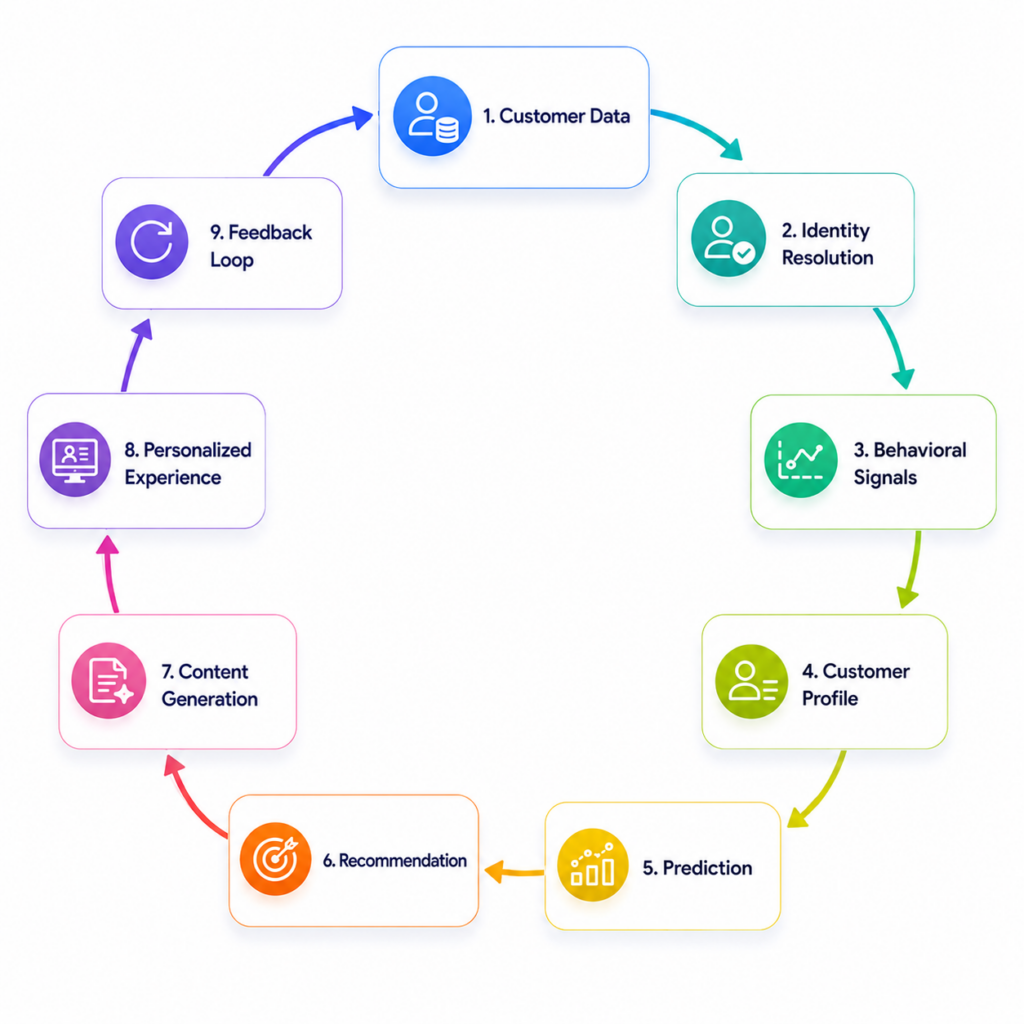
The AI personalization process follows the same workflow explained in Treevire’s CDP and AI marketing guides. Customer data is collected and combined to create a single customer profile. That profile is then used by AI models to predict behavior and generate personalized recommendations, content, and experiences. Every new interaction is added back to the profile, helping the system become even more accurate over time.
The ethical concern is not with any one step in this process. It comes from the fact that each step makes it harder for customers to understand what is happening with their data and how it is being used. Most customers know they shared their email address. However, they often don’t realize that their email, browsing activity, device information, and other data can be combined to estimate things like their income level, buying habits, or how likely they are to respond to an urgent offer.
The technology behind this process—including CRM systems, Customer Data Platforms (CDPs), machine learning, recommendation engines, predictive analytics, generative AI, and AI agents—is the same technology covered in detail throughout Treevire. This report is not about the technology itself. Instead, it focuses on the ethical decisions businesses make at every stage of the personalization process and how those decisions affect customer trust and privacy.
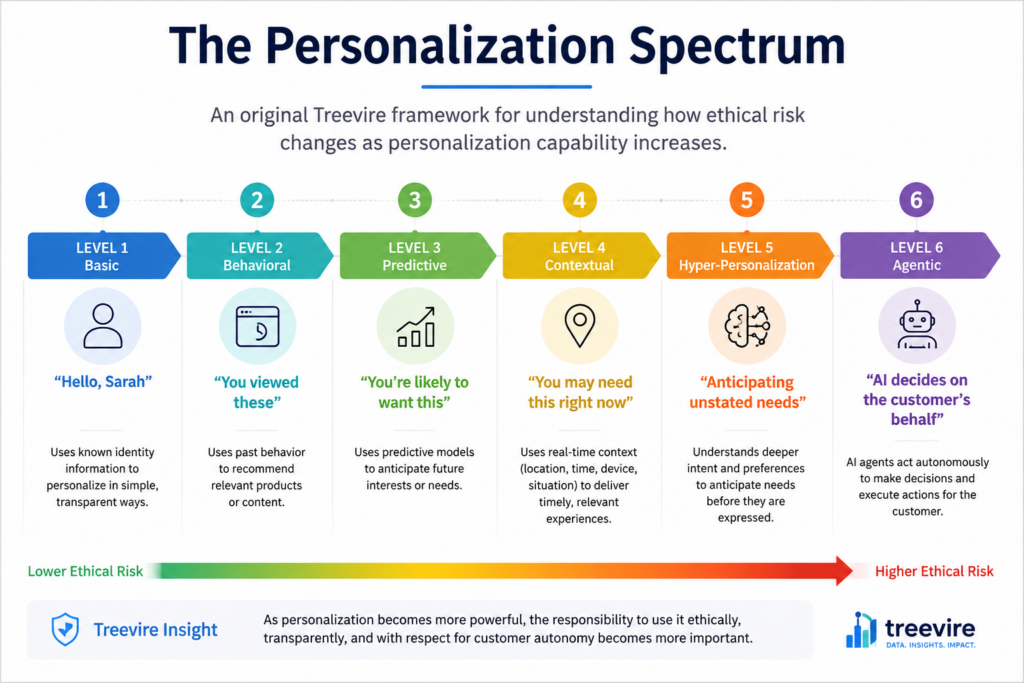
The Six Levels of AI Personalization
Not all personalization carries the same level of ethical risk. As AI becomes more sophisticated, businesses can use increasingly detailed information to predict and influence customer behavior.
The following framework shows how personalization can progress from simple, transparent customization to highly autonomous AI-driven decision-making.
| Level | Type of Personalization | What It Means | Example | Ethical Risk |
|---|---|---|---|---|
| 1. Basic | Identity-based | Uses information the customer has directly provided, such as their name, preferences, or account details. | “Hello, Sarah.” | Minimal — The customer expects the business to know this information, and its use is generally transparent. |
| 2. Behavioral | Behavior-based | Uses actions the customer has taken on a website, app, or other digital channel. | “You viewed these products recently.” | Low — Generally expected, as long as the data is collected and used appropriately. |
| 3. Predictive | Prediction-based | Uses historical behavior and AI models to predict what a customer may want or do next. | “You may be interested in these products.” | Moderate — The risk increases when customers are unaware that the business is making predictions about them. |
| 4. Contextual | Context-aware | Combines customer behavior with real-time information such as time, location, device, or current activity. | “You may need this while traveling.” | Moderate to High — Combining multiple signals can reveal information or make assumptions that customers may not expect. |
| 5. Hyper-Personalized | Anticipatory | Uses large amounts of data and AI predictions to anticipate needs that the customer has not directly expressed. | Predicting that a customer may need a particular product or service before they actively search for it. | High — The system can begin to feel intrusive, especially when it makes sensitive or highly personal inferences. |
| 6. Agentic | Autonomous | AI independently decides who to target, what to offer, what message to use, and when to deliver it, with limited human involvement in individual decisions. | An AI system continuously adjusts personalized offers for individual customers based on real-time behavior. | Highest — High personalization combined with limited human oversight creates greater risks of unintended manipulation, unfair treatment, or misuse of customer data. |
Understanding the progression
The important point is that more advanced personalization is not automatically unethical.
The risk increases when personalization becomes more difficult for customers to understand, when it relies on increasingly sensitive or unexpected information, or when AI begins making decisions with little human oversight.
For example, using a customer’s name is straightforward.
Remembering the products they recently viewed is still relatively expected.
Predicting what they might purchase next introduces more uncertainty.
Using location, timing, and behavioral patterns together requires greater care.
And when an AI system starts making these decisions automatically and continuously, businesses need much stronger safeguards.
The key question at every level should therefore be:
Are we using personalization to make the customer’s experience more relevant, or are we using what we know about the customer to influence them in ways they would not reasonably expect?
That distinction is at the heart of responsible AI personalization.
Ethical Boundary: Risk in this framework does not rise because a level uses “more data.” It rises because each level removes a checkpoint — a customer’s expectation, a human’s review, or a clear boundary on inference — that existed at the level below it. Level 6 is the highest-risk level specifically because it can combine all of Levels 1–5 without the human oversight that traditionally caught mistakes before they reached the customer.
When Does Personalization Become Manipulation?
Personalization is not automatically manipulative.
A business can use customer data to make its marketing more relevant, helpful, and convenient. The ethical problem begins when personalization is used to exploit weaknesses, hide important information, deceive customers, or reduce their ability to make a free and informed decision.
To understand where that line is, it helps to distinguish between four different ideas.
Understanding the Difference
Persuasion means presenting genuine information, benefits, or reasons that may encourage someone to change their mind. This is a normal and legitimate part of marketing. For example, showing a customer how a product solves a problem they already have is persuasion.
Influence means shaping someone’s decision through things such as relevant information, product recommendations, social proof, or how an option is presented. Influence is not necessarily unethical, but it can become problematic depending on how it is used.
Manipulation goes further. It involves using deception, exploiting a psychological vulnerability, or creating artificial pressure to influence someone’s decision in a way they may not reasonably recognize or freely choose.
Coercion is the most serious category. It involves removing or severely limiting meaningful choice. This is uncommon in normal marketing but can be relevant when businesses use aggressive dark patterns that make it extremely difficult for customers to decline an offer, cancel a service, or change a decision.
A simple way to think about the spectrum is:
Persuasion → Influence → Manipulation → Coercion
The further marketing moves toward the right, the greater the ethical concern.
Where Can AI Personalization Cross the Line?
AI makes this issue more complicated because it can identify patterns that humans may never notice.
A marketer might not intentionally decide to manipulate a customer.
Instead, an AI system may discover that a certain tactic increases conversions and automatically start using it more often.
Here are some of the most important warning signs.
1. Dark Patterns
Dark patterns are design techniques that make it difficult for people to understand their choices or take an action they actually want to take.
For example:
- Making the “Accept” button obvious while hiding “Decline”
- Making cancellation much harder than signing up
- Using confusing language to obtain consent
- Making an option look like an error or warning
- Automatically selecting an option that benefits the business
AI can make these techniques even more sophisticated by testing different designs and automatically identifying which version makes customers more likely to take a particular action.
The ethical problem is not simply that the design is persuasive.
It’s that the design may intentionally reduce meaningful choice.
2. Emotional Targeting
AI can sometimes infer patterns that suggest a person’s emotional state or vulnerability.
For example, a system might identify behavior associated with:
- Stress
- Loneliness
- Grief
- Anxiety
- Financial difficulty
- Frustration
Using ordinary customer interests to personalize an advertisement is one thing.
Using an inferred emotional vulnerability as the reason to target someone is much more ethically sensitive.
The question becomes:
Are we responding to a genuine customer need, or are we using someone’s emotional state to make them easier to influence?
That is an important distinction.
3. Artificial Urgency
Urgency can be a legitimate marketing technique when the urgency is real.
For example:
“Applications close Friday.”
If that deadline is genuine, informing customers about it is reasonable.
The problem occurs when businesses create urgency that doesn’t actually exist.
Examples include:
“Only 2 left!”
when there is plenty of inventory,
or:
“Offer expires in 10 minutes!”
when the same offer simply resets after the countdown reaches zero.
AI can make this more powerful by identifying which forms of urgency work best for particular customers.
Once urgency is fabricated rather than truthful, personalization can move from persuasion into deception.
4. Fear-Based Messaging
Marketing can legitimately explain the risks associated with a problem.
But there is a difference between explaining a real risk and deliberately increasing someone’s fear to make them buy.
For example, a security company might explain:
“Weak passwords can increase the risk of account compromise.”
That’s information.
But deliberately exaggerating the danger because an AI model has identified that a particular customer responds strongly to fear-based messaging is much more problematic.
The goal should be to inform customers about genuine risks, not manufacture anxiety to increase conversions.
5. Targeting Vulnerable Moments
This is one of the most important ethical concerns with advanced personalization.
An AI system may discover that certain customers are more likely to purchase under particular circumstances.
For example, it might find that a customer is more likely to make an impulse purchase late at night.
The business could then deliberately schedule promotions during that period because the system knows the customer is less likely to carefully consider the purchase.
The question becomes:
Are we reaching the customer when they need something, or when they are easiest to influence?
Those are not necessarily the same thing.
6. Optimizing for Addictive Behavior
AI can also optimize engagement.
For example, a platform might continuously test:
- Notifications
- Recommendations
- Content order
- Infinite scrolling
- Rewards
- Alerts
- Timing of messages
The goal may simply be to increase engagement.
But if the system learns that certain techniques encourage compulsive behavior and continues using them because they improve the engagement metric, the ethical problem becomes much more serious.
There is a significant difference between:
“How can we provide more value to the customer?”
and:
“How can we keep the customer engaged for as long as possible, regardless of whether the experience is actually valuable?”
The metric being optimized matters.
7. Exploiting Impulse Purchases
AI can identify when customers are most likely to make quick purchasing decisions.
A responsible business might use that information to make relevant products easier to discover.
A less responsible business might deliberately target customers during moments when they are less likely to think carefully about a purchase.
The difference is subtle but important.
Personalization should ideally respond to customer intent, not manufacture or exploit impulsive behavior.
8. Exploiting Repetitive or Potentially Harmful Behavior
AI systems can identify repeated patterns very effectively.
For example, a system might notice that a customer repeatedly purchases a particular product.
That information could be used for a normal replenishment reminder.
But businesses should be careful when the behavior itself may indicate a problem.
If an AI system identifies a potentially compulsive pattern and then deliberately encourages more of the same behavior because it increases revenue, the ethical risk becomes significantly higher.
The fact that the behavior is profitable does not automatically make it responsible to encourage.
Privacy vs. Personalization
| Consideration | Personalization’s Need | Privacy’s Concern |
|---|---|---|
| Data collection | More signal generally improves relevance | More collection increases exposure and misuse risk |
| Consent | Broad consent enables richer personalization | Narrow, specific, informed consent respects autonomy |
| First-party data | The most reliable, highest-quality personalization input | Still requires clear purpose limitation |
| Zero-party data | Explicitly and voluntarily shared — the most ethically clean input | Requires honoring what was actually shared, not extrapolating beyond it |
| Behavioral tracking | Reveals genuine interest signals | Can reconstruct a surprisingly complete picture of a person’s life |
| Location data | Enables highly relevant, timely offers | Among the most sensitive data categories — reveals home, work, and routine |
| Cross-device tracking | Creates a more complete, useful profile | Often happens without a customer’s awareness that it’s occurring at all |
| Data brokers / third-party data | Can fill gaps in a company’s own first-party data | Customers have essentially no visibility or control over this data’s existence |
Regulatory frameworks are increasingly placing greater emphasis on privacy, transparency, and consumer control. Under the GDPR, personalization based on profiling generally requires a valid legal basis and, in many cases, gives individuals the right to object. The CCPA and related California privacy laws also give consumers specific rights, including the ability to opt out of the sale and certain uses of their personal information.
As of 2026, the EU AI Act adds another layer of AI-specific regulation. AI systems that profile individuals — such as analyzing their preferences, behavior, or economic circumstances through automated processing — can fall under the Act’s high-risk framework when used in certain contexts. Transparency requirements are already taking effect, while some of the more extensive high-risk compliance obligations have been deferred to December 2027 under the EU’s recent simplification measures.
For marketers, the practical message is clear: 2026 is the year AI-specific personalization regulation became a real operational consideration, rather than something businesses could treat as a future concern.
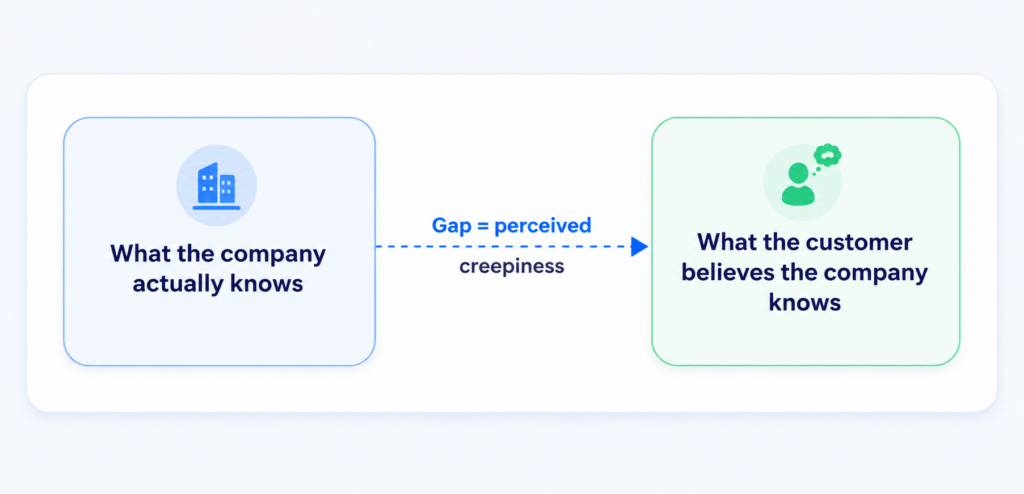
Several factors can make this gap wider or narrower:
- Context: An advertisement for hiking boots after someone has visited a hiking website feels natural and expected. The same advertisement appearing because a company detected that the person was physically at a hiking trail can feel much more intrusive, even if both are technically based on first-party behavioral data.
- Customer expectations: People generally expect retailers to remember their purchases. They may not expect a retailer to infer that they are going through a major life change based on changes in their buying behavior, even if the available data makes that inference possible.
- Transparency: Explaining why a recommendation appears — for example, “Because you viewed X” — can make personalization feel more acceptable. When customers have no idea why they are seeing something, the same recommendation can feel much more intrusive.
- Control: Giving customers an easy way to understand, manage, or adjust how their data is used can significantly change how personalization is perceived. The more control customers have, the more comfortable they are likely to feel.
- Sensitivity: Some types of information are naturally more sensitive than others. Inferences about health, finances, relationships, or other personal circumstances can feel far more intrusive than recommendations based on ordinary product preferences.
- Timing: Even a reasonable recommendation can feel intrusive if it appears at the wrong moment. A customer actively researching a product may welcome a relevant recommendation, while receiving the exact same message when they aren’t thinking about that product at all may feel unexpected.
Treevire Insight: Creepiness is not simply an irrational reaction from customers. It can be a useful signal that a company’s use of data has gone beyond what customers reasonably expect. Closing this gap through greater transparency and customer control is often more effective for building trust than simply trying to make personalization less noticeable.
Should Customers Know Why They Are Seeing Something?
“Recommended because you viewed hiking boots last week” and “You may also like…” deliver the same underlying recommendation, but they are not ethically equivalent. The first respects the customer’s ability to understand and evaluate the system acting on their data. The second asks for blind trust.
| Explained Recommendation | Unexplained Recommendation |
|---|---|
| Trust impact | Generally builds trust over time because customers can understand why a recommendation was shown. |
| Complexity | Requires the system to provide a clear and understandable reason for the recommendation. |
| User experience | Can add extra information to the interface and may become distracting if explanations are shown too often. |
| Regulatory alignment | Better supports transparency and explainability expectations under regulations such as the GDPR and relevant EU AI Act requirements. |
The trade-off is real — not every recommendation needs a full explanation, and over-explaining can clutter an experience as much as under-explaining can erode trust. The practical guidance this report offers: explain personalization proportionally to how surprising or consequential it would be if the customer discovered it without an explanation. A product recommendation from browsing history needs minimal explanation. A denied offer, a price difference, or an inference about a sensitive life circumstance needs a clear, available explanation, even if it isn’t displayed by default.
AI Personalization and Algorithmic Bias
AI personalization systems learn from historical data. That means they can also learn and repeat the biases and inequalities present in that data.
This is one of the most established risks in machine learning, and it applies directly to marketing personalization.
Training Data Bias
If historical marketing data reflects unequal treatment, an AI model can learn and reproduce those patterns.
For example, if a company historically showed premium offers more frequently to certain customer groups, a model trained on that data may continue making similar decisions — even if nobody explicitly tells it to do so.
The model is learning from the past.
If the past contains bias, the model can carry that bias into the future.
Proxy Variables
AI systems don’t necessarily need to use sensitive information directly to produce biased outcomes.
A model may use another variable that is strongly correlated with a protected characteristic.
For example:
- ZIP code may correlate with race or ethnicity.
- Certain purchasing patterns may correlate with gender.
- Neighborhood characteristics may correlate with income.
- Device or behavioral patterns may correlate with demographic characteristics.
The sensitive attribute may never appear directly in the model, yet the outcome can still produce a discriminatory effect.
Demographic and Economic Bias
Predictive models can also unintentionally provide better offers or opportunities to some groups while giving less favorable treatment to others.
For example, if historical data shows that certain income groups generated lower profits, an AI system optimized purely for profitability might reduce the number of premium offers, discounts, or loyalty benefits shown to those customers.
The system may be accurately optimizing for its chosen business objective while still producing an unfair outcome.
This creates an important distinction:
An AI model can be statistically effective and still be ethically problematic.
Geographic Bias
Location can also introduce bias.
A personalization system may use information such as:
- ZIP code
- City
- Neighborhood
- Region
- Store location
These variables can be correlated with demographic and socioeconomic characteristics.
As a result, location-based targeting can unintentionally produce different experiences for different groups, even when the business never explicitly targets those groups.
Gender Bias
Personalization systems can also produce different recommendations, offers, or pricing patterns based on signals that are associated with gender.
The system may not explicitly receive a person’s gender.
Instead, it may infer preferences from browsing behavior, purchasing patterns, product categories, or other signals.
This is an established area of research in algorithmic fairness and should be treated as a real risk when designing personalization systems.
Accessibility Bias
AI systems are often trained on the behavior of large user populations.
This can create problems for people whose interaction patterns differ from the majority.
For example, customers with disabilities may interact with websites, applications, or devices differently from the users represented most heavily in the training data.
A system optimized only for the majority pattern may therefore perform less effectively for these customers.
This can result in poorer recommendations, less relevant experiences, or reduced access to beneficial offers.
Why Algorithmic Bias Matters
The biggest problem is that algorithmic bias can be difficult to see.
A human marketer might consciously decide to treat two customer groups differently.
An AI system can produce a similar outcome without anyone explicitly making that decision.
The system may simply be learning patterns from historical data.
That’s why businesses need to evaluate not only:
“Is the model accurate?”
but also:
“Are the outcomes fair across different groups of customers?”
A model that increases overall conversion by 15% may still require investigation if that improvement comes with significantly worse outcomes for a particular demographic group.
Practical Ways to Reduce Bias
Businesses can take several steps to reduce the risk of biased personalization:
- Audit personalization outcomes regularly across relevant demographic and customer groups, rather than looking only at overall performance.
- Review training data to identify historical patterns that could lead to unfair outcomes.
- Limit the use of protected characteristics and inappropriate proxy variables where they are not necessary for a legitimate purpose.
- Test models across different customer groups before deploying them at scale.
- Monitor outcomes continuously, because bias can emerge or increase as customer behavior and data change.
- Use human review when a personalization system produces materially different outcomes across demographic groups.
- Document important model decisions so teams can understand why a system behaves differently across customer segments.
The goal isn’t necessarily to remove every difference between customer groups. Different customers can legitimately have different needs and preferences.
The goal is to make sure those differences are based on legitimate customer needs and business purposes rather than hidden discrimination or historical bias.
Treevire Insight: AI doesn’t automatically remove human bias from marketing. In many cases, it can scale the patterns already present in historical data. Responsible personalization therefore requires businesses to evaluate not only what their AI predicts, but also who benefits, who is excluded, and whether the resulting customer experience is fair.
Personalization and Vulnerable Customers
Some customers may require stronger protections than the general customer population. This does not mean that personalization for these groups is automatically inappropriate. It means that a marketing technique that may be harmless for one person can have much more serious consequences for someone who is in a vulnerable situation.
Children and Teenagers
Children and teenagers may have less-developed decision-making skills and can be particularly sensitive to social, emotional, and persuasive messaging.
For this reason, they are subject to stronger ethical and regulatory protections in many jurisdictions, including frameworks such as COPPA in the United States and child-related protections under the GDPR and EU AI Act.
Businesses should therefore take extra care when collecting data, profiling younger users, or using personalization to influence their decisions.
Financially Vulnerable Consumers
Customers experiencing financial difficulty may be more susceptible to certain types of marketing.
For example, aggressively promoting high-interest financial products or unnecessary purchases based on signals of financial distress can create significantly greater harm than the same marketing approach directed at a financially secure customer.
The key question should be:
Is the personalization helping the customer meet a genuine need, or is it taking advantage of their financial situation?
People Experiencing Personal Distress
Major life events such as grief, illness, or significant personal disruption can affect how people make decisions.
Using personalization to aggressively target someone during these periods can therefore create serious ethical concerns, even when the system does not explicitly intend to cause harm.
Businesses should be particularly cautious when customer data could reveal highly sensitive circumstances.
People Showing Addictive or Compulsive Behavior Patterns
AI can identify repeated patterns of behavior very effectively.
But that capability creates additional responsibility when those patterns may indicate compulsive behavior.
For example, personalization designed to encourage excessive purchasing, continuous engagement, or other potentially harmful behavior becomes much more concerning when directed at someone who already shows signs of compulsive activity.
In such situations, businesses should prioritize customer protection over additional engagement or revenue.
Other Vulnerable Groups
Additional caution may also be appropriate for groups such as:
- Older customers who may experience cognitive difficulties
- People unfamiliar with local consumer protections
- Customers with certain disabilities
- People with limited digital literacy
- Individuals who may have difficulty understanding complex terms or marketing practices
The appropriate level of protection will depend on the specific context, but the underlying principle remains the same: greater vulnerability should lead to greater care.
Treevire Position: This report does not provide instructions for identifying or targeting vulnerable individuals more precisely. Turning vulnerability signals into targeting strategies could transform a discussion about responsible personalization into a guide for exploitation. The responsible approach is the opposite: when a signal may indicate vulnerability, treat it as a reason for greater caution, additional safeguards, and human review — not as a marketing opportunity. Businesses should consider explicit exclusion and suppression rules so that sensitive vulnerability signals reduce aggressive personalization rather than trigger it.
Personalization in Sensitive Industries
| Industry | Why Standards Should Be Stricter | Example Risk |
|---|---|---|
| Healthcare | Decisions can directly affect physical wellbeing; health data is among the most protected data categories under most privacy law | Personalized health product marketing based on inferred (not disclosed) conditions |
| Finance | Directly affects a person’s financial stability and long-term wellbeing | Personalized credit or loan offers that vary unfairly by inferred risk proxies |
| Insurance | Personalization can directly determine access to and cost of essential protection | Pricing personalization that effectively discriminates via proxy variables |
| Education | Affects a person’s developmental and economic trajectory, often involving minors | Personalized upsells targeting financial-aid-eligible or academically struggling students |
| Employment | Directly affects livelihood and is explicitly named as a high-risk use case under the EU AI Act | Personalized job ad targeting that inadvertently excludes protected groups |
| Politics | Affects democratic participation and is subject to distinct legal and platform-level restrictions in most jurisdictions | Micro-targeted political messaging exploiting emotional or demographic profiling |
| Housing | Directly implicated by fair-housing law in the U.S. and equivalent protections elsewhere | Personalized housing ad targeting that excludes protected classes, even unintentionally via proxy variables |
The common thread: the more consequential the decision a personalization system influences, the less acceptable it is to optimize purely for engagement or conversion, and the more essential explicit fairness testing and human oversight become. A personalized shoe recommendation and a personalized loan offer are not the same category of decision, even though the underlying technology stack may be nearly identical.
The Ethics of Predicting Customer Behavior
Predictive models — churn prediction, purchase prediction, customer lifetime value scoring, creditworthiness assessment, intent prediction, and increasingly emotional inference — are core to modern marketing analytics, and each carries a distinct ethical profile.
| Prediction Type | Legitimate Use | Ethical Risk Point |
|---|---|---|
| Churn prediction | Proactively addressing genuine dissatisfaction | Using churn risk to lock in a customer via pressure rather than genuine value |
| Purchase prediction | Timely, relevant recommendations | Treating a probabilistic forecast as certain, over-personalizing based on thin data |
| Customer lifetime value | Better resource allocation for service and retention | Providing worse service or higher prices to customers predicted to have lower value |
| Creditworthiness | Legitimate risk assessment in lending contexts | Using non-financial behavioral proxies that function as discriminatory shortcuts |
| Intent prediction | Reducing friction for a customer who’s ready to act | Pressuring a customer who was only casually browsing, based on a misread signal |
| Emotional inference | Potentially useful for support prioritization | Using inferred emotional state as a persuasion lever rather than a service-quality signal |
The Ethics of Predicting Customer Behavior
Predictive models — churn prediction, purchase prediction, customer lifetime value scoring, creditworthiness assessment, intent prediction, and increasingly emotional inference — are core to modern marketing analytics, and each carries a distinct ethical profile.
| Prediction Type | Legitimate Use | Ethical Risk Point |
|---|---|---|
| Churn prediction | Proactively addressing genuine dissatisfaction | Using churn risk to lock in a customer via pressure rather than genuine value |
| Purchase prediction | Timely, relevant recommendations | Treating a probabilistic forecast as certain, over-personalizing based on thin data |
| Customer lifetime value | Better resource allocation for service and retention | Providing worse service or higher prices to customers predicted to have lower value |
| Creditworthiness | Legitimate risk assessment in lending contexts | Using non-financial behavioral proxies that function as discriminatory shortcuts |
| Intent prediction | Reducing friction for a customer who’s ready to act | Pressuring a customer who was only casually browsing, based on a misread signal |
| Emotional inference | Potentially useful for support prioritization | Using inferred emotional state as a persuasion lever rather than a service-quality signal |
The Ethics of Predicting Customer Behavior
Predictive models — churn prediction, purchase prediction, customer lifetime value scoring, creditworthiness assessment, intent prediction, and increasingly emotional inference — are core to modern marketing analytics, and each carries a distinct ethical profile.
| Prediction Type | Legitimate Use | Ethical Risk Point |
|---|---|---|
| Churn prediction | Proactively addressing genuine dissatisfaction | Using churn risk to lock in a customer via pressure rather than genuine value |
| Purchase prediction | Timely, relevant recommendations | Treating a probabilistic forecast as certain, over-personalizing based on thin data |
| Customer lifetime value | Better resource allocation for service and retention | Providing worse service or higher prices to customers predicted to have lower value |
| Creditworthiness | Legitimate risk assessment in lending contexts | Using non-financial behavioral proxies that function as discriminatory shortcuts |
| Intent prediction | Reducing friction for a customer who’s ready to act | Pressuring a customer who was only casually browsing, based on a misread signal |
| Emotional inference | Potentially useful for support prioritization | Using inferred emotional state as a persuasion lever rather than a service-quality signal |
The deeper distinction this report wants to draw sharply: there is a real difference between predicting a behavior and defining a person by that prediction. A model that predicts “this customer has an 80% chance of churning this month” is making a probabilistic, revisable forecast. A system that treats that customer as permanently low-value, deprioritizes their service quality, or locks them out of future favorable offers based on that single score has converted a prediction into an identity — a much more consequential and much less defensible move. Predictions should inform action; they should not become a fixed label attached to a person.
Should AI Infer Things Customers Never Told You?
This is, in Treevire’s judgment, the single most consequential question in this entire report, because it’s the one most marketing teams haven’t explicitly confronted.
Modern machine learning doesn’t need a customer to state a preference, an income level, a life circumstance, or an emotional state to infer it with meaningful accuracy. Browsing patterns, purchase timing, device type, and dozens of other seemingly innocuous signals can be combined to produce surprisingly accurate inferences about:
- Preferences and interests the customer never explicitly stated
- Intent — whether someone is close to a purchase decision or just browsing
- Income and purchasing power proxies derived from device, location, and category signals
- Lifestyle and life-stage indicators — inferring a major life change from a shift in purchase categories
- Potential vulnerability — financial distress, health concerns, or emotional state, inferable from behavior patterns even when never disclosed
The central ethical question
Does consent to data collection automatically mean consent to every inference derived from that data?
Treevire’s answer, stated directly: no, and treating it as though it does is the single most common ethical shortcut in AI personalization today. A customer who consents to a company tracking their browsing history to improve product recommendations has not thereby consented to that same data being used to infer their income bracket, their relationship status, or a health condition — even if the inference is technically derivable from data they agreed to share. Consent is supposed to be informed and purpose-specific; an inference the customer never anticipated, used for a purpose they never agreed to, breaks that chain even when no new data was technically collected.
This is precisely the distinction privacy regulators have increasingly focused on. The GDPR’s purpose-limitation principle and the EU AI Act’s profiling provisions both point toward this same conclusion: the legal and ethical unit of analysis isn’t just “what data did you collect,” it’s “what did you do with it, and did the person have a reasonable basis to expect that.”
Responsible Practice: Before deploying any inference — even one technically derivable from already-collected, consented data — ask whether a reasonable customer, told plainly what was being inferred and why, would be surprised or uncomfortable. If the honest answer is yes, that inference needs its own explicit disclosure and, in most cases, its own separate consent — not a blanket justification borrowed from the original data-collection consent.
Generative AI Personalization
Generative AI changes this entire conversation by removing the last remaining bottleneck: production cost. Where personalization once required selecting from a finite set of pre-written variants, generative models can now produce a genuinely unique version of nearly any customer-facing asset — copy, images, video, full landing pages, email sequences, chat conversations, sales pitches, and voice interactions — for each individual, at near-zero marginal cost.
This matters ethically for a specific reason: generative personalization can tailor not just what is shown, but how persuasively it’s framed, on a per-individual basis. A rule-based system might show the same discount to everyone in a segment. A generative system can craft the specific emotional framing, word choice, and narrative structure most likely to persuade this particular person, based on their own historical response patterns — effectively giving every customer a uniquely optimized persuasion attempt, invisible to anyone else, including internal reviewers who only see aggregate patterns rather than every individual output.
This is not inherently manipulative — a uniquely well-crafted, genuinely relevant message is still just good marketing. But it does mean the traditional safeguard of “someone reviewed the creative before it went out” breaks down at scale, because there is no longer one piece of creative to review — there are, in principle, as many versions as there are customers. Governance has to shift from reviewing individual assets to reviewing the system generating them: its constraints, its guardrails, and its outputs sampled and audited on an ongoing basis rather than approved once before launch.
AI Agents and Autonomous Personalization
The next stage beyond generative personalization is agentic personalization — AI systems that don’t just generate content on request, but autonomously decide the full sequence of a personalization strategy: choosing audiences, creating campaigns, changing offers, selecting messages, adjusting timing, running experiments, allocating budget, and optimizing continuously, all with minimal per-decision human involvement.
This is where governance challenges compound rather than simply add up:
- No single decision to review: Traditional oversight assumed a human approved a campaign before launch. An agentic system makes thousands of micro-decisions continuously, making a single-point review model structurally inadequate.
- Emergent behavior: An agent optimizing across audience, offer, and timing simultaneously can discover and exploit a manipulative pattern (like the midnight-vulnerability example in this report’s introduction) without any human explicitly instructing it to.
- Accountability ambiguity: When an autonomous system produces a harmful outcome, the question of who is responsible — the team that set the objective, the team that built the constraints, the vendor that built the underlying model — becomes genuinely harder to answer than in a human-executed campaign.
- Speed outpacing review: An agent that can test and adjust hourly outpaces a governance process built around weekly or monthly review cycles, creating a structural gap between deployment speed and oversight speed.
Ethical Boundary: Treevire’s position is direct: full autonomous execution without defined human checkpoints is not currently appropriate for any personalization decision involving sensitive data, vulnerable populations, or high-consequence outcomes (pricing, credit, health-adjacent content). Agentic capability should expand the scale of what a governed system can do, not replace the governance itself. The framework in the next section is built specifically to operationalize this boundary.
The Treevire Responsible Personalization Framework
Every personalization decision — whether made by a human marketer or an autonomous agent — should be evaluated against ten principles. This is Treevire’s original governance framework, built specifically for the AI personalization era.
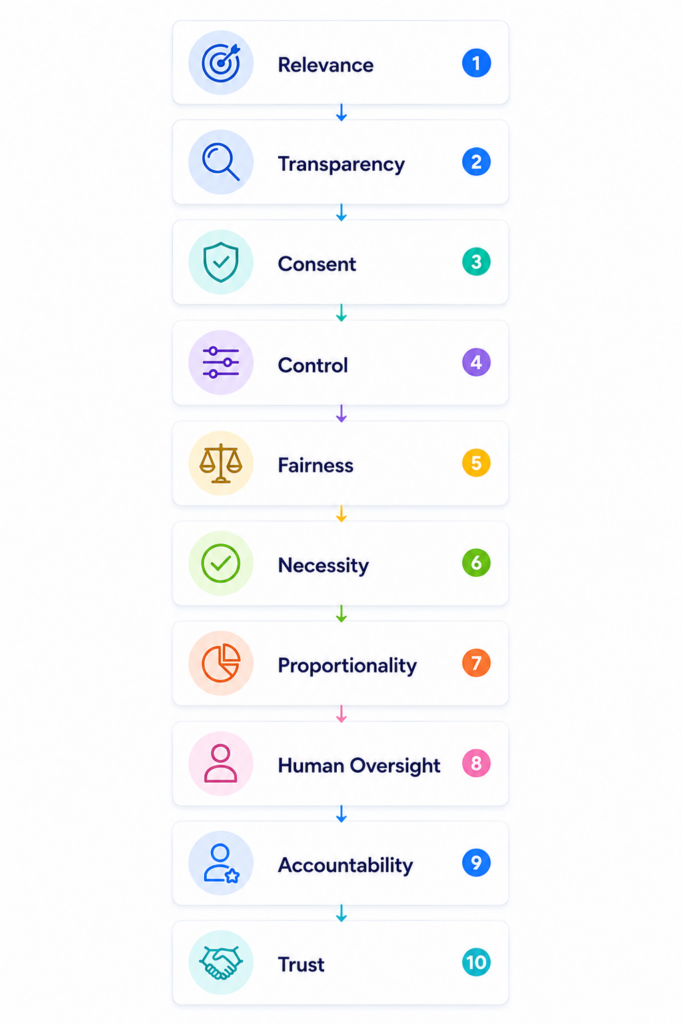
- Relevance — Does this personalization genuinely serve the customer’s interest, not just the company’s conversion metric?
- Transparency — Can the customer see, in plain language, why they’re seeing this if they ask?
- Consent — Did the customer meaningfully agree to this specific use of their data, not just to data collection in general?
- Control — Can the customer adjust or turn off this personalization without disproportionate effort?
- Fairness — Does this personalization produce materially different outcomes across demographic groups without a legitimate, defensible reason?
- Necessity — Is this specific data actually required to deliver the value, or is it collected because it’s available?
- Proportionality — Does the sensitivity of the data and the consequence of the decision match the strength of the safeguards applied?
- Human oversight — Is there a defined checkpoint where a human can review, intervene, or override the system, appropriate to the decision’s stakes?
- Accountability — Is it clear, in advance, who is responsible if this system produces a harmful outcome?
- Trust — Would the company be comfortable if the customer, or a journalist, fully understood how this system works?
Executive Recommendation: Use this framework as a required checklist before launching any new personalization initiative above a defined risk threshold — not as an abstract values statement, but as an operational gate with the same seriousness as a security or legal review.
The Personalization Ethics Test
A practical, scoreable decision tool for evaluating any specific personalization initiative before launch.
| # | Question | Yes (Low Risk) | No (High Risk) |
|---|---|---|---|
| 1 | Would the customer reasonably expect us to know this? | 1 pt | 0 pt |
| 2 | Did the customer meaningfully consent to this specific use? | 1 pt | 0 pt |
| 3 | Is this data necessary for the value being delivered? | 1 pt | 0 pt |
| 4 | Could this personalization plausibly cause harm? | 0 pt (inverted) | 1 pt |
| 5 | Could it unfairly disadvantage any group? | 0 pt (inverted) | 1 pt |
| 6 | Are we targeting a known or plausible vulnerability? | 0 pt (inverted) | 1 pt |
| 7 | Can the customer easily opt out? | 1 pt | 0 pt |
| 8 | Can we clearly explain the recommendation if asked? | 1 pt | 0 pt |
| 9 | Is this an automated decision with real consequence and no human checkpoint? | 0 pt (inverted) | 1 pt |
| 10 | Would we be comfortable publicly explaining exactly how this works? | 1 pt | 0 pt |
Scoring guide:
- 8–10 points: Low risk. Standard review process is sufficient.
- 5–7 points: Moderate risk. Requires a documented privacy and fairness review before launch.
- 0–4 points: High risk. Requires executive, legal, and (where applicable) AI governance sign-off before launch — or should not proceed as designed.
Responsible AI Personalization Governance
A mature personalization governance program includes the following components, each with a clear owner:
- Data governance: Clear rules on what data can be collected, how long it’s retained, and what it can and cannot be used for.
- Model governance: Documentation of what each personalization model was trained on, what it optimizes for, and what constraints are built in.
- Consent management: A centralized system (typically CDP-anchored, as covered in Treevire’s CDP guide) tracking granular consent per data type and use case, not a single blanket opt-in.
- Access controls: Limiting who — human or system — can access sensitive inferred attributes, separate from general customer data access.
- Audit trails: A record of what personalization decisions were made, by which system version, and why — essential for investigating any customer complaint or regulatory inquiry.
- Human oversight: Defined checkpoints scaled to risk level, as established in the Personalization Ethics Test above.
- Bias testing: Regular, structured testing of personalization outcomes across demographic segments, not just aggregate performance.
- Model monitoring: Ongoing observation of live system behavior, since a model’s outputs can drift from its original tested behavior as data and conditions change.
- Privacy reviews: A required step before launching any personalization initiative using new data types or new inference categories.
- Incident management: A defined process for responding when a personalization system produces a harmful or clearly inappropriate outcome — including a rollback capability.
- Documentation: A living record of policy, decisions, and rationale, both for internal accountability and for responding to regulatory inquiries under frameworks like the EU AI Act’s documentation requirements for high-risk systems.
Who Should Be Responsible?
| Role | Responsibility |
|---|---|
| CMO | Owns the business case and ultimate accountability for how personalization is used in market-facing work |
| CTO | Owns the technical infrastructure’s security, reliability, and adherence to governance requirements |
| Chief Data Officer | Owns data quality, data governance policy, and consent infrastructure |
| AI Leader / Head of AI | Owns model-level governance, bias testing, and technical oversight of AI systems specifically |
| Marketing team | Owns day-to-day use of personalization tools within approved policy boundaries |
| Data science team | Owns model design, testing, and the technical implementation of fairness and constraint requirements |
| Legal | Owns regulatory compliance interpretation and risk assessment |
| Compliance | Owns audit processes and documentation of adherence to policy and regulation |
| Product | Owns how personalization surfaces in the actual customer experience and interface |
| Engineering | Owns the technical implementation of consent enforcement, access controls, and audit logging |
Treevire Insight: Ethics cannot be delegated entirely to legal or technical teams, for a simple structural reason: legal teams are optimized to assess regulatory compliance, which is a floor, not a ceiling, and technical teams are optimized to assess whether a system works, not whether it should be built. Only a cross-functional structure — with marketing leadership genuinely at the table, not just informed after the fact — can evaluate whether a personalization initiative is both legal and right. Organizations that route ethics questions solely through legal review consistently produce systems that are compliant and still damaging to trust.
Building an AI Personalization Policy
A practical policy template every organization deploying AI personalization should adapt to its own context:
Allowed personalization: Personalization based on first-party behavioral and transactional data, with clear purpose limitation and available explanation, applied to non-sensitive product and content recommendations.
Restricted personalization: Personalization involving inferred sensitive attributes (health, financial distress, life events) requires explicit additional review and, in most cases, should not be automated without human sign-off.
Prohibited personalization: Personalization exploiting known or inferred vulnerability, using fabricated urgency or scarcity, targeting minors with persuasive commercial content beyond clearly permitted categories, or using protected-class proxy variables for differential treatment.
Sensitive data rules: Define explicitly which data categories (health, financial, biometric, precise location, inferred emotional state) require elevated review before any personalization use.
Consent requirements: Specify that consent must be specific to use case, not blanket; that inference-based uses require their own disclosure; and that consent must be as easy to withdraw as it was to give.
Human review requirements: Define, by risk tier (using the Personalization Ethics Test above), which personalization initiatives require human sign-off before launch and which can proceed under standing policy.
Customer disclosure: Specify what customers are told, by default, about how personalization works, and how they can request a fuller explanation.
Opt-out mechanisms: Require that personalization be genuinely optional wherever legally and technically feasible, with an opt-out that’s real (not a dark pattern) and doesn’t degrade core service quality disproportionately.
Audit requirements: Define the cadence and scope of internal audits for bias, accuracy, and policy adherence across live personalization systems.
Vendor requirements: Any third-party personalization or AI vendor must be contractually required to meet the same standards — governance obligations do not disappear when a capability is outsourced.
Real-World Examples
Real-World Example — Amazon: Amazon’s product recommendation system is one of the most publicly documented large-scale personalization systems in the industry, widely reported to use collaborative filtering based on purchase and browsing history. Customer benefit: genuinely useful product discovery at scale. Ethical consideration raised by researchers and journalists over the years: algorithmic pricing and ranking systems of this scale and complexity raise ongoing questions about transparency and the potential for search-ranking or pricing patterns that aren’t fully visible to regulators or customers — a subject of continued academic and regulatory scrutiny rather than a settled finding of wrongdoing. What businesses can learn: scale and effectiveness in personalization also scale the importance of auditability, since a system operating at Amazon’s scale is functionally difficult for outsiders (and sometimes insiders) to fully verify.
Real-World Example — Netflix: Netflix has publicly discussed its use of machine learning for content recommendations and even per-user thumbnail personalization, aiming to maximize engagement with content the viewer is likely to enjoy. Customer benefit: reduced choice overload in a famously large content library. Ethical consideration: critics and researchers have raised broader questions across the streaming industry about whether engagement-maximizing recommendation systems can inadvertently encourage compulsive viewing patterns — a concern raised about the category of engagement-optimized recommendation systems generally, not a confirmed specific finding about Netflix’s internal intent. What businesses can learn: optimizing purely for engagement time, without any counterbalancing wellbeing consideration, is a pattern worth deliberately designing against, regardless of industry.
Real-World Example — Spotify: Spotify’s personalized playlists (Discover Weekly and similar features) are widely documented as using a mix of collaborative filtering and content analysis. Customer benefit: consistently cited by users and reviewers as a genuinely valued, low-friction discovery feature. Ethical consideration: relatively low compared to other examples in this section — largely because the personalization operates on low-sensitivity data (listening history) toward a low-consequence outcome (music discovery). What businesses can learn: personalization risk correlates strongly with data sensitivity and decision consequence, not personalization sophistication alone — a highly sophisticated system operating on low-stakes data can be genuinely low-risk.
Real-World Example — Target: Target’s statistical pregnancy-prediction model, based on purchase pattern analysis, became a widely reported and widely taught case study in retail analytics after public reporting (notably a well-known 2012 New York Times investigation) described an incident in which the company’s predictive marketing inadvertently revealed a teenage customer’s pregnancy to her family before she had disclosed it herself. Customer benefit (as originally intended): timely, relevant offers around a major life transition. Ethical concern: this is one of the most cited real-world illustrations of the exact risk this report describes in its “Should AI Infer Things Customers Never Told You?” section — a technically accurate inference, derived from consented data, used in a way the customer never anticipated or consented to, with real emotional and relational consequences. What businesses can learn: this remains, over a decade later, the clearest publicly documented cautionary example in the entire personalization industry, and it should still inform how any organization thinks about inferring sensitive life events.
Real-World Example — Meta and Google (advertising ecosystems): Both companies operate large-scale, well-documented ad-targeting infrastructure that has been the subject of extensive regulatory scrutiny (including under GDPR in the EU and FTC inquiries in the U.S.) regarding the granularity of behavioral targeting and, at various points, allegations regarding targeting categories that touched on sensitive inferred characteristics. Customer benefit: genuinely more relevant advertising than untargeted alternatives, by most measures. Ethical consideration: the scale of these platforms means governance failures — even affecting a small percentage of targeting decisions — can affect enormous numbers of people, and both companies have made public, documented changes to targeting policies over time in response to regulatory and public pressure. What businesses can learn: regulatory and public scrutiny of ad-targeting granularity has intensified steadily for a decade and shows no sign of reversing — a business model built on the assumption that granular behavioral targeting will remain lightly regulated indefinitely is building on an increasingly fragile foundation.
Real-World Example — Apple: Apple has positioned on-device processing and limited data sharing (notably its App Tracking Transparency framework) as a core product and marketing differentiator, explicitly contrasting its approach with more data-intensive personalization models used elsewhere in the industry. Customer benefit: meaningfully reduced cross-app tracking exposure for users who opt out. Ethical consideration: this approach has drawn its own criticism — from advertisers over reduced targeting effectiveness, and from some researchers over whether it primarily benefits Apple’s own advertising position relative to competitors. What businesses can learn: privacy-forward positioning can be a genuine, market-tested competitive and brand differentiator, not merely a compliance cost — Apple’s public marketing has treated it as exactly that.
Real-World Example — TikTok: TikTok’s recommendation algorithm is widely reported, including in regulatory and legislative scrutiny across multiple countries, to be highly effective at engagement optimization through granular behavioral signal analysis. Customer benefit: widely cited by users as unusually accurate content discovery. Ethical consideration: the platform has faced sustained public and regulatory scrutiny — including congressional testimony and international regulatory inquiries — regarding whether its engagement optimization is calibrated with sufficient regard for user wellbeing, particularly among younger users. This is an active, contested area of public policy debate, not a settled finding, and readers should treat ongoing regulatory and legislative developments as the most current source. What businesses can learn: engagement-optimized personalization operating on very large, young user populations draws intensified regulatory and public attention specifically because of the “sensitive population” and “consequence” factors emphasized throughout this report.
Real-World Example — Sephora: Sephora’s Beauty Insider loyalty program and in-store/app personalization are frequently cited industry examples of a program built substantially on zero-party and first-party data (stated skin type, stated preferences) rather than purely inferred behavioral signals. Customer benefit: widely regarded by industry analysts as an example of personalization built on genuine, disclosed customer input. Ethical consideration: relatively low compared to more purely inference-driven systems — directly consistent with this report’s repeated point that zero-party data is the ethically cleanest input available to a personalization system. What businesses can learn: investing in explicit, zero-party data collection (asking rather than inferring) is both good ethics and, per this example, compatible with strong commercial performance.
The Business Case for Ethical Personalization
Responsible personalization is not simply a compliance cost — it’s a genuine, defensible competitive strategy, for several converging reasons:
- Customer trust: Trust, once damaged by a personalization misstep gone public, is expensive and slow to rebuild — considerably more expensive than the governance investment that would have prevented it.
- Brand reputation: In an environment of intensifying media and regulatory scrutiny of AI practices, a company with a genuinely defensible personalization policy has a real communications and reputational advantage over one that doesn’t.
- Retention: Customers who feel a company respects their data and autonomy are more likely to remain engaged long-term than customers who feel surveilled or manipulated, even if the latter converts marginally better in the short term.
- Long-term customer value: A trust-preserving personalization strategy compounds over a customer relationship; a trust-eroding one tends to produce diminishing returns as customers become more guarded, use ad blockers, or opt out where possible.
- Regulatory risk reduction: Building governance ahead of enforcement, particularly with the EU AI Act’s transparency obligations now in active enforcement as of August 2026, reduces exposure to fines and forced-remediation costs.
- Customer loyalty: Transparent, controllable personalization is consistently associated in customer research with higher stated trust and willingness to share further data — a virtuous cycle that purely extractive personalization strategies forgo.
- Data quality: Customers who trust how their data is used are more likely to provide accurate, high-quality zero-party data voluntarily — directly improving personalization quality at the source.
- Consent rates: Transparent, clearly-scoped consent requests consistently achieve higher opt-in rates than vague, broad ones, directly expanding the addressable data a company can ethically use.
- Competitive differentiation: As personalization capability commoditizes across the industry, how responsibly a company personalizes becomes one of the few remaining genuine differentiators available.
Treevire Position: The business case for ethical personalization isn’t a values argument layered on top of the commercial argument. In an environment of rising regulatory scrutiny, more sophisticated and skeptical customers, and increasing media attention to AI practices, they are converging into the same argument.
Treevire Responsible Personalization Score™
A practical scoring model for evaluating a personalization initiative across eight weighted dimensions.
| Category | Weight | Scoring Guidance |
|---|---|---|
| Privacy | 15% | Does the initiative use only necessary, appropriately scoped data? |
| Transparency | 15% | Can the logic be explained to a customer in plain language? |
| Fairness | 15% | Have outcomes been tested across demographic segments? |
| Customer Benefit | 15% | Does this genuinely serve the customer, not just the conversion metric? |
| Customer Control | 10% | Can the customer see, adjust, and opt out easily? |
| Risk | 15% | What’s the potential harm if this goes wrong, and how likely is that? |
| Governance | 10% | Is there a documented policy and review process covering this initiative? |
| Human Oversight | 5% | Is there an appropriate human checkpoint given the stakes? |
Sample evaluation — “Predictive win-back email using churn score and generative subject-line personalization”:
| Category | Score (1–5) | Notes |
|---|---|---|
| Privacy | 4 | Uses existing first-party engagement data; no new sensitive collection |
| Transparency | 3 | Underlying churn logic not customer-facing; could add a light explanation |
| Fairness | 3 | Not yet audited across demographic segments — flagged for review |
| Customer Benefit | 4 | Genuinely useful re-engagement offer, not purely extractive |
| Customer Control | 4 | Standard unsubscribe available; churn-specific opt-out not yet built |
| Risk | 4 | Low-to-moderate; primarily reputational if timing feels intrusive |
| Governance | 3 | Covered under general email policy, not a specific reviewed initiative |
| Human Oversight | 3 | Launched under standing policy without individual sign-off |
Weighted score: approximately 3.6 / 5 — moderate-to-good, with clear, specific improvement areas (fairness audit, individual governance sign-off) rather than a fundamental redesign requirement.
Visual suggestion: A radar/spider chart with the eight scoring dimensions as axes, showing the sample evaluation plotted against a target “responsible” baseline. AI image prompt: “clean radar chart infographic, eight labeled axes, two overlapping shaded polygons in teal and gray, minimalist data visualization style, white background.”
Examples: Good vs. Bad Personalization
| # | Good | Bad |
|---|---|---|
| 1 | “Because you viewed hiking shoes, here are three similar products.” | “We know you’re stressed, so buy this now.” |
| 2 | “Recommended based on your recent purchases.” | “You’re probably wealthy enough to afford this.” |
| 3 | “Personalized recommendations — turn them off anytime.” | Hidden personalization with no visible control. |
| 4 | A visible “why am I seeing this?” link on personalized ads. | No explanation offered, even on request. |
| 5 | A genuine limited-time discount with an accurate expiration. | A countdown timer that resets when the page reloads. |
| 6 | “You often reorder this — want us to remind you next month?” | Automatically re-billing based on inferred habit without clear consent. |
| 7 | Send-time optimization based on when a customer typically opens email. | Send-time optimization deliberately targeting a customer’s known late-night, low-willpower browsing window. |
| 8 | A support agent seeing relevant order history to resolve an issue faster. | A support agent referencing inferred private details the customer never disclosed. |
| 9 | Offering a loyalty discount to a long-tenured customer. | Charging a long-tenured, price-insensitive customer more than a new one, based on inferred loyalty. |
| 10 | A clear preference center letting customers state what they want to see more or less of. | A one-way “personalization” toggle that’s technically present but buried three menus deep. |
| 11 | Recommending a smaller size based on past return patterns. | Inferring and acting on a health or body-image-sensitive attribute without disclosure. |
| 12 | A win-back email genuinely offering improved value. | A win-back email fabricating scarcity (“only for the next hour”) with no real basis. |
| 13 | Suggesting a product bundle based on what similar customers bought together. | Suggesting a bundle specifically because a customer’s profile suggests reduced price sensitivity. |
| 14 | Personalized onboarding content based on a stated role or goal. | Personalized content based on an inferred vulnerability disclosed nowhere by the customer. |
| 15 | A clearly labeled “sponsored” or “recommended” placement. | A personalized placement designed to be indistinguishable from organic content. |
| 16 | Asking directly what a customer is shopping for (zero-party data). | Silently inferring the same information from cross-device tracking without disclosure. |
| 17 | A opt-out that immediately and fully takes effect. | An opt-out that reduces but doesn’t eliminate the targeted behavior, without saying so. |
| 18 | Personalizing content recommendations for an adult account. | Applying the same persuasive personalization techniques to a known minor’s account. |
| 19 | A pricing page that’s the same for everyone, personalized only in which plan is highlighted based on stated needs. | Dynamic, individualized pricing based on inferred willingness to pay, without disclosure. |
| 20 | An AI chat assistant that discloses it’s AI and explains its recommendation logic when asked. | An AI chat assistant designed to be indistinguishable from a human, deployed for persuasive sales conversations. |
How Marketing Teams Should Implement Ethical AI Personalization
- Identify the use case. Define specifically what the personalization initiative is meant to accomplish and for whom.
- Identify the data. Map exactly what data — collected and inferred — the initiative would use.
- Assess risk. Run the initiative through the Personalization Ethics Test earlier in this report.
- Define consent. Determine whether existing consent covers this specific use, or whether new, specific consent is required.
- Define boundaries. Set explicit rules for what the system will not do — sensitive inferences, vulnerable-population targeting, fabricated urgency — before building it.
- Test for bias. Evaluate projected or pilot outcomes across demographic segments before full launch.
- Conduct a privacy review. Involve legal and data governance teams before launch, not after a complaint.
- Add human oversight. Define the specific checkpoint appropriate to the initiative’s risk tier.
- Launch gradually. Roll out to a limited audience first, with monitoring in place, rather than full-scale immediately.
- Monitor. Track not just conversion performance but the fairness, complaint, and opt-out metrics defined during the risk assessment.
- Audit. Conduct scheduled reviews, not just reactive ones triggered by a complaint.
- Improve. Feed audit findings back into the system’s constraints and the organization’s broader policy — treating this as a continuous discipline, not a one-time launch checklist.
Future of Ethical AI Personalization
| Trend | Likelihood Through 2030–2035 |
|---|---|
| AI agents managing full personalization workflows autonomously | Likely — already emerging in 2026, per this report’s companion “future of marketing teams” analysis |
| Emotion AI (inferring emotional state from voice, text, or behavior) in mainstream marketing use | Possible, contested — technically advancing quickly, but facing significant regulatory headwinds, including explicit restrictions in the EU AI Act on emotion recognition in certain contexts |
| Predictive commerce (AI initiating purchases on a customer’s behalf, within set rules) | Possible — early forms exist in subscription and replenishment models; full autonomous purchasing remains limited and trust-dependent |
| Customer digital twins (continuously updated predictive models of individual customers) | Likely, directionally — a natural extension of current CDP and predictive-modeling trends, per Treevire’s CDP guide |
| Ambient computing and wearable AI enabling continuous, passive personalization | Possible — technically plausible, but dependent on consumer adoption of always-on data-sharing devices at greater scale than currently seen |
| Personal AI agents negotiating with company AI agents on a customer’s behalf | Speculative — a genuinely interesting emerging idea, discussed by researchers and technologists, but with no clear current commercial deployment at scale |
| Voice assistants as a primary personalization interface | Possible — growing steadily, but still a secondary channel relative to visual/app interfaces for most personalization use cases |
| Autonomous commerce (AI agents completing full transactions with minimal human involvement) | Possible, longer horizon — meaningful current momentum, but trust, liability, and regulatory frameworks remain underdeveloped relative to the technical capability |
Treevire Insight: The clearest throughline across every item in this table: the more autonomous and ambient personalization becomes, the more essential explicit consent and visible control become — precisely the opposite of where unconstrained technical development naturally tends to go. This is the central governance challenge for the next decade of this field, not a solved problem.
Where Should Marketers Draw the Line?
This report has deliberately avoided offering a single bright-line rule, because none exists that holds up across every industry, data type, and customer relationship. What it offers instead is a clear, defensible principle:
Treevire Position: Personalization should become more transparent and more controlled as it becomes more powerful. The more sensitive the data involved and the more consequential the decision it informs, the stronger the safeguards should be. This is not a static line — it’s a sliding scale that should move in lockstep with capability.
In practical terms, this means:
- Basic personalization (Level 1–2 on this report’s spectrum) can operate under lightweight, standing governance.
- Predictive and contextual personalization (Level 3–4) should require documented fairness testing and a visible explanation mechanism.
- Hyper-personalization and agentic personalization (Level 5–6) should require explicit, specific consent; active human oversight at meaningful checkpoints; and ongoing, not one-time, bias and outcome auditing.
- Any personalization touching sensitive industries, inferred vulnerability, or protected characteristics — regardless of which level it technically sits at — should be treated as high-risk by default, not by exception.
This principle scales with the technology rather than trying to freeze it in place, which is the only approach realistic for a field advancing this quickly. It also gives marketing leaders something more useful than a fixed rulebook: a repeatable way to reason about the next capability, tool, or use case that doesn’t yet exist but will within the next planning cycle.
Key Takeaways
- AI personalization exists on a spectrum from basic to agentic, and ethical risk rises with each level — not because of data volume alone, but because each level removes a checkpoint that used to catch mistakes.
- Manipulative personalization is frequently not a deliberate choice — it’s the predictable output of an optimization system given a single metric and no constraints.
- Consent to data collection does not automatically extend to every inference that data makes possible; treating it as though it does is the most common ethical shortcut in the industry today.
- The “creepiness gap” — between what a company knows and what a customer believes it knows — is a reliable signal of where transparency is falling short, not an irrational customer overreaction.
- Regulation has moved decisively toward requiring transparency and fairness in AI-driven personalization, with the EU AI Act’s transparency obligations now in active enforcement as of August 2026.
- Bias in personalization is a well-documented, empirically established risk, not a hypothetical one — proxy variables can produce discriminatory outcomes without ever using a protected attribute directly.
- Vulnerable populations and sensitive industries warrant categorically stronger safeguards, not just marginally stronger ones.
- Generative and agentic AI remove the traditional safeguard of reviewing individual creative before launch, requiring governance to shift toward reviewing systems and constraints rather than individual outputs.
- Ethical personalization is not primarily a legal or technical responsibility — it requires genuine cross-functional ownership, with marketing leadership at the table.
- Responsible personalization is an increasingly real competitive advantage, not merely a compliance cost, as customer skepticism and regulatory scrutiny both intensify.
- There’s no single fixed ethical line — the right approach is a sliding scale where safeguards scale directly with data sensitivity and decision consequence.
1. Is AI personalization ethical?
It can be, and often is, when it uses data a customer would reasonably expect the company to have, is transparent about its logic, and leaves genuine room for the customer to see and control it. It becomes ethically problematic specifically when it relies on unexpected inference, exploits vulnerability, or removes meaningful choice — not simply because AI is involved.
2. Is personalized advertising invasive?
It depends heavily on the gap between what data is used and what the customer expects — the “creepiness gap” described in this report. Personalization based on clearly expected data (browsing history on the same site) is generally not perceived as invasive; personalization based on unexpected cross-context inference often is.
3. What is ethical personalization?
Personalization that is relevant, transparent, consented to for its specific use, controllable by the customer, tested for fairness, and proportionate to the sensitivity of the data and consequence of the decision involved.
4. What data should marketers never use for personalization?
As a strong default: inferred health conditions, inferred financial distress, and any data specifically indicating a vulnerable psychological or emotional state should not be used to drive persuasive marketing, regardless of how it was derived.
5. Can AI personalization be manipulative?
Yes — and frequently without deliberate intent, since an optimization system trained purely on a conversion metric will tend to discover manipulative patterns (fabricated urgency, vulnerability targeting) as a side effect of pursuing that metric, unless explicitly constrained against it.
6. How does GDPR affect personalization?
GDPR requires a valid legal basis for processing personal data used in profiling, generally requires purpose limitation (data used only for the purpose it was collected for), and gives individuals rights to access, object to, and in some cases obtain an explanation of automated decisions that significantly affect them.
7. What is the difference between personalization and manipulation?
Personalization uses data to make an experience more relevant; manipulation exploits psychological vulnerability, fabricates urgency, or conceals information specifically to bypass a person’s rational decision-making rather than appeal to it.
8. How can companies build responsible AI personalization?
By adopting a structured framework (like the Treevire Responsible Personalization Framework™ in this report), scoring initiatives against risk before launch, and building cross-functional governance rather than delegating the question entirely to legal or technical teams.
9. Should customers be told when AI is personalizing content?
Yes, at least at a general level — and for higher-stakes or more surprising personalization, a specific, accessible explanation should be available even if not displayed by default.
10. Does the EU AI Act regulate marketing personalization?
Yes, indirectly and increasingly directly — profiling-based AI systems can fall under the Act’s high-risk framework depending on context, and general transparency obligations for AI systems are in active enforcement as of August 2026, even as the heaviest high-risk-specific obligations have been deferred to December 2027.
11. Is it ethical to predict when a customer might churn?
Generally yes, when the prediction is used to genuinely improve service or offer real value — it becomes ethically questionable when the prediction is used to pressure or manipulate rather than to serve.
12. What is the “creepiness gap”?
The difference between what a company actually knows about a customer and what the customer believes the company knows — a wider gap generally predicts a stronger negative reaction to personalization, even when the underlying data use is technically permitted.
13. Should companies infer sensitive information even if it’s technically possible?
This report’s position is no, not without explicit, purpose-specific disclosure and consent — technical derivability from already-collected data does not, on its own, make an inference ethically or legally justified.
14. What industries should have the strictest personalization standards?
Healthcare, finance, insurance, education, employment, politics, and housing — industries where personalization decisions can materially affect access to essential services, opportunities, or rights.
15. Can algorithms discriminate without using protected characteristics directly?
Yes — proxy variables correlated with protected characteristics (zip code, certain purchase categories, browsing patterns) can produce discriminatory outcomes even when the model never explicitly uses race, gender, or similar attributes.
16. What is agentic personalization?
AI systems that autonomously make and execute personalization decisions — audience selection, offer, timing, messaging — across multiple steps with minimal per-decision human review, as opposed to a human approving each individual campaign.
17. How should companies handle personalization for children?
With categorically stronger safeguards than for adults, consistent with regulations like COPPA and child-specific provisions in frameworks like the EU AI Act and GDPR — persuasive, engagement-optimized personalization techniques appropriate for adults are generally not appropriate for minors.
18. Is dynamic, individualized pricing ethical?
It’s one of the more contested areas in this field — pricing personalization based on legitimate factors (loyalty, volume) is broadly accepted, while pricing based on inferred willingness-to-pay or ability-to-pay raises significant fairness concerns and is increasingly scrutinized by regulators.
19. What’s the risk of generative AI in personalization specifically?
Generative AI can produce a uniquely persuasive version of an asset for every individual customer, which breaks the traditional safeguard of reviewing a finite set of creative before launch — governance has to shift to reviewing the generating system itself, not each output.
20. How can a company test its personalization for bias?
By regularly comparing outcomes (conversion rates, offer values, pricing) across demographic segments, not just aggregate performance, and investigating any material disparity for a legitimate, non-discriminatory explanation.
21. What should a company do if it discovers its personalization system is causing harm?
Follow a defined incident management process: pause or roll back the system, investigate root cause, document findings, and adjust the underlying constraints — treating it as a governance failure to learn from, not just a single bad output to patch.
22. Is personalization based on location data more sensitive than other behavioral data?
Generally yes — location data can reveal home, work, and routine with unusual precision and is treated as a more sensitive data category under most privacy regulation.
23. Can a company be ethical and still use AI personalization aggressively?
Yes, if “aggressive” refers to sophistication and effectiveness rather than to exploiting vulnerability or removing genuine choice — this report explicitly does not equate technical sophistication with ethical risk; the two are related but distinct.
24. What’s the single most important step a marketing team can take toward ethical personalization?
Building genuine cross-functional review (not just legal sign-off) into the launch process for any new personalization initiative above a defined risk threshold, using a structured tool like the Personalization Ethics Test in this report.
25. How does zero-party data reduce ethical risk?
Because it’s explicitly and voluntarily provided by the customer for a stated purpose, it avoids the core ethical problem of unconsented inference described throughout this report — the customer told you, rather than you deducing it.
26. Should AI-generated marketing content disclose that it’s AI-generated?
Increasingly, yes, both as good practice and as an emerging regulatory expectation — the EU AI Act’s transparency obligations specifically address disclosure when a person is interacting with an AI system.