

Starbucks Deep Brew
The business challenge: Starbucks wanted to give millions of customers a more personalized experience across thousands of stores without losing the human, handcrafted experience that defines the brand. At the same time, it had to manage the enormous operational complexity that comes with running stores around the world, including staffing, inventory, and equipment.
The AI solution: Starbucks developed Deep Brew, its own AI and machine learning platform, which launched in 2019 and runs on Microsoft Azure. The platform helps personalize recommendations in the Starbucks app and supports areas such as labor and inventory forecasting. By 2025, Starbucks had also started using generative AI to support employees through a tool called Green Dot Assist.
The technology: Deep Brew uses machine learning for recommendations, predictive analytics for forecasting, and connected equipment monitoring through technologies such as Azure Sphere. More recently, Starbucks has also been using generative AI through Azure OpenAI.
The results: Starbucks Rewards had reached 35.8 million active U.S. members over a 90-day period by fiscal Q3 2026. These members accounted for roughly 59–60% of revenue from Starbucks’ company-operated U.S. stores. This growth came alongside continued comparable-sales improvement as part of Starbucks’ broader “Back to Starbucks” turnaround strategy.
The key lessons: Starbucks’ experience shows that personalization at this scale starts with strong data infrastructure. The AI models matter, but they are only one part of the equation. Operational AI can also make customer-facing AI more valuable by improving areas such as staffing, inventory, and equipment management. And despite its extensive use of AI, Starbucks continues to position the technology as something that helps employees rather than simply replacing them.
Confirmed vs. Analysis: Throughout this article, we clearly separate publicly confirmed information from our own analysis. When Starbucks, Microsoft, or verified financial disclosures have provided specific information, we identify it as such. When a technical detail has not been publicly disclosed — such as the exact model architecture or algorithms Deep Brew uses — we don’t present assumptions as facts. There are also third-party articles that claim specific Deep Brew products or ROI figures that we could not verify through primary Starbucks or Microsoft sources. Those figures have therefore been left out.
Introduction
Personalization becomes much harder when a business gets really big.
A barista at a small coffee shop might remember your usual order, recognize you when you walk in, and even know how you like your drink. That personal connection is easy to create when you have a small number of customers and locations.
But Starbucks operates more than 40,000 stores across roughly 80 markets. At that scale, people alone can’t provide the same level of personalized service to every customer.
Technology has to help.
Customer expectations have also changed. Mobile ordering, loyalty programs, and recommendation systems from companies such as Amazon and Netflix have changed what people expect from digital experiences. A generic discount or the same notification sent to everyone doesn’t feel very personalized anymore.
Starbucks started building toward this long before AI personalization became a popular business term. Its loyalty and mobile app launched in 2011, giving the company years of customer purchase and behavior data that it could eventually use to create more personalized experiences.
In 2019, Starbucks brought much of this thinking together through Deep Brew, its proprietary AI and machine learning platform.
The basic idea was fairly simple: Starbucks was already generating enormous amounts of information from customer purchases, locations, ordering patterns, timing, and loyalty activity. Instead of simply storing that information, the company could use it to predict what customers might want and make better decisions across the business.
This case study looks at what is publicly known about Deep Brew, what can reasonably be understood from Starbucks’ own disclosures and Microsoft’s public information about their partnership, and what other businesses can learn from Starbucks’ approach to building AI capabilities over time.
Company Background
Starbucks is a global coffee company with three main parts to its business: company-operated stores, licensed stores, and a channel development business that includes packaged and ready-to-drink products sold through retail partners.
The company has traditionally positioned itself as an “accessible premium” brand. Its products generally cost more than those of many quick-service coffee competitors, but Starbucks has built its brand around making the coffeehouse experience part of people’s everyday routines rather than presenting it as a luxury.
The digital ecosystem
The Starbucks mobile app has become one of the company’s most important digital touchpoints.
Customers can use it to:
- Order ahead
- Pay digitally
- Manage their Starbucks Card
- Participate in Starbucks Rewards
- Receive personalized offers and recommendations
The app and loyalty program have also given Starbucks a long history of customer data.
Since the program began in 2011, the company has been able to build years of information about how customers purchase, when they visit, what they order, and how their behavior changes over time.
That information became an important foundation for the company’s later AI initiatives.
Starbucks Rewards
Starbucks Rewards is a major part of the company’s customer relationship strategy.
In fiscal Q3 2026, Starbucks reported 35.8 million 90-day active U.S. Rewards members. The company also reported that customer affinity and Rewards engagement had reached five-year highs.
Industry analysis of Starbucks’ disclosures has estimated that Rewards members account for roughly 59–60% of revenue from U.S. company-operated stores. Those figures should be treated as approximate because they come from a combination of Starbucks disclosures and third-party analysis rather than one single company statement.
Starbucks’ scale
At the end of fiscal Q3 2026, Starbucks reported 18,371 coffeehouses in North America and 22,933 international coffeehouses.
The company also made a major change to its China business in March 2026, moving its roughly 8,000 China retail stores into a licensed joint venture with Boyu Capital. This changed how Starbucks accounts for that market financially.
The competitive environment
Starbucks competes with large quick-service chains such as Dunkin’ and McDonald’s McCafé, along with independent coffee shops, regional chains, and increasingly, at-home and delivery-based coffee options.
At Starbucks’ scale, personalization and customer loyalty can be important differentiators.
A competitor can copy a drink.
It can match a price.
It can launch a similar promotion.
But building a long-term relationship with millions of customers and understanding their individual preferences is much harder.
That’s where Starbucks’ data and digital ecosystem become strategically important.
The Business Problem
Deep Brew didn’t come from a single problem.
Starbucks was dealing with several connected challenges at the same time, and solving one without addressing the others wouldn’t have been enough.
Personalization at scale
Starbucks wanted to recommend the right products and offers to individual customers.
But millions of customers have different tastes, routines, locations, and purchasing habits.
A marketing team can’t manually figure out what every customer is likely to want.
A system has to do it.
Keeping loyalty valuable
A loyalty program becomes less useful if every customer receives the same generic offer.
If customers feel that Starbucks doesn’t understand their preferences, the program becomes little more than a digital discount card.
Personalization gives the loyalty program more value by making the experience feel more relevant to each individual customer.
Keeping customers coming back
Coffee is a category where switching costs are relatively low.
A customer can easily choose another coffee shop tomorrow.
That means Starbucks has to give customers reasons to keep returning, and a more relevant experience can be one part of that relationship.
Store operations
There’s another side to the problem that is easy to overlook.
Personalization doesn’t matter much if the store experience doesn’t work.
A customer might receive the perfect recommendation, but if the store is understaffed, an order takes too long, or a key ingredient isn’t available, the experience still fails.
That means staffing, equipment, inventory, and order flow are closely connected to the customer experience.
Forecasting and inventory
Starbucks operates stores in very different locations, and demand can change depending on weather, local events, seasons, holidays, and customer habits.
Trying to predict demand manually across tens of thousands of stores is extremely difficult.
Better forecasting can help stores have the right products available while reducing unnecessary waste and stockouts.
Making better recommendations
Starbucks also has an unusually complicated menu.
Customers can customize drinks in thousands of different ways.
Recommending what someone is likely to order isn’t simply a matter of saying:
“People who bought this also bought that.”
The system needs to consider the customer’s previous behavior, the time of day, location, weather, recent purchases, and other contextual signals.
Managing all of this globally
And finally, none of these problems exists in isolation.
Starbucks operates across dozens of markets with different languages, menus, regulations, customer preferences, and operating environments.
Any system designed to support the business has to work within that complexity.
Treevire Insight: Many companies approach AI personalization by focusing almost entirely on the customer-facing side — recommendations, offers, and marketing messages. Starbucks’ approach is more interesting because the customer experience is connected to the operational side as well. A great recommendation doesn’t mean much if the store can’t deliver it efficiently.
The Business Problem
Before Deep Brew, Starbucks was dealing with several connected problems that couldn’t be solved by one team alone:
- Personalization at scale. Starbucks needed to recommend the right products to millions of customers, each with different preferences, habits, and local circumstances. A marketing team couldn’t do that manually. The company needed a system that could continuously analyze customer behavior and context.
- Loyalty engagement. A loyalty program only becomes more valuable when customers feel that it actually understands them. If everyone receives the same generic offers, the experience quickly becomes less useful.
- Customer retention. Switching from one coffee shop to another is easy. Starbucks therefore needed to make each customer visit feel relevant and give people a reason to keep coming back.
- Store operations. The customer experience isn’t just about the offer someone receives. Staffing, equipment, and order times also matter. A perfectly personalized offer doesn’t help much if the store is understaffed or the product isn’t available when the customer arrives.
- Forecasting and inventory. Starbucks has thousands of stores, and each location has its own demand patterns. Weather, local events, seasons, and customer habits can all affect what people order. Managing inventory manually at that scale could lead to waste or products being unavailable when customers want them.
- Order recommendations. Starbucks has a huge number of drink combinations and customizations. Figuring out which product or customization a particular customer is most likely to want is much more complicated than following a few simple rules.
- Operational complexity. All of these challenges had to be managed across nearly 80 markets, each with different languages, menus, regulations, and customer behaviors.
Treevire Insight: Many companies focus on the customer-facing side of AI personalization, such as recommendations and offers, while paying less attention to the operations behind them. Starbucks took a broader approach with Deep Brew, connecting personalization with the operational side of the business. After all, a great recommendation doesn’t mean much if the store is understaffed or the product isn’t available.
What Is Deep Brew?
Confirmed: Deep Brew is Starbucks’ own artificial intelligence and machine learning platform. It was launched in 2019 and built on Microsoft Azure. Starbucks and Microsoft have publicly described Deep Brew as the technology behind personalized recommendations in the Starbucks app.
These recommendations can take several things into account, including:
- What the customer has ordered before
- What’s popular at a particular store
- What products are currently available
- The weather
- The time of day
- Preferences within the local community
When Microsoft originally reported on Deep Brew, the system was already serving recommendations to around 16 million active Starbucks Rewards members. That number reflected the size of the Rewards program at the time and has since grown considerably.
Deep Brew is also being used to help employees
Confirmed: Starbucks expanded its use of AI in 2025 with Green Dot Assist, a generative AI assistant designed for baristas.
Instead of having employees search through manuals to find answers, Green Dot Assist allows them to ask questions directly on in-store iPads and receive quick, conversational answers.
The system initially launched as a pilot in 35 coffeehouses. Starbucks confirmed plans for a broader rollout across the U.S. and Canada during fiscal 2026. Multiple sources have also reported that the tool is built using Microsoft Azure’s OpenAI technology.
Deep Brew goes beyond recommendations
Industry consensus / reasonable inference: Deep Brew is commonly described as doing more than simply recommending drinks and food.
Industry reporting, Microsoft’s case-study material, and retail technology coverage have connected Starbucks’ AI efforts with areas such as:
- Labor scheduling
- Inventory and demand forecasting
- Predictive maintenance for connected equipment
These applications have been reported across several independent sources, including Microsoft’s Azure Sphere announcements and retail technology publications, as well as Starbucks’ own public comments about automation and forecasting.
However, Starbucks has not publicly released a complete technical explanation of Deep Brew’s internal architecture. So while these applications are consistently reported, the exact way they are built and connected within Deep Brew isn’t fully public.
What isn’t confirmed
There are several third-party articles and marketing materials that attribute specific product names, ROI percentages, and cost savings to Deep Brew.
Some of those claims cannot be traced back to Starbucks, Microsoft, or official investor-relations sources.
Because those numbers cannot be independently verified through primary sources, this case study does not treat them as confirmed facts.
How Deep Brew Works
Starbucks has not published a full technical architecture diagram for Deep Brew. The flow below represents a reasonable, industry-standard interpretation of how a system with Deep Brew’s confirmed capabilities would need to be structured — not a confirmed internal blueprint
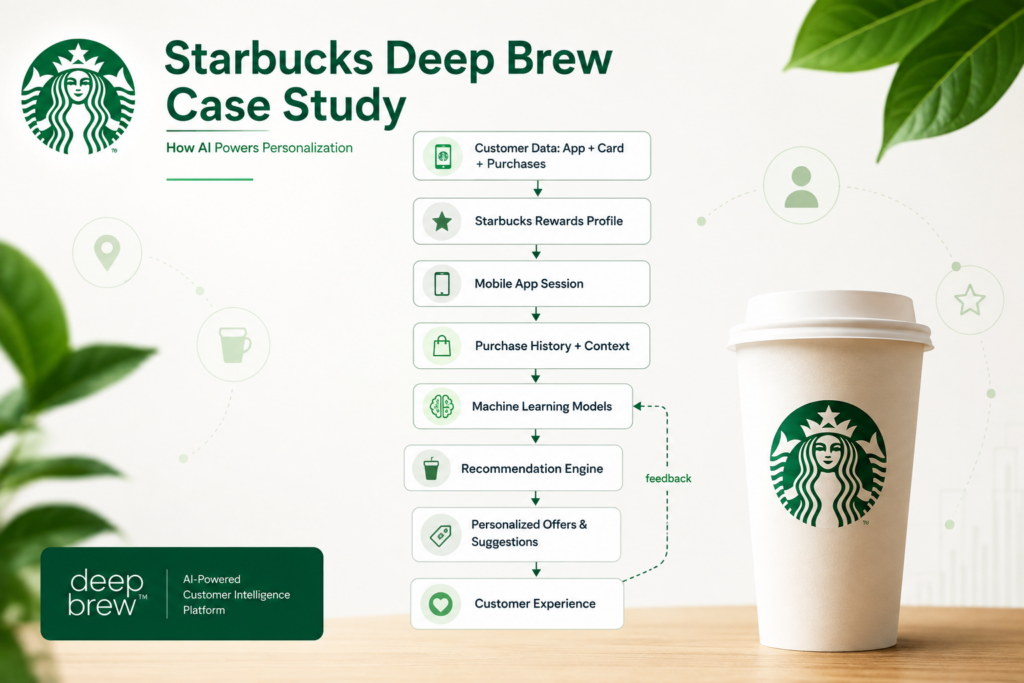
Customer data enters the system through the Starbucks app, Starbucks Card transactions, and in-store purchases connected to a Rewards account.
Rewards profile brings that information together across different channels — such as mobile ordering, drive-thru, and in-store purchases — to create a more complete picture of each customer.
Mobile app session data adds information about what is happening right now. This can include when someone opens the app, where they are, and what they are looking at.
Purchase history and context combine what Starbucks already knows about a customer’s past orders with factors such as the weather, time of day, and what is available at the customer’s local store — factors Starbucks has publicly identified as inputs to its recommendations.
Machine learning models then analyze these different signals to estimate what a customer might be interested in at a particular moment. This is consistent with Microsoft’s public descriptions of Starbucks using machine learning and reinforcement learning techniques on Azure, although Starbucks has not publicly explained the exact models or architecture behind Deep Brew.
Recommendation engine takes those predictions and turns them into something the customer can actually see, such as a drink recommendation, food pairing, or promotional offer.
Personalized offers are then shown through the Starbucks app. Starbucks has also indicated that personalization is expanding into other parts of the ordering experience, including in-store and drive-thru interactions.
Feedback loop: What happens after a recommendation is made can provide another useful signal. If a customer accepts it, changes it, or ignores it, that behavior can potentially be used to improve future recommendations. This kind of feedback loop is common in recommendation systems, although Starbucks has not publicly explained exactly how often its models are retrained or how this process works internally.
Data Used
| Data Source | Status | Why It Matters |
|---|---|---|
| Purchase History | Confirmed input | Shows what an individual customer has bought and helps reveal their preferences and buying habits. |
| Rewards Data | Confirmed | Helps connect customer activity across different visits and ordering channels. |
| Time of Day | Confirmed input | What customers want can change depending on whether they’re ordering in the morning, afternoon, or evening. |
| Store Location | Confirmed through inventory context | Helps account for differences in product availability and customer preferences from one location to another. |
| Seasonality | Industry consensus | Seasonal patterns can affect which products and offers are likely to be relevant. |
| Weather | Confirmed input | Starbucks and Microsoft have specifically identified weather as a factor used in recommendations. |
| Customer Preferences | Confirmed | Previous orders and stated preferences provide direct information about what a customer tends to like. |
| Behavioral Signals | Industry consensus | App activity, browsing, and engagement can provide additional clues about customer interests. |
| Order Frequency | Reasoned inference | How often someone orders can be useful for understanding customer behavior and engagement at this scale. |
| Contextual Information | Confirmed through community preferences | Local customer preferences and popularity patterns can help make recommendations more relevant to a particular area. |
Treevire Insight: One of the easiest signals to overlook is also one of the simplest: time of day. Starbucks has specifically identified it as a factor in its recommendations. Businesses already collect this information every time a transaction happens, yet many don’t make meaningful use of it.
AI Technologies
Starbucks uses several different AI and machine learning technologies as part of its broader approach to personalization and operations. Some are publicly confirmed by Starbucks or Microsoft, while others are based on common industry practices and should be treated as informed inference rather than confirmed details.
| Technology | Status | What it does |
|---|---|---|
| Machine Learning | Confirmed | Serves as a core part of the technology behind personalized recommendations. |
| Recommendation Systems | Confirmed | Suggests products and offers to customers through the Starbucks app. |
| Predictive Analytics | Industry consensus | Used to help understand demand and support areas such as inventory forecasting. |
| Reinforcement Learning | Confirmed through Microsoft documentation | Uses feedback from outcomes to help improve recommendation quality over time. |
| Customer Segmentation | Reasoned inference | Helps group customers based on their behavior and characteristics so offers can be more relevant. |
| Forecasting Models | Industry consensus | Used to support areas such as labor planning and inventory management. |
| Natural Language AI | Confirmed through Green Dot Assist | Allows employees to ask questions and receive conversational answers. |
| Generative AI | Confirmed through Green Dot Assist in 2025 | Powers the AI assistant built using Azure OpenAI technology. |
Green Dot Assist is a different kind of AI
Green Dot Assist represents a different stage of Starbucks’ AI development compared with the original Deep Brew recommendation system.
The earlier system is mainly predictive. It looks at available information and tries to estimate what a customer might want.
Green Dot Assist is generative and conversational. Instead of predicting an outcome, it can respond to an employee’s question in natural language.
Starbucks’ Chief Technology Officer has described the purpose of the tool as making store operations easier and giving partners more time to focus on preparing beverages and interacting with customers.
The goal is therefore to help employees do their jobs more effectively, rather than simply replace them.
Customer Personalization
Personalization is one of the most visible ways Starbucks uses its customer data and AI capabilities.
Offers
Starbucks can provide personalized promotional offers through its Rewards program based on information such as previous purchases and customer engagement.
The basic idea is simple:
If Starbucks understands what a customer tends to buy, it can make offers more relevant to that customer.
Drink recommendations
The Starbucks app can recommend drinks and food based on several contextual signals.
Starbucks has publicly identified factors such as:
- Previous orders
- Weather
- Time of day
- Local store inventory
- Popular choices within the local community
This allows recommendations to be more specific than simply showing the same products to everyone.
Rewards structure
In 2026, Starbucks changed its Rewards program to include three tiers: Green, Gold, and Reserve.
Each tier has different benefits and Star-earning rates.
This represents a move toward a more structured loyalty experience, where customer rewards and benefits can vary based on their level of engagement.
Seasonal campaigns
Starbucks regularly introduces limited-time and seasonal products.
Demand forecasting can help support these campaigns by helping the company understand how much product stores may need and when demand is likely to increase.
This is an industry-consensus application rather than something Starbucks has publicly explained in complete technical detail.
App experience
Personalization isn’t limited to marketing messages.
Recommendations can appear directly within the ordering experience, meaning customers encounter personalized suggestions while they’re actually deciding what to buy.
That’s an important distinction.
Instead of simply sending someone an advertisement and hoping they return later, personalization can happen at the moment of purchase.
Messaging
Push notifications and in-app messages can also be tailored around customer engagement and behavior.
The general use of personalized messaging is common in loyalty programs, although Starbucks has not publicly disclosed the exact rules or algorithms it uses to decide which customer receives which message.
Loyalty
Starbucks Rewards plays two important roles at the same time.
It gives Starbucks a way to build an ongoing relationship with customers, while also generating valuable information about customer behavior.
That creates a continuous cycle:
Customer uses Rewards → Starbucks learns from the interaction → Personalization improves → Customer receives a more relevant experience → Customer interacts again
This connection between data collection and personalization is one of the most important parts of Starbucks’ overall AI strategy
Operational AI
Deep Brew isn’t limited to what customers see in the Starbucks app. Its role also extends into the day-to-day operations of Starbucks stores.
Several industry sources describe this broader use of AI as part of Starbucks’ wider approach to running its stores more efficiently.
- Inventory forecasting: AI can help predict how much of a particular product a store is likely to need, helping reduce both waste and situations where products run out. This is consistently reported as an area associated with Deep Brew, although Starbucks has not publicly explained the exact models it uses.
- Demand forecasting: Starbucks can use forecasting to estimate how much demand a store or group of stores is likely to experience. This can support purchasing and supply chain decisions.
- Scheduling: Staffing can be planned around expected demand. For example, a store may need more employees during busy periods and fewer during quieter times.
- Supply chain: Forecasting and store-level demand information can help support replenishment and the movement of products across Starbucks’ large store network.
- Store operations: AI is also becoming part of everyday store management. Green Dot Assist extends this further by helping supervisors with tasks such as finding available baristas who can cover shifts.
- Partner support: Green Dot Assist can help baristas and shift supervisors with things such as recipe questions, equipment troubleshooting, and shift coverage.
- Order management: Managing the flow of orders becomes particularly important when a large number of customers are using mobile ordering and drive-thru services. Better coordination can help stores manage orders and keep them moving efficiently.
Connected equipment
Confirmed: Starbucks has also worked with Microsoft on Azure Sphere, a secured IoT platform that connects store equipment to the cloud.
This includes equipment such as espresso machines and related hardware.
According to Microsoft’s reporting, one of the goals was to move Starbucks from reactive maintenance to predictive maintenance.
Instead of waiting for equipment to cause a problem, connected equipment can provide information that helps Starbucks identify potential issues earlier.
The same connectivity can also make it easier to manage things such as recipe and firmware updates across a very large number of stores, rather than handling those updates manually one store at a time.
Business Results
Confirmed vs. Analysis: The numbers below come from Starbucks’ public disclosures and statements. Where a result cannot be directly attributed to Deep Brew alone, that distinction is important. Starbucks has not published a separate financial report showing exactly how much revenue or profit came specifically from Deep Brew.
| Metric | Figure | Source Status |
|---|---|---|
| U.S. Rewards active members (Q3 FY2026) | 35.8 million 90-day active members | Confirmed through Starbucks’ earnings disclosure |
| Rewards engagement level | Described as reaching five-year highs | Confirmed through Starbucks’ Q3 FY2026 commentary |
| Global comparable store sales (Q3 FY2026) | Up 7.9% | Confirmed through Starbucks’ earnings disclosure |
| North America coffeehouse count | 18,371 | Confirmed through Q3 FY2026 disclosure |
| International coffeehouse count | 22,933 | Confirmed through Q3 FY2026 disclosure |
| Rewards member share of U.S. revenue | Roughly 59–60% | Reported by multiple sources using Starbucks investor disclosures; treat as approximate |
| Green Dot Assist pilot | 35 coffeehouses initially | Confirmed by Starbucks in 2025 |
Customer engagement and loyalty growth
Starbucks Rewards has continued to grow over the years.
The number of active Rewards members increased from roughly 30 million in early 2023 to 35.8 million by Q3 FY2026.
Starbucks has repeatedly highlighted its loyalty and digital investments as important parts of customer engagement. Deep Brew’s recommendation engine is one part of that digital strategy.
However, Starbucks does not publish a separate number showing exactly how much of this growth came from AI.
So it would be inaccurate to say that Deep Brew alone caused the increase.
Digital adoption
Mobile ordering and other digital channels have become an important part of how Starbucks customers interact with the company.
That shift matters for Deep Brew because personalization happens directly within these digital experiences.
The more customers use the app and digital ordering, the more opportunities Starbucks has to use customer and contextual information to make the experience more relevant.
Operational efficiency
Starbucks reported that more than 98% of scheduled U.S. shifts were filled and food availability reached roughly 99% under its staffing model in Q3 FY2026.
These results are consistent with the kind of improvements that better forecasting and scheduling can support.
However, Starbucks has not attributed these results solely to Deep Brew.
Revenue
Starbucks reported 7.9% global comparable-store sales growth in Q3 FY2026 and raised its full-year guidance.
That’s a significant result, but it would be misleading to say that Deep Brew caused it.
Starbucks’ broader “Back to Starbucks” turnaround involved many different changes, including staffing, menu changes, pricing, store operations, and technology investments.
AI is one part of that larger strategy.
Treevire Insight: Starbucks does not publish a number showing exactly how much revenue came from Deep Brew. That’s important to keep in mind when reading AI case studies. The results above reflect Starbucks’ broader digital, loyalty, and operational strategy. Deep Brew is a confirmed part of that strategy, but its individual financial contribution has not been publicly quantified. Claims that assign a precise ROI percentage to Deep Brew should therefore be treated carefully unless they can be traced back to a primary Starbucks or Microsoft source.
Technology Stack
Starbucks has not publicly released a complete technical architecture for Deep Brew. Some parts of the technology stack are confirmed, while others can only reasonably be inferred from the capabilities Starbucks has described.
| Layer | Confirmed / Inferred | Detail |
|---|---|---|
| Cloud Infrastructure | Confirmed | Microsoft Azure |
| Generative AI Layer | Confirmed | Azure OpenAI, used for Green Dot Assist |
| IoT / Equipment Connectivity | Confirmed | Azure Sphere |
| Recommendation Engine | Confirmed function; architecture not publicly disclosed | Machine learning models used within Deep Brew |
| CRM / Loyalty System | Industry consensus | Starbucks Rewards works alongside the Starbucks app and point-of-sale systems |
| Customer Data Platform | Reasoned inference | A system with Deep Brew’s capabilities would need a way to bring customer data together, although Starbucks has not publicly identified a specific CDP product |
| Analytics | Industry consensus | Data science and analytics capabilities supporting areas such as forecasting |
| Data Lakes | Reasoned inference | Large-scale infrastructure would be expected to store and process transaction, behavioral, and connected-device data, although Starbucks has not publicly confirmed a specific data-lake architecture |
Treevire AI Personalization Framework
An original, eight-stage framework for structuring an AI personalization initiative — developed by Treevire and applicable well beyond retail.
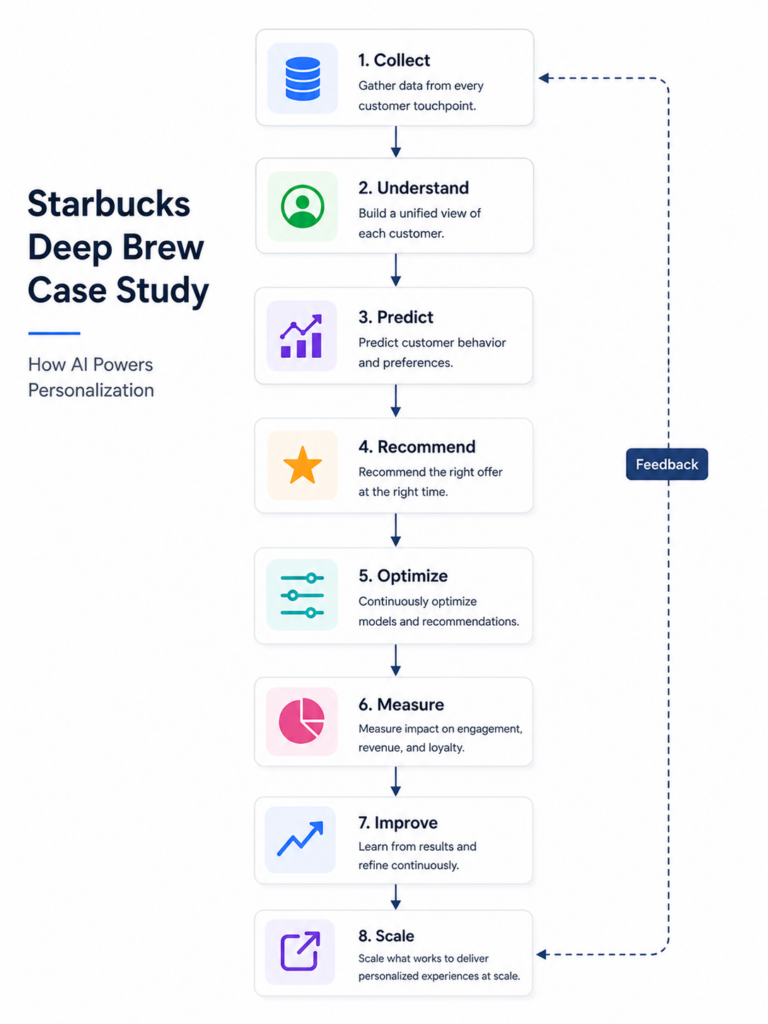
1. Collect — Establish consistent, structured capture of transaction, behavioral, and contextual data across every customer touchpoint, before attempting any modeling.
2. Understand — Build a unified customer profile that reconciles identity across channels, so behavior in one channel informs recommendations in another.
3. Predict — Train models on historical outcomes to estimate future preference or behavior, rather than relying on static segmentation rules.
4. Recommend — Convert predictions into a specific, actionable output — an offer, a message, a product suggestion — delivered at the moment of relevance.
5. Optimize — Continuously refine the recommendation logic based on which suggestions customers actually accept versus ignore.
6. Measure — Track outcomes against clearly defined business metrics (engagement, conversion, retention), not just model accuracy in isolation.
7. Improve — Feed real-world outcome data back into model retraining on a defined cadence, closing the loop between prediction and reality.
8. Scale — Extend proven personalization logic across new channels, markets, or product lines, only after the core loop has demonstrated reliable performance.
Treevire Insight: Starbucks’ own trajectory — recommendation engine first (2019), operational forecasting next, generative AI for employees last (2025) — is a real-world illustration of Collect → Understand → Predict → Recommend happening years before Scale extended the platform into net-new use cases like Green Dot Assist.
How Small Businesses Can Apply These Ideas
| Business Type | Practical First Step |
|---|---|
| Small Business | Start capturing repeat-customer data through a simple loyalty mechanism (even a basic punch card app) before investing in any AI tooling |
| Startup | Instrument the product or storefront to log behavioral events from day one — the data gap is the hardest thing to retroactively fix |
| E-commerce Store | Use existing platform-native recommendation tools (most major e-commerce platforms include basic ML-driven product recommendations) before building custom models |
| Restaurant | Combine order history with simple contextual data (day of week, weather, local events) to inform manual or semi-automated promotional targeting |
| Retail Chain | Prioritize inventory and staffing forecasting alongside any customer-facing personalization — Starbucks’ lesson applies directly here |
| B2B Company | Apply the same Collect → Understand → Predict logic to lead and account scoring rather than product recommendations — the underlying framework transfers directly |
Risks
- Privacy: Personalization at Starbucks’ scale depends on continuous behavioral and location-adjacent data collection, which carries inherent privacy obligations and scrutiny, particularly across jurisdictions with differing data protection regulations (e.g., GDPR in the EU).
- Data Governance: Maintaining accuracy, consent, and appropriate access controls across a data set spanning tens of millions of customers and multiple markets is a substantial and ongoing operational burden.
- Bias: Recommendation and forecasting models trained on historical data can encode and perpetuate existing patterns — for instance, underserving less common preferences or newer customer segments with thinner historical data.
- Customer Trust: Personalization that feels helpful can tip into feeling surveillant if not carefully calibrated; the same data that improves a recommendation can also alarm a customer who wasn’t aware it was being used that way.
- AI Accuracy: Predictive models are probabilistic, not deterministic — forecasting errors in inventory or staffing carry real operational and financial cost at Starbucks’ scale.
- Regulatory Considerations: As generative AI tools like Green Dot Assist expand into employee-facing workflows, questions around AI-assisted decision-making, labor relations, and disclosure requirements are likely to draw increasing regulatory attention across markets.
Future of Starbucks AI
The following section contains predictions and reasoned projections, not confirmed roadmap items, unless directly attributed to a specific Starbucks statement.
- Predictive ordering: Starbucks CEO Brian Niccol has publicly discussed a long-term vision for the app to anticipate and help prepare a customer’s order before it is placed — a confirmed statement of direction, though not yet a shipped feature at the time of this writing.
- Conversational and voice ordering: Given Green Dot Assist’s conversational foundation, extending similar generative AI interaction patterns to customer-facing ordering is a reasonable industry-consensus prediction, consistent with broader retail AI trends.
- Broader Green Dot Assist rollout: Starbucks has confirmed plans to expand Green Dot Assist across U.S. and Canada company-operated stores through fiscal 2026 — a confirmed near-term roadmap item.
- AI agents in store operations: Extending Green Dot Assist-style tools toward more autonomous operational decision-making (e.g., automatically flagging and resolving scheduling gaps) is a reasonable projection based on the tool’s current trajectory, not a confirmed feature.
- Hyper-personalization: Deeper integration of predictive ordering with real-time contextual data is a plausible next step consistent with Deep Brew’s stated design philosophy, though Starbucks has not detailed specific technical plans.
- Store intelligence: Continued expansion of IoT-based equipment monitoring toward broader real-time store analytics is a reasonable extrapolation from the existing Azure Sphere partnership.
- Autonomous marketing: Greater automation of offer generation and targeting is a plausible direction consistent with industry trends, though this remains speculative for Starbucks specifically.
Key Takeaways
- Deep Brew is Starbucks’ confirmed, Azure-built AI platform launched in 2019, powering personalized app recommendations based on weather, time of day, local inventory, and purchase history.
- Green Dot Assist (2025) marks a distinct second generation of Starbucks AI — generative and employee-facing, rather than purely predictive and customer-facing.
- Operational AI (forecasting, scheduling, equipment monitoring) is as central to Deep Brew as customer personalization, and arguably a prerequisite for it to work well in practice.
- Starbucks’ Rewards program — 35.8 million active U.S. members as of Q3 FY2026 — functions as both the primary data source and the primary delivery channel for AI-driven personalization.
- No public source isolates a specific revenue or ROI figure directly attributable to Deep Brew; broader digital and loyalty metrics are confirmed, but the AI-specific contribution is not separately disclosed.
- The core lesson for other businesses is sequencing: build the data foundation and operational reliability before layering on advanced personalization — not the reverse.
What is Starbucks Deep Brew?
Deep Brew is Starbucks’ proprietary AI and machine learning platform, launched in 2019 and built on Microsoft Azure, that powers personalized recommendations in the Starbucks app and supports store operations such as forecasting and scheduling.
When did Starbucks launch Deep Brew?
Starbucks launched Deep Brew in 2019, building on customer data the company had been collecting through its mobile app since 2011.
Is Deep Brew built on Microsoft Azure?
Yes, this is confirmed through Microsoft’s own public case study content and reporting on the Starbucks-Microsoft partnership.
What data does Deep Brew use for recommendations?
Confirmed inputs include weather, time of day, local store inventory, popular selections, community preferences, and previous customer orders.
What is Green Dot Assist?
Green Dot Assist is a generative AI assistant Starbucks launched in 2025, built on Microsoft Azure’s OpenAI platform, that helps baristas get real-time answers on recipes, equipment troubleshooting, and shift coverage through in-store iPads.
Is Green Dot Assist the same thing as Deep Brew?
They are related but distinct: Green Dot Assist is a newer, generative AI tool for employees, while the original Deep Brew platform is primarily a predictive recommendation and forecasting system. Public reporting generally treats Green Dot Assist as part of Starbucks’ broader AI strategy alongside Deep Brew.
How many Starbucks Rewards members are there?
As of Starbucks’ fiscal Q3 2026 earnings disclosure, the company reported 35.8 million 90-day active U.S. Rewards members.
What percentage of Starbucks revenue comes from Rewards members?
Multiple sources citing Starbucks investor disclosures place this figure around 59–60% of U.S. company-operated revenue, though this specific percentage should be treated as approximate rather than a directly quoted company statistic.
Does Starbucks use AI to replace baristas?
No. Starbucks executives, including CEO Brian Niccol, have publicly stated that tools like Green Dot Assist are designed to support baristas, not replace them.
What machine learning techniques does Deep Brew use?
Starbucks and Microsoft have publicly referenced the use of reinforcement learning techniques on Azure to improve recommendation quality; full technical architecture has not been publicly disclosed.
Does Deep Brew forecast inventory and staffing?
Industry reporting and trade press consistently describe Deep Brew as supporting inventory and demand forecasting and labor scheduling, though Starbucks has not published detailed technical documentation of these specific functions.
What is Azure Sphere and how does it relate to Starbucks?
Azure Sphere is a secured IoT platform Starbucks adopted, in partnership with Microsoft, to connect store equipment to the cloud and support predictive maintenance rather than purely reactive repairs.
How does weather affect Starbucks’ AI recommendations?
Starbucks has confirmed weather as a direct input into its app-based recommendation engine, influencing which drinks or food items are suggested to a given customer at a given time.
What is the Starbucks Rewards tier structure?
As of the 2026 program relaunch, Starbucks Rewards operates on three tiers — Green (free), Gold, and Reserve — each with different star-earning rates.
How does Starbucks personalize the drive-thru experience?
Public statements from Starbucks executives have referenced AI-informed menu suggestions in drive-thru contexts based on factors like weather and popularity, though the company has not published full technical details of this specific implementation.
What can small businesses learn from Starbucks’ AI strategy?
The clearest transferable lesson is sequencing: build consistent data capture and a loyalty mechanism first, since Starbucks’ 2019 AI platform was built on data collected starting in 2011 — the data foundation preceded the AI investment by nearly a decade.
Did Starbucks’ AI investment directly cause its recent sales growth?
This cannot be confirmed as a direct, isolated causal link. Starbucks’ recent comparable sales growth reflects a broader turnaround strategy under CEO Brian Niccol involving staffing, menu, and pricing changes, of which AI and technology are contributing factors among several.
What risks come with AI-driven personalization at Starbucks’ scale?
Confirmed industry-wide risks applicable to a system like Deep Brew include data privacy obligations, algorithmic bias in recommendations, data governance complexity, and the general accuracy limitations of any probabilistic forecasting model.
Does Starbucks use generative AI for marketing content?
Starbucks’ confirmed generative AI deployment (Green Dot Assist) is employee-facing rather than for customer marketing content; no public source confirms a customer-facing generative AI marketing tool as of this writing.
How is Deep Brew different from a traditional CRM?
A traditional CRM primarily manages customer records and communication history; Deep Brew, as described by Starbucks and Microsoft, actively generates predictions and personalized recommendations from that underlying data.
What role does the Starbucks app play in Deep Brew?
The app is both a primary data-collection surface and the primary delivery channel for Deep Brew’s personalized recommendations and offers.
Has Starbucks disclosed a specific ROI figure for Deep Brew?
No verified primary source — Starbucks investor relations or Microsoft — discloses an isolated ROI or revenue-attribution figure specific to Deep Brew; broader digital and loyalty metrics are disclosed, but not an AI-specific breakout.