
Predictive Customer Intelligence Explained: How Businesses Forecast Customer Behavior Using AI

a retailer sends one customer a 20% discount coupon. A few weeks earlier, the customer had started visiting competitor websites, opening fewer emails, and ignoring a loyalty-app notification for the first time in two years. The company’s AI system detected this change in behavior before anyone on the marketing team noticed it and predicted that the customer had a high chance of leaving within the next 60 days.
At the same time, another customer receives an invitation to join a premium membership program. The customer had not asked for it, and the company did not simply send the offer at random. Their purchase frequency had been steadily increasing, their average order value had grown for three consecutive months, and an AI model trained on thousands of similar customers had identified this pattern as a strong indicator that the customer was likely to become one of the company’s highest-value customers.
Neither decision came from someone manually reviewing a spreadsheet.
Neither decision was based on guesswork.
Both were based on a system that analyzed historical customer data, identified patterns, and predicted what was likely to happen next — allowing the business to take action before that outcome actually occurred.
This is Predictive Customer Intelligence (PCI).
Predictive Customer Intelligence represents a major shift in how businesses understand and manage customer relationships.
For much of the history of business analytics, companies have focused mainly on understanding the past.
They could answer questions such as:
- How much revenue did we generate last quarter?
- How many customers left last month?
- Which campaign performed best last week?
- How many products did we sell?
- Which customers purchased the most?
These are important questions, but they are primarily descriptive.
They tell a business what has already happened.
Predictive Customer Intelligence adds another layer:
What is likely to happen next?
Instead of discovering that a customer has already left, a company can identify signals suggesting that the customer may be about to leave.
Instead of waiting for a customer to make another purchase, the business can identify customers who are likely to buy again.
Instead of treating every customer the same, the company can estimate which customers are likely to become high-value customers and take action accordingly.
This creates a fundamental shift:
Traditional analytics:
“What happened?”
Predictive analytics:
“What is likely to happen?”
Predictive Customer Intelligence:
“What is likely to happen, and what should we do about it?”
That final step is what makes Predictive Customer Intelligence particularly valuable.
The goal isn’t simply to produce predictions.
The goal is to turn those predictions into better customer decisions and timely actions.
This guide provides a complete explanation of Predictive Customer Intelligence — what it means, how it works, which AI and machine learning models power it, what data it requires, how businesses implement it, where it can fail, and how the field is evolving.
Whether you’re a RevOps leader evaluating an investment, a marketer trying to understand how AI uses customer data, or a student learning the subject from the beginning, this guide takes you from the fundamentals to an advanced understanding of Predictive Customer Intelligence.
1. What Is Predictive Customer Intelligence?
Predictive Customer Intelligence (PCI) is the use of artificial intelligence and machine learning to study customer data and predict what a customer is likely to do next.
For example, a business may use it to predict whether a customer is likely to:
- Cancel a subscription
- Make another purchase
- Upgrade to a higher plan
- Respond to an offer
- Stop using a product
- Become a high-value customer
- Need a particular product or service
The important idea is that the business doesn’t wait for the outcome to happen.
Instead, it uses data to identify patterns early and take action before the predicted outcome occurs.
To understand Predictive Customer Intelligence properly, it helps to break the concept into its main parts.
Customer Intelligence
Customer Intelligence is the broader process of collecting, organizing, and understanding everything a business knows about its customers.
This can include:
- Who the customer is
- What they have purchased
- How they interact with the company
- What products they use
- How often they engage
- What they respond to
- What problems they experience
- How their behavior changes over time
The purpose is to help the business make better decisions about how to attract, serve, retain, and grow customer relationships.
Predictive Analytics
Predictive Analytics focuses on the future.
Instead of simply asking:
“What happened?”
it asks:
“What is likely to happen next?”
Predictive analytics uses historical data, statistics, and machine learning to identify patterns that can help forecast future outcomes.
For example, instead of simply reporting that customers who stop using a product often churn, a predictive model can estimate:
“This customer has a high probability of churning within the next 30 days.”
AI Prediction
AI prediction refers to using trained machine learning models to make these forecasts at scale.
Traditional business rules might say:
“If a customer hasn’t logged in for 30 days, mark them as at risk.”
An AI model can look at many more signals simultaneously.
It might consider:
- Login frequency
- Purchase history
- Email engagement
- Support interactions
- Product usage
- Website activity
- Changes in behavior
- Previous customer patterns
The model learns from historical examples and uses those patterns to make predictions for current customers.
This allows a business to evaluate thousands or even millions of customers without manually analyzing each one.
Behavioral Forecasting
Behavioral Forecasting is the practical result of this process.
Instead of making a general statement such as:
“Customer churn usually increases during the third quarter.”
the system can make an individual prediction:
“This customer has a 78% probability of churning within the next 30 days.”
That prediction can then trigger an appropriate business action.
For example:
High churn probability
→ Personalized retention offer
High purchase probability
→ Relevant product recommendation
High upgrade probability
→ Premium plan offer
Declining engagement
→ Re-engagement campaign
This is where predictive customer intelligence becomes operational rather than simply analytical.
In Simple Terms
You can think of Predictive Customer Intelligence as the point where customer intelligence stops looking only at the past and starts helping the business prepare for the future.
Traditional analytics might tell you:
“This customer stopped buying.”
Predictive customer intelligence tries to tell you:
“This customer is showing patterns that suggest they may stop buying soon.”
That difference gives the business an opportunity to act before the outcome happens.
A Simple Analogy
Imagine a doctor reviewing a patient’s medical history.
A descriptive approach might say:
“Your blood pressure was high last month.”
A predictive approach looks at trends and multiple factors and says:
“Your recent pattern suggests that you may have a higher risk of a serious health problem in the future, so we should take action now.”
Predictive Customer Intelligence applies the same basic idea to customer relationships.
Instead of looking at a patient’s health data, the business looks at customer data.
Instead of predicting a health outcome, it predicts a customer behavior.
And instead of waiting for the outcome to happen, the business uses the prediction to decide what action should happen next.
2. Why Historical Analytics Isn’t Enough
For many years, business analytics has mainly focused on looking at the past.
Companies use monthly sales reports, quarterly churn dashboards, revenue charts, and campaign reports to understand what has already happened.
This information is important. Businesses need to know whether revenue increased, whether customers left, and which campaigns performed well.
But historical analytics has one major limitation:
By the time you see the result, the event has already happened.
If a customer has already cancelled their subscription, knowing that they cancelled doesn’t give the business an opportunity to prevent that specific cancellation.
If a campaign has already failed, analyzing the results can explain why it failed, but the money has already been spent.
This is why businesses need to move beyond simply understanding the past.
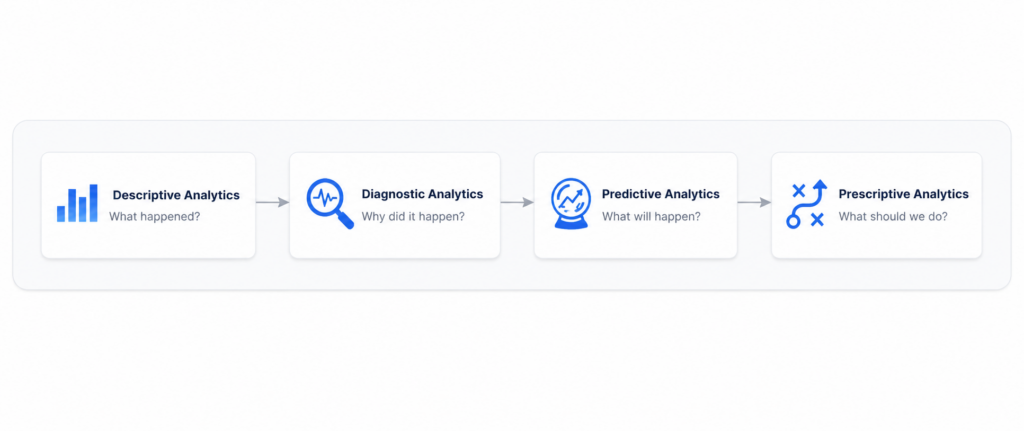
The Four Stages of Analytical Maturity
Business analytics can generally be viewed as four stages:
| Stage | Key Question | Purpose |
|---|---|---|
| Descriptive Analytics | What happened? | Understand past performance |
| Diagnostic Analytics | Why did it happen? | Identify the reasons behind an outcome |
| Predictive Analytics | What is likely to happen? | Forecast future outcomes |
| Prescriptive Analytics | What should we do? | Recommend or determine the best action |
Each stage builds on the previous one.
1. Descriptive Analytics — What Happened?
Descriptive analytics looks at historical data and summarizes what has already happened.
For example:
“Customer churn was 4.2% last quarter.”
Or:
“Revenue increased by 8% compared with last year.”
Or:
“Email campaign A generated a 6% conversion rate.”
Most traditional business dashboards operate primarily at this level.
Descriptive analytics is essential because businesses need a reliable understanding of their past performance.
But it is retrospective.
It tells you what happened after the event has already occurred.
2. Diagnostic Analytics — Why Did It Happen?
Diagnostic analytics goes one step further.
Instead of simply reporting the outcome, it tries to explain the reason behind it.
For example:
“Churn increased because the recent pricing change had a larger impact on the mid-tier customer segment.”
Or:
“Revenue declined because new customer acquisition fell by 15% in the previous quarter.”
Diagnostic analytics helps businesses understand the causes behind their results.
This is more useful than simply knowing the numbers, but it is still focused on the past.
The business is explaining something that has already happened.
3. Predictive Analytics — What Will Happen?
Predictive analytics changes the question.
Instead of asking what happened or why it happened, the business asks:
“What is likely to happen next?”
For example:
“This group of 4,000 customers has a significantly higher probability of churning within the next 45 days.”
Now the business has an opportunity to act.
It could identify the customers at highest risk, investigate why they may be leaving, and take appropriate retention actions before the predicted outcome occurs.
This is where analytics moves from hindsight to foresight.
4. Prescriptive Analytics — What Should We Do?
Prescriptive analytics takes the next step.
Knowing that something is likely to happen is useful, but businesses also need to know what they should do about it.
For example:
“Contact the 400 highest-value customers with elevated churn risk and offer proactive support.”
Or:
“Do not offer discounts to the 1,200 customers who are already highly likely to convert without an incentive.”
Prescriptive analytics connects predictions with potential actions.
Instead of simply saying:
“This is likely to happen.”
it asks:
“Given that this is likely to happen, what action should we take?”
Where Predictive Customer Intelligence Fits
Predictive Customer Intelligence operates primarily in the third stage — Predictive Analytics — while also providing the information needed for Prescriptive Analytics.
The progression looks like this:
What happened?
↓
Why did it happen?
↓
What is likely to happen?
↓
What should we do about it?
This represents a major change in how a business operates.
A company that relies mainly on descriptive and diagnostic analytics is often reacting to events.
It discovers that customers have already churned.
It discovers that revenue has already declined.
It discovers that a campaign has already underperformed.
A company using predictive and prescriptive analytics can begin acting before the outcome is fully realized.
That creates a valuable window for intervention.
Treevire Insight: The biggest change required to adopt Predictive Customer Intelligence is not necessarily technical. It is a change in how teams make decisions. Teams accustomed to reviewing historical numbers must become comfortable making decisions based on probabilities rather than certainties. A 78% churn-risk score does not mean a customer will definitely leave. It means the likelihood is high enough that taking action may be worthwhile. That is a fundamentally different way of making business decisions than simply reading a report about what has already happened.
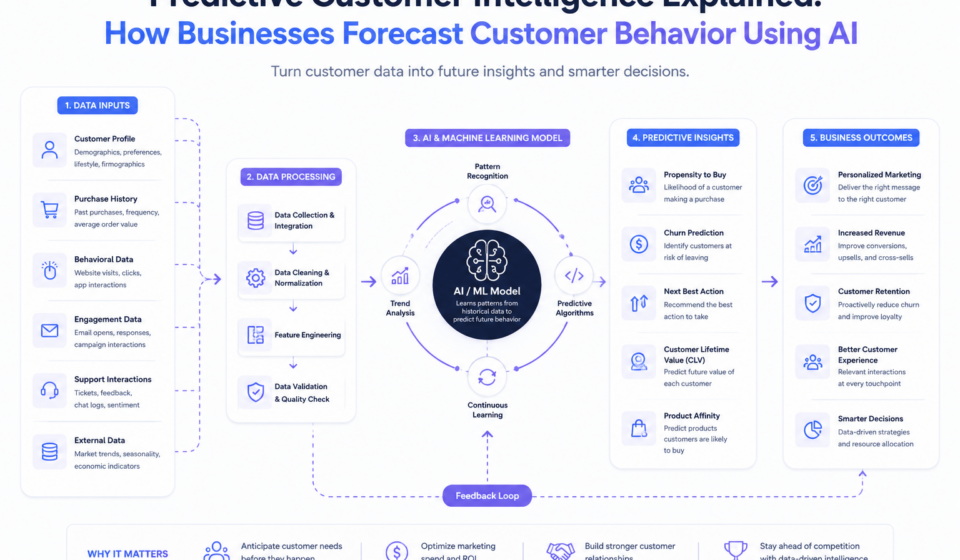
3. How Predictive Customer Intelligence Works: The Complete Pipeline
Predictive Customer Intelligence isn’t a single tool — it’s a pipeline, and understanding each stage is essential to understanding why the whole system works (or why it fails)
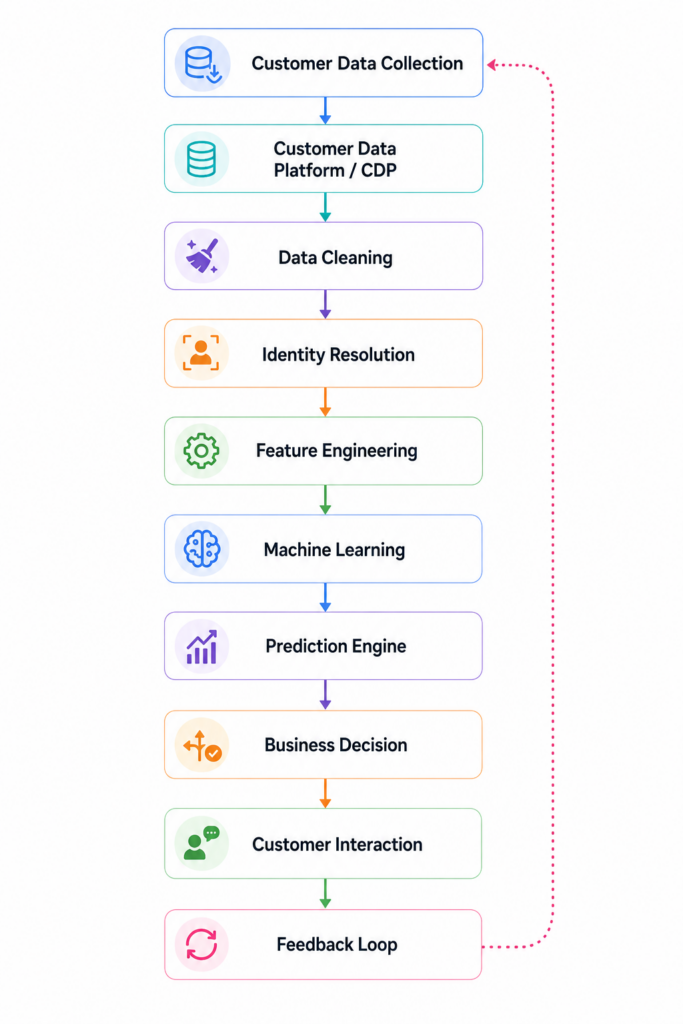
Customer Data Collection. Every touchpoint a customer has with a business — a website visit, an email open, a support ticket, a purchase, a product login — generates data. This is the raw material the entire system depends on, and it typically originates from a dozen or more disconnected systems.
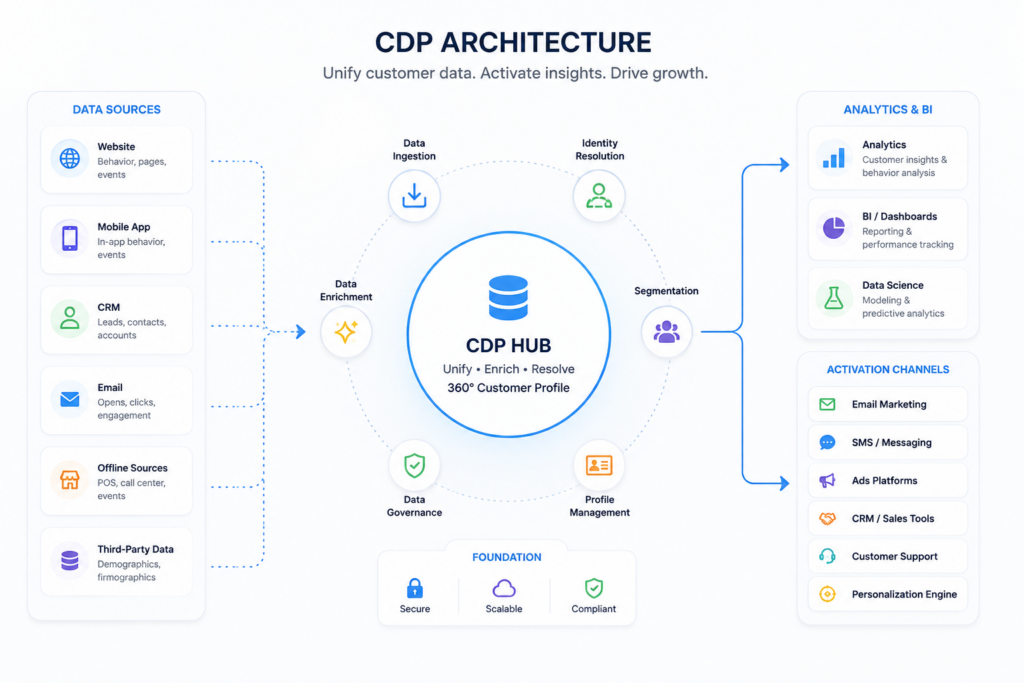
Customer Data Platform (CDP). Raw data from all those disconnected systems needs somewhere to be unified. A CDP is purpose-built software that ingests data from every source, structures it around the individual customer rather than the individual system, and makes it available for analysis and activation. Without this layer, most companies simply have a pile of disconnected data, not a usable customer picture.
Data Cleaning. Raw customer data is messy by default — duplicate records, missing fields, inconsistent formatting, outdated information. Before any prediction can be trusted, the underlying data has to be cleaned, standardized, and validated. This step is unglamorous, and it’s also the single most common point of failure in the entire pipeline.
Identity Resolution. The same customer often exists as multiple different, disconnected records — a website cookie, an email address, a loyalty card number, a CRM contact ID. Identity resolution is the process of recognizing that all of these belong to the same person and merging them into one coherent customer profile. Without it, a model can’t reason about “this customer” at all — it’s reasoning about fragments of several different customers who happen to share some data points.
Feature Engineering. A machine learning model doesn’t consume raw data directly — it consumes “features,” which are transformed, calculated signals derived from raw data. “Days since last purchase,” “percentage change in monthly logins,” and “number of support tickets in the last 30 days” are all features. This step is where domain expertise about customers matters most, and it’s frequently the single biggest driver of how accurate the resulting predictions turn out to be — more so than which specific algorithm is chosen afterward.
Machine Learning. This is the stage most people picture when they hear “AI” — an algorithm is trained on historical data where the outcome is already known (which customers churned, which upgraded, which converted) so it can learn the relationship between the input features and that outcome.
Prediction Engine. Once trained and validated, the model is deployed to run continuously against live, current customer data — generating an updated score or forecast for every customer, on a defined schedule (daily, hourly, or in real time, depending on the use case).
Business Decision. A prediction only has value once it’s connected to a decision rule: what happens when a customer’s churn score crosses a threshold? Who gets notified? What offer gets triggered? This is the step most companies underinvest in — building a highly accurate model and then never operationalizing what to actually do with its output.
Customer Interaction. The decision becomes a real action the customer experiences — a retention call, a personalized offer, a proactive support outreach, a tailored recommendation.
Feedback Loop. The outcome of that interaction — did the customer stay, did they convert, did they ignore the offer — becomes new training data, feeding back into the system and improving the next generation of the model. This loop is what separates a one-time predictive project from an ongoing predictive intelligence capability.
Visual suggestion: Predictive Intelligence Architecture diagram — a full-width horizontal pipeline graphic showing all ten stages above as connected nodes, with icons for each stage, in Treevire’s editorial navy/teal palette.
4. Types of Predictions Businesses Make
Predictive Customer Intelligence isn’t one prediction — it’s a family of related predictions, each answering a different business question.
Churn Prediction — the probability that a specific customer will cancel, downgrade, or stop engaging within a defined time window. Example: a SaaS company flags accounts whose product usage has dropped 40% over three weeks, prioritizing them for a customer success outreach before the renewal date.
Lifetime Value (LTV) Prediction — a forecast of the total future revenue a customer will generate, not just what they’ve spent historically. Example: an e-commerce brand identifies first-time buyers who show early behavioral signals associated with high long-term value, and fast-tracks them into a loyalty program.
Purchase Propensity — the likelihood a customer will make a purchase within a given timeframe. Example: a retailer times a promotional email to arrive during a customer’s individually modeled highest-propensity window rather than a fixed calendar date.
Upsell Prediction — the likelihood an existing customer will accept an upgrade to a higher tier or add-on. Example: a software company identifies accounts approaching a usage ceiling on their current plan and proactively offers an upgrade before the customer hits a frustrating limit.
Cross-sell Prediction — the likelihood a customer will purchase a complementary product. Example: a bank identifies checking-account customers with a high propensity to open a savings account based on the behavior of similar past customers.
Customer Segmentation (Predictive) — grouping customers not by static demographics, but by predicted future behavior, creating segments like “likely to churn,” “likely to upgrade,” and “likely dormant.”
Lead Scoring — ranking inbound and outbound sales leads by their probability of converting, so sales teams prioritize the leads most worth their time.
Renewal Prediction — specifically for subscription and contract-based businesses, the probability a customer will renew at the end of their term, often modeled separately from general churn because renewal has a fixed decision point.
Fraud Detection — identifying transactions or account behaviors statistically unlikely to be legitimate, based on patterns learned from confirmed past fraud cases.
Product Recommendation — predicting which specific products or content a given customer is most likely to want next, based on their behavior and the behavior of similar customers.
Next Best Action — a broader decision-support prediction that recommends the single most valuable action to take with a specific customer at a specific moment — an offer, an outreach, a piece of content, or simply no action at all.
Customer Health Score — a composite, often continuously updated score combining usage, engagement, sentiment, and support signals into a single indicator of relationship strength, commonly used in B2B and subscription businesses.
Risk Prediction — a broader category encompassing churn, fraud, and credit risk, all sharing the same underlying methodology of forecasting an undesirable future event.
Engagement Prediction — forecasting how likely a customer is to open an email, respond to a notification, or interact with a specific channel, used to optimize send timing and channel selection.
Demand Forecasting — predicting aggregate future demand for a product or service, informing inventory, staffing, and marketing budget decisions at the portfolio level rather than the individual customer level.
5. AI Models Used in Predictive Customer Intelligence
Different prediction types call for different algorithms. Understanding when each is appropriate is more useful than memorizing how each one works mathematically.
| Model | How It Works (Plain English) | Best Used For | Limitations |
|---|---|---|---|
| Decision Trees | Splits customers into groups based on a series of yes/no questions about their data | Simple, highly explainable predictions | Prone to overfitting on their own |
| Random Forest | Combines hundreds of decision trees and averages their votes | Churn and propensity scoring where accuracy matters more than simplicity | Harder to explain than a single tree |
| Gradient Boosting | Builds trees sequentially, each one correcting the previous one’s mistakes | High-accuracy tabular predictions across most customer use cases | Requires careful tuning to avoid overfitting |
| XGBoost | A highly optimized, widely adopted implementation of gradient boosting | The default choice for most production churn, LTV, and propensity models today | Still requires feature engineering to perform well |
| Logistic Regression | Estimates the probability of a binary outcome (will churn / won’t churn) using a weighted combination of inputs | Simple, fast, highly explainable baseline models | Struggles with complex, non-linear relationships |
| Neural Networks | Layers of interconnected nodes that learn complex patterns from data | Large-scale personalization and recommendation problems | Requires large volumes of data; harder to explain |
| Deep Learning | Neural networks with many layers, capable of learning from unstructured data | Text-based signals (support tickets, reviews), images, and complex sequences | Expensive to train, least explainable of the group |
| Time Series Models | Models a metric’s own historical pattern — trend, seasonality — to project it forward | Demand forecasting, revenue forecasting | Assumes historical patterns will continue |
| Survival Analysis | Models the time until an event occurs, not just whether it will | Predicting not just churn risk but when churn is likely | Requires specialized statistical setup |
| Reinforcement Learning | An agent learns optimal actions through trial, error, and reward feedback over time | Next-best-action systems that improve through ongoing interaction | Complex to implement responsibly; needs careful reward design |
| Large Language Models (LLMs) | Models trained on text that can understand and generate natural language | Analyzing unstructured signals — support tickets, call transcripts, reviews — for sentiment and risk cues | Not inherently built for structured numeric prediction; best paired with traditional models |
Expert Tip: In practice, gradient boosting models — especially XGBoost and LightGBM — win the large majority of production churn, LTV, and propensity use cases on structured customer data. Neural networks and LLMs earn their added complexity specifically on unstructured signals (support conversations, reviews, call transcripts) that traditional models can’t read directly. Don’t reach for the most sophisticated model available by default — reach for the one that matches your data shape and your need for explainability.
6. Data Required for Predictive Customer Intelligence
A prediction is only as good as the data feeding it. The richest predictive systems draw on a wide, deliberately diverse set of sources:
- CRM Data — contact records, deal stages, account ownership, sales activity history.
- Marketing Data — campaign engagement, email opens and clicks, ad interaction.
- Sales Data — quote history, negotiation activity, discount patterns, deal velocity.
- Website Behavior — page views, session duration, browsing paths, cart activity.
- Product Usage — feature adoption, login frequency, session depth (critical for SaaS churn prediction).
- Support Tickets — volume, resolution time, sentiment, and recurring issue types.
- Call Center Logs — call transcripts and outcomes, increasingly analyzed with LLMs for sentiment and risk signals.
- Email Engagement — open rates, click behavior, unsubscribe patterns.
- Purchase History — transaction frequency, recency, monetary value (the classic RFM inputs).
- Subscription Data — plan tier, billing history, upgrade/downgrade events.
- Social Media — public engagement and sentiment signals, where available and consented to.
- Survey Data — NPS, CSAT, and other direct voice-of-customer input.
- IoT Data — for connected products, usage telemetry that reveals real-world behavior beyond app logins.
- Third-Party Data — firmographic or demographic enrichment data, used carefully given growing privacy constraints.
- Identity Graphs — the structural layer connecting all of the above to a single, unified customer identity.
Common Mistake: Believing that more data sources automatically produce better predictions. A model built on ten well-integrated, high-quality sources will consistently outperform one built on thirty poorly integrated, inconsistent ones. Depth of integration matters more than breadth of collection.
7. The Role of Customer Data Platforms (CDPs)
Predictive Customer Intelligence depends on having a single, reliable, individual-level view of each customer — and that’s precisely the problem a CDP is built to solve. Without one, most companies have customer data scattered across a dozen systems that don’t talk to each other.
| System | Primary Purpose | Customer-Centric? | Real-Time Capable? | Best For |
|---|---|---|---|---|
| CRM | Managing sales and account relationships | Partially (per-record, not unified) | Limited | Sales and account management |
| Data Warehouse | Storing and querying structured business data at scale | No (system-centric, not identity-resolved by default) | No (typically batch) | BI reporting and historical analysis |
| CDP | Unifying customer data across every source into one identity-resolved profile | Yes, by design | Often yes | Powering personalization and predictive models |
| Data Lake | Storing large volumes of raw, often unstructured data cheaply | No | Depends on architecture | Storing raw data for later processing |
| Customer Intelligence Platform | Layering analytics, prediction, and activation on top of unified customer data | Yes | Yes | Turning unified data into predictions and decisions |
Why this matters for prediction specifically: a machine learning model needs consistent, identity-resolved, feature-ready data about “this customer” as a whole — not fragments spread across five systems with five different definitions of who that customer is. The CDP (or an equivalent unified customer data layer) is what makes that possible at scale.
8. Predictive Customer Intelligence vs. Traditional BI
| Dimension | Historical Reports | Dashboards | Predictive AI | Real-Time Intelligence |
|---|---|---|---|---|
| Time orientation | Past | Past/present | Future | Present, continuously updated |
| Core question answered | What happened? | What’s happening now? | What will happen? | What’s happening right now, and what should we do? |
| Update frequency | Periodic (weekly/monthly) | Periodic or near-real-time | Scheduled (daily/hourly) or streaming | Continuous |
| Granularity | Aggregate (segment/company level) | Aggregate | Individual customer level | Individual customer level |
| Action orientation | Informational | Informational | Decision-supporting | Decision-triggering |
| Typical output | A report or chart | A visual dashboard | A score or probability per customer | An automated or recommended action |
| Example | “Churn was 4.2% last quarter” | “Churn rate by month, live dashboard” | “This customer has a 78% churn probability in 30 days” | “Trigger a retention offer for this customer now” |
The two are not competitors — they’re complementary layers. BI tells a business how it’s doing. Predictive Customer Intelligence tells it what’s likely to happen next, and increasingly, what to do about it before it does.
9. Business Benefits of Predictive Customer Intelligence
Higher Revenue. Identifying and acting on high-propensity moments — the right offer, to the right customer, at the right time — converts more of the demand that already exists in your customer base.
Lower Churn. Early identification of at-risk accounts creates a window for intervention before the decision to leave has fully solidified. <cite index=”8-1″>Forrester’s 2025 Customer Intelligence Wave research found that companies combining quantitative product data with qualitative conversation data achieve meaningfully higher churn-prediction accuracy than quantitative-only approaches</cite>, and <cite index=”8-1″>B2B SaaS teams using AI-powered churn prediction report reductions in churn of roughly 15–30% within twelve months</cite> when paired with a disciplined intervention playbook — though results vary significantly by data quality and how consistently interventions are executed.
Better Personalization. Predictions turn generic marketing into individually relevant experiences, at a scale no human team could manually replicate.
Lower CAC. Better lead scoring and propensity targeting mean acquisition spend concentrates on the prospects most likely to convert, reducing wasted spend on low-probability audiences.
Higher LTV. Proactive upsell, cross-sell, and retention actions, informed by prediction, extend and deepen the customer relationship over time.
Better Forecasting. Demand and revenue forecasts built on individual-level predictive signals are consistently more accurate than aggregate trend extrapolation.
Improved Customer Experience. Customers experience a business that seems to understand their needs proactively — an outcome of prediction, not coincidence.
Better Resource Allocation. Customer success, sales, and marketing teams can prioritize their limited time toward the accounts and prospects where it will have the most impact.
Reduced Marketing Waste. Suppressing offers to customers who were going to convert anyway, and targeting only genuinely persuadable audiences, directly reduces wasted spend.
Better Retention. Beyond raw churn reduction, predictive intelligence supports proactive relationship management that builds durable loyalty over time.
Higher ROI. <cite index=”8-1″>Industry survey data from G2 and TrustRadius reports an average return of roughly $4–7 in protected revenue for every $1 spent on churn prediction AI specifically</cite> — one of the more consistently cited return benchmarks in the category, though it should be read as directional given the variety of underlying survey methodologies.
10. Industry Use Cases
Each industry applies Predictive Customer Intelligence to a different core business problem. Below, each includes the problem it solves, the prediction involved, and the typical outcome pattern — ROI figures are described directionally rather than as universal benchmarks, since actual results vary significantly by company maturity and execution quality.
Retail — Problem: inconsistent customer loyalty and discount-driven margin erosion. Prediction: purchase propensity and churn risk at the individual shopper level. Outcome: targeted offers replace blanket discounting, protecting margin while improving retention.
E-commerce — Problem: high cart abandonment and one-time-purchase behavior. Prediction: purchase propensity, product recommendation, and LTV. Outcome: higher repeat-purchase rates and more efficient recovery of abandoned carts.
Healthcare — Problem: patient disengagement from care plans and preventable readmissions. Prediction: engagement risk and care-plan adherence likelihood. Outcome: proactive outreach that improves adherence and reduces costly readmissions.
Insurance — Problem: policy lapses and claims fraud. Prediction: renewal likelihood and fraud risk scoring. Outcome: proactive renewal outreach and faster identification of suspicious claims.
Manufacturing — Problem: unpredictable demand and customer attrition in long B2B sales cycles. Prediction: demand forecasting and account health scoring. Outcome: better inventory planning and earlier intervention on at-risk accounts.
Telecommunications — Problem: historically high subscriber churn in a commoditized market. Prediction: churn prediction is one of the most mature and widely studied applications in this industry specifically. Outcome: materially reduced subscriber loss through targeted retention offers.
Travel — Problem: highly seasonal, infrequent purchase behavior that’s hard to personalize. Prediction: purchase propensity tied to life-event and seasonal signals. Outcome: better-timed offers that match natural booking windows.
Hospitality — Problem: inconsistent guest loyalty across a fragmented booking landscape. Prediction: loyalty propensity and personalized offer targeting. Outcome: higher direct-booking rates and loyalty program engagement.
Banking — Problem: product cross-sell inefficiency and attrition to competitors. Prediction: cross-sell propensity and attrition risk. Outcome: more relevant product offers and earlier retention intervention on at-risk relationships.
FinTech — Problem: high user acquisition cost with thin early-stage engagement. Prediction: activation and engagement propensity for new users. Outcome: more efficient onboarding flows that convert signups into active, retained users.
Education — Problem: student attrition and disengagement, particularly in online and continuing-education programs. Prediction: dropout/attrition risk scoring. Outcome: earlier academic and engagement intervention.
SaaS — Problem: subscription churn and expansion-revenue inefficiency. Prediction: usage-based churn and upsell propensity — one of the most mature and widely benchmarked applications of predictive customer intelligence. Outcome: materially improved net revenue retention when paired with a disciplined customer success intervention motion.
B2B (broader) — Problem: long, multi-stakeholder sales cycles with limited visibility into buying intent. Prediction: lead and account scoring based on intent and engagement signals. Outcome: sales teams prioritize the accounts most likely to close.
Real Estate — Problem: long, infrequent purchase cycles that make traditional marketing inefficient. Prediction: buyer readiness and propensity scoring. Outcome: better-timed agent outreach and marketing spend efficiency.
Automotive — Problem: long vehicle-ownership cycles between purchases, and service-department underutilization. Prediction: service and trade-in propensity. Outcome: better-timed service reminders and trade-in offers that improve dealership revenue per customer.
11. Step-by-Step Implementation Guide
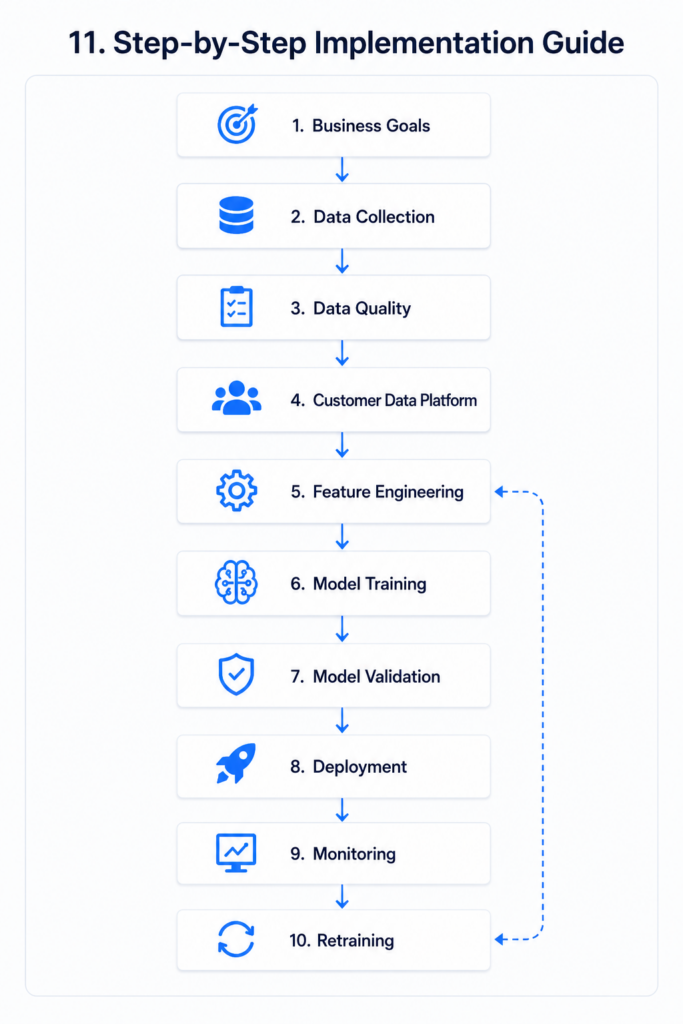
1. Business Goals. Start with the decision you want to improve, not the model you want to build. “Reduce 90-day churn among mid-tier accounts” is a workable starting point; “use AI on our customer data” is not.
2. Data Collection. Inventory the sources described in Section 6 that are relevant to your specific prediction goal, and confirm they’re actually accessible, not just theoretically available.
3. Data Quality. Assess completeness, accuracy, and consistency before doing anything else. Fixing data quality after a model is already built is far more expensive than fixing it first.
4. Customer Data Platform. Unify the relevant sources into an identity-resolved customer view — this step is what makes “individual customer prediction,” rather than “aggregate segment analysis,” possible at all.
5. Feature Engineering. Translate raw data into the specific, calculated signals your model will actually learn from — this is where marketing and customer-success domain knowledge should directly inform the technical build.
6. Model Training. Train candidate models on historical data where the outcome is already known, so the algorithm can learn the pattern between the input features and the outcome.
7. Model Validation. Test the model against data it hasn’t seen before, to confirm it generalizes rather than having simply memorized the training set — never trust a model’s performance on the same data it was trained on.
8. Deployment. Operationalize the trained, validated model — pushing live scores into the CRM, triggering a workflow in the marketing platform, or feeding a customer success dashboard.
9. Monitoring. Track whether the model’s predictions continue to hold up as customer behavior and market conditions shift — a model that was accurate at launch degrades over time if left untouched.
10. Retraining. Refresh the model on new data on a defined cadence, closing the loop back into feature engineering as new patterns and new outcome data become available.
12. Common Challenges
Poor Data Quality. The single most common root cause of underperforming predictive models — incomplete, duplicated, or inconsistent data produces confidently wrong predictions.
Data Silos. When CRM, product, support, and marketing data don’t connect, no model can see the complete customer picture.
Privacy Regulations. GDPR, CCPA, and an expanding set of regional privacy laws directly constrain what data can be collected, retained, and used for prediction — compliance has to be designed in, not retrofitted.
Bias. Models trained on historically biased outcomes can reproduce and even amplify that bias — for example, systematically undervaluing a segment the business has historically underserved.
Cold Start Problem. New customers, with little or no historical data, are inherently hard to predict accurately — most systems need a defined fallback strategy for this segment.
Model Drift. Customer behavior and market conditions change continuously; a model’s accuracy degrades over time if it isn’t monitored and retrained.
Lack of Explainability. Some high-performing models (especially deep learning) are difficult to interpret, which creates real friction when a customer success team or a regulator asks “why was this customer flagged?”
Changing Customer Behavior. Structural shifts — a new competitor, an economic downturn, a pricing change — can invalidate patterns a model learned from data that predates the shift.
Incomplete Data. Even well-integrated systems often have meaningful gaps — offline behavior, unrecorded conversations, unmeasured sentiment — that limit prediction accuracy no matter how sophisticated the model is.
Legacy Systems. Older CRM, billing, and support platforms often weren’t built with modern API access or clean data export in mind, creating real integration friction.
Common Mistake: Treating model accuracy as the finish line. A highly accurate model that never gets connected to an actual business workflow — an alert, a trigger, a prioritized list — produces zero business value. The model is the easy half of the problem; operationalizing it is the hard half.
13. Ethical AI in Predictive Customer Intelligence
Predicting individual human behavior carries real ethical weight, and responsible organizations treat it as an operating principle, not a compliance afterthought.
Transparency. Customers and internal stakeholders alike deserve reasonable clarity about when and how AI is influencing the experience they receive.
Fairness. Predictive models should be systematically tested for disparate impact across customer segments, not assumed to be neutral by default.
Bias Detection. Ongoing auditing — not a one-time check — is necessary because bias can emerge or worsen as a model is retrained on new data over time.
Consent. Customer data used for prediction should be used in ways consistent with what the customer actually agreed to, enforced technically at the point of use.
Privacy. Data minimization — using only what’s genuinely necessary for the prediction — reduces both risk and ethical exposure.
GDPR (EU) and CCPA (California) are the two most frequently referenced privacy regulations shaping predictive customer intelligence practice; both include provisions relevant to automated decision-making and profiling. Requirements evolve, and organizations operating across jurisdictions should verify current specific obligations against official regulatory sources rather than relying on general summaries.
Human Oversight. High-impact predictions — those materially affecting pricing, eligibility, or a customer’s opportunities — should retain a documented human review point, not run in a fully automated black box.
Responsible AI and AI Governance are the broader organizational disciplines that turn these individual principles into enforced, auditable practice — covering model approval processes, ongoing monitoring, and clear accountability for AI-influenced decisions.
Best practices:
- Test every customer-facing predictive model for fairness across relevant segments before deployment, not just for raw accuracy.
- Maintain clear, documented data lineage so any prediction can be traced back to the data that produced it.
- Apply proportional human oversight — light-touch for low-stakes predictions (a product recommendation), rigorous for high-stakes ones (a pricing or eligibility decision).
- Revisit model fairness and accuracy on a defined ongoing cadence, not only at initial launch.
14. Popular Tools for Predictive Customer Intelligence
| Tool | Category | Best For |
|---|---|---|
| Salesforce Einstein | AI layer within CRM | Organizations already standardized on Salesforce |
| Adobe Experience Platform | Enterprise CDP with built-in AI | Large B2C brands needing real-time personalization at scale |
| Microsoft Dynamics 365 AI | AI layer within CRM/ERP | Organizations standardized on the Microsoft ecosystem |
| HubSpot AI | AI features within CRM/marketing platform | SMB and mid-market teams wanting built-in predictive scoring |
| SAP | Enterprise customer/business data platform with AI features | Large enterprises with SAP-centric operations |
| Oracle CX | Customer experience suite with AI capabilities | Oracle-standardized enterprise environments |
| Google Cloud Vertex AI | End-to-end ML platform | Teams with data science capacity building custom models |
| AWS SageMaker | End-to-end ML platform | Teams building custom models and recommendation systems on AWS |
| Databricks | Unified data and AI platform | Data teams needing a combined data engineering and ML environment |
| Snowflake | Cloud data warehouse with native ML capabilities | Organizations consolidating fragmented customer data before modeling |
| Hightouch | Reverse ETL / data activation | Sending warehouse-based predictions into operational tools |
| Segment | Customer Data Platform | Unifying customer event data across sources |
| Bloomreach | Commerce-focused CDP and personalization | E-commerce and retail personalization use cases |
| Treasure Data | Enterprise CDP | Large enterprises needing a flexible, API-driven CDP |
| Amperity | Identity resolution-focused CDP | Retail and hospitality brands prioritizing identity resolution |
| Power BI | Business intelligence and visualization | Teams needing to visualize and socialize predictive output |
| Tableau | Business intelligence and visualization | Communicating predictive insights across the organization |
| Python | Programming language / modeling environment | Teams building and customizing models directly |
| R | Programming language / statistical environment | Statistically intensive modeling and academic-adjacent analysis |
Treevire Insight: Tool selection should follow data maturity, not brand recognition. A company without a unified, identity-resolved customer data foundation will get more value from investing in that foundation first than from evaluating the “best” predictive AI platform before it’s ready to use one effectively.
15. Future Trends in Predictive Customer Intelligence
Agentic AI. The next evolution moves beyond prediction into autonomous action — systems that don’t just flag a churn risk but independently select and execute an appropriate response, with human oversight shifting toward governance rather than manual triggering.
Autonomous Marketing. Full prediction-to-action loops — targeting, offer selection, and follow-up — increasingly running with minimal manual intervention, under defined guardrails.
Generative AI. Increasingly paired with predictive models to not just identify who to target, but to generate the personalized content and messaging delivered to them.
Real-Time Decision Engines. Prediction and action converging into millisecond-level decisioning at the point of customer interaction, rather than overnight batch scoring.
Digital Twins of Customers. Simulated behavioral models of customer segments that let businesses test strategies in a modeled environment before committing real budget or outreach.
Federated Learning. A training approach where models learn from data that never leaves its original, secure location — a promising direction for privacy-preserving prediction across sensitive data sources.
Privacy-Preserving AI. A growing category of techniques (including federated learning and differential privacy) designed to let prediction improve without centralizing or exposing raw personal data.
Synthetic Data. Artificially generated data that mimics the statistical properties of real customer data, increasingly used to train and test models without exposing actual personal information.
Customer AI Agents. AI systems acting on the customer’s own behalf — comparing options, negotiating, or making decisions for them — an emerging dynamic predictive intelligence systems will increasingly need to account for on the business side too.
Hyper-personalization. The continued extension of personalization from the segment level down to the individual, moment-by-moment level, as prediction, generation, and real-time execution converge.
1. What is Predictive Customer Intelligence?
The use of AI and machine learning to forecast what individual customers are likely to do next — churn, purchase, upgrade, or disengage — so businesses can act before the outcome occurs.
2. How is Predictive Customer Intelligence different from regular customer analytics?
Regular customer analytics typically describes what already happened; Predictive Customer Intelligence forecasts what’s likely to happen next, at the individual customer level.
3. How does Predictive Customer Intelligence work?
It works through a pipeline: collecting and unifying customer data, cleaning and resolving identity across sources, engineering predictive features, training and validating a machine learning model, and deploying it to generate ongoing, actionable predictions.
4. What data is needed for Predictive Customer Intelligence?
Typically CRM, marketing, sales, website behavior, product usage, support, purchase history, and subscription data, unified around a single customer identity — with third-party and other data sources adding depth where available.
5. What is a Customer Data Platform (CDP), and why does it matter?
A CDP unifies customer data from every source into a single, identity-resolved profile, providing the clean foundation predictive models require to reason about “this customer” as a whole.
6. What is churn prediction?
A specific application of Predictive Customer Intelligence that estimates the probability a customer will cancel, downgrade, or disengage within a defined time window.
7. How accurate are churn prediction models?
Accuracy varies significantly by data quality and industry; a 2026 industry benchmark cited typical churn-model performance (measured by AUROC) in roughly the 0.70–0.85 range, meaning strong but not perfect discrimination between at-risk and stable accounts — results should always be validated against your own historical outcomes.
8. What AI models are used for churn prediction specifically?
Gradient boosting models (XGBoost, LightGBM) and random forests are the most common production choices for structured data, often supplemented with neural networks or LLM-based analysis of unstructured signals like support tickets and call transcripts.
9. What is Customer Lifetime Value (CLV) prediction?
A model that forecasts a customer’s total future value to the business, not just their historical spend, used to guide acquisition and retention prioritization.
10. What is Next Best Action?
A decision-support prediction that recommends the single most valuable action to take with a specific customer at a specific moment, combining multiple underlying predictions into one recommendation.
11. Can small businesses use Predictive Customer Intelligence?
Yes — many CRM and marketing platforms now offer built-in predictive features that don’t require building custom models or hiring a data science team.
12. What is the cold start problem?
The challenge of generating accurate predictions for new customers who have little or no historical behavioral data yet — typically addressed with fallback rules or models trained on similar-customer patterns until enough individual data accumulates.
13. How does Predictive Customer Intelligence handle privacy regulations?
Compliant systems rely primarily on consented first-party data, apply data minimization principles, and build human oversight into higher-stakes automated decisions — specific obligations vary by jurisdiction and should be verified against current regulatory guidance.
14. What is model drift?
The gradual decline in a model’s prediction accuracy as real-world customer behavior shifts away from the patterns it was originally trained on — addressed through ongoing monitoring and periodic retraining.
15. What’s the difference between predictive and prescriptive customer intelligence?
Predictive intelligence forecasts what’s likely to happen; prescriptive intelligence goes a step further and recommends what action to take in response.
16. How long does it take to implement Predictive Customer Intelligence?
It varies significantly by data readiness; a single, well-scoped use case (like basic churn scoring) with reasonably clean existing data can often move from design to first deployment within a few months, while a full enterprise-wide capability typically takes considerably longer.
17. What industries benefit most from Predictive Customer Intelligence?
Subscription-based industries (SaaS, telecommunications, insurance) see some of the most mature and well-documented applications, particularly for churn prediction, though the discipline applies broadly across retail, banking, healthcare, and beyond.
18. Is Predictive Customer Intelligence the same as AI personalization?
They’re closely related but distinct — prediction identifies what a customer is likely to want or do; personalization is the resulting tailored experience delivered based on that prediction.
19. What is identity resolution, and why does it matter for prediction?
Identity resolution is the process of recognizing that multiple data records (a cookie, an email, a loyalty ID) belong to the same person and merging them into one profile — without it, models can’t reliably reason about an individual customer’s complete behavior.
20. What’s the ROI of investing in Predictive Customer Intelligence?
Returns vary substantially by use case and execution quality, but industry survey data on churn-prediction specifically has reported average returns in the range of several dollars of protected revenue for every dollar invested — a figure that should be treated as directional rather than a guaranteed benchmark for any specific company.
21. Do I need a data science team to get started?
Not necessarily — many platforms now offer built-in predictive scoring requiring no custom model development, though building custom models offers more precision and flexibility as needs mature.