

Marketing used to depend heavily on experience and guesswork. Marketers planned campaigns on calendars, tracked results in spreadsheets, and made many decisions based on what they thought would work.
That is changing quickly.
This shift is called AI marketing.
In 2026, artificial intelligence (AI) is becoming a major part of how marketing works. AI can analyze huge amounts of data, predict what customers might do next, create content, test different campaigns, and even improve marketing activities automatically.
And AI marketing is no longer just an interesting experiment. For many businesses, it is becoming an important part of how they compete and grow.
The numbers show how quickly things are changing. According to IBM’s Global AI Adoption Index, AI adoption in marketing has grown from around 29% in 2021 to roughly 76% today. HubSpot’s 2026 State of Marketing report found that 91% of marketing teams now use AI somewhere in their work. Salesforce also reports that 87% of marketers use generative AI in at least one marketing activity, compared with 51% just two years earlier.
The benefits can be significant. Marketers using AI strategically report improvements in productivity and save several hours every week on repetitive tasks. Instead of spending hours creating basic content, analyzing spreadsheets, or manually testing campaigns, marketers can use AI to handle much of this work.
But there is an important problem.
Using AI and knowing how to use AI effectively are two different things.
Many companies have started using AI, but only a much smaller number have successfully built AI into their everyday marketing processes. In other words, many businesses are experimenting with AI, but they haven’t yet figured out how to make it a reliable part of their marketing system.
The biggest problem isn’t necessarily the technology.
It’s the skills gap.
Many marketers know that AI is important, but they don’t know how to connect AI tools with their existing marketing processes, data, analytics, customer journeys, and business goals. Many also haven’t received practical, job-specific training on how to use AI effectively.
And that’s exactly where the opportunity lies.
This guide is designed to help close that gap.
Instead of simply showing you a list of AI tools, we’ll focus on understanding how AI marketing actually works. You’ll learn what AI marketing is, how businesses use it, which tools are worth considering, how companies such as Amazon and Netflix use AI, and how you can start applying AI to real marketing problems.
By the end, you should have a much clearer idea of how to move from simply using AI tools to actually building an AI-powered marketing system.
What Is AI Marketing?
AI marketing means using artificial intelligence to help businesses understand customers, make better marketing decisions, and automate work that would normally require people to do it manually.
AI can analyze customer data, predict what people are likely to do, create and improve content, personalize messages, and even make some marketing decisions automatically.
In simple terms:
AI marketing is marketing where software can help with the thinking, not just the doing.
For example, traditional marketing automation might send the same email to everyone on your list at 9 a.m.
AI marketing can go much further.
It can look at a customer’s past behavior and decide:
- What message should this person receive?
- What product or offer is most relevant to them?
- When are they most likely to open the email?
- Which subject line is most likely to get their attention?
- What should happen if they don’t open it?
- How should the next message change based on their response?
The system can then measure the results and use that information to improve the next campaign.
That’s the real difference between automation and AI-powered marketing.
The business definition
For a business owner, founder, or marketing leader, AI marketing can be thought of more simply as:
Using AI to make marketing more accurate, more personalized, faster, and less dependent on manual work.
AI can be used across almost the entire marketing process.
For example:
Acquisition — Finding and attracting potential customers.
Nurturing — Building relationships with people who aren’t ready to buy yet.
Conversion — Helping turn potential customers into paying customers.
Retention — Keeping existing customers engaged and coming back.
Advocacy — Turning happy customers into repeat buyers, reviewers, and promoters.
So AI marketing isn’t just one software tool or one marketing channel.
It is more like an intelligence layer that works across your marketing system.
Why does AI marketing exist?
To understand why AI marketing has become so important, it helps to look at how marketing has evolved.
For much of the 20th century, marketers had access to relatively limited customer data. They relied on things such as surveys, focus groups, television ratings, newspaper circulation numbers, and market research.
Because there wasn’t much individual customer data available, marketers often had to make decisions based on broad groups of people.
For example:
“People between 25 and 40 are likely to be interested in this product.”
Then the internet changed everything.
Businesses suddenly started collecting enormous amounts of information about what people searched for, clicked on, watched, purchased, and interacted with.
But there was still a problem.
There was more data than humans could realistically analyze.
Marketing teams had to manually create customer segments, write campaigns, adjust advertising budgets, analyze reports, and decide what to do next.
Marketing automation tools helped solve part of the problem.
Platforms such as HubSpot, Mailchimp, and Marketo could automate repetitive tasks. For example, a marketer could create a rule saying:
“If someone downloads this guide, send them an email three days later.”
That saved time, but the marketer still had to create the rule.
AI takes this a step further.
Instead of simply following a rule created by a human, AI can analyze large amounts of data and identify patterns that humans may not notice.
For example, an AI system might discover that customers who visit certain pages, interact with certain emails, and purchase within a particular time period are much more likely to buy again.
The system can then use that information to decide who should receive a particular message and when.
This becomes especially important when a business has millions of customers or website visitors.
A human marketing team cannot manually create a different experience for every person.
AI can.
That’s the fundamental reason AI marketing exists.
Modern businesses have more customers, more data, more channels, and more marketing decisions than humans can manage manually.
AI helps businesses handle that complexity at a much larger scale.
And this is what makes AI marketing different from simply using a chatbot or an AI writing tool.
AI marketing is not about replacing marketers with software. It’s about giving marketers the ability to understand more data, make better decisions, personalize experiences, and operate at a scale that would otherwise be impossible.
History of AI Marketing: A Timeline
Understanding where AI marketing came from makes it much easier to understand where it’s going.
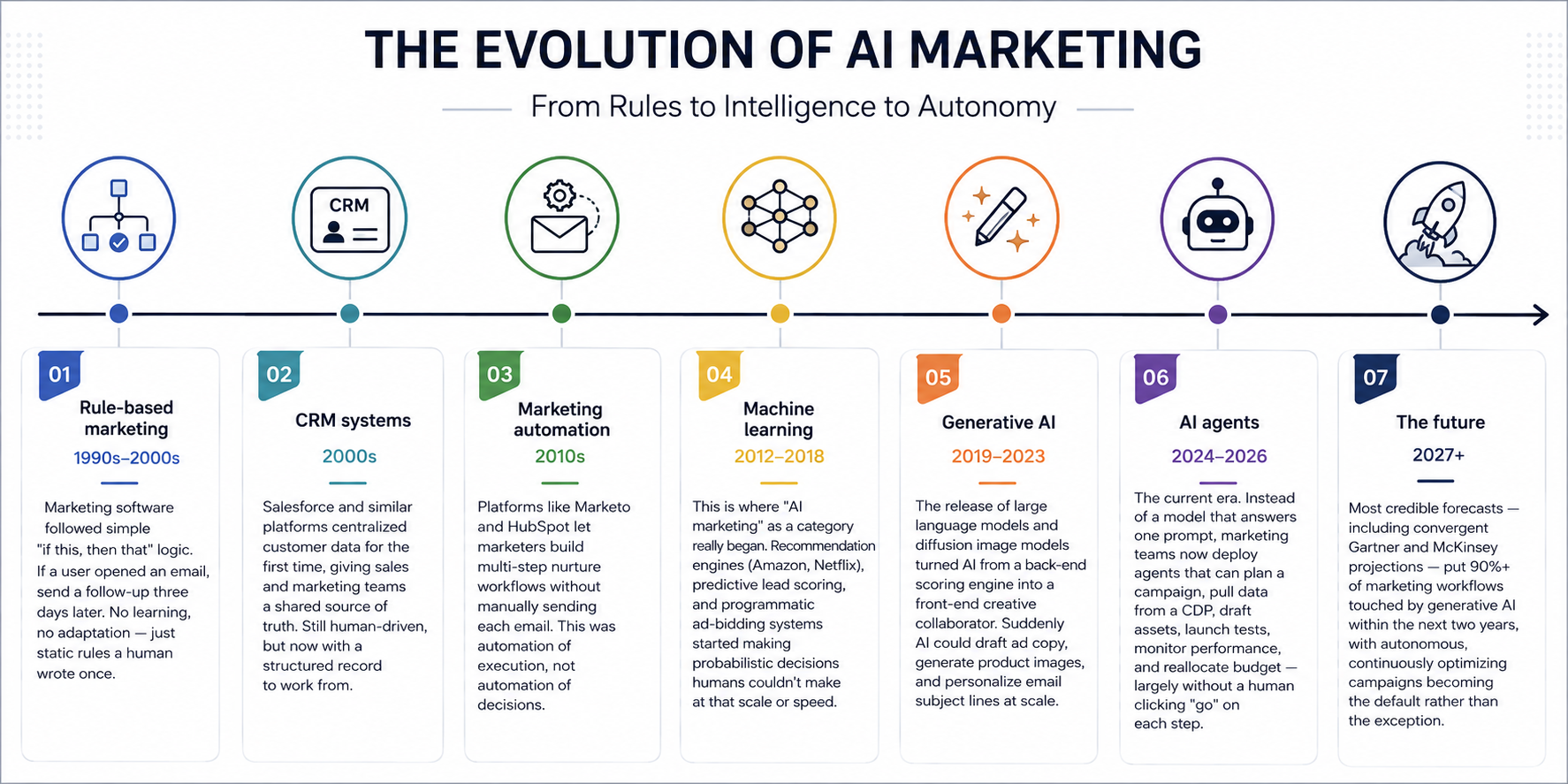
The Evolution of AI Marketing: From Rules to Autonomous Systems
AI marketing did not appear overnight.
What we call AI marketing today is the result of several decades of development in marketing technology. Each generation solved a problem that the previous generation could not solve efficiently.
The journey started with simple rules.
Then businesses began collecting and organizing customer data.
Next came marketing automation.
Then machine learning started making predictions.
Generative AI brought AI into content creation.
And now, AI agents are beginning to perform entire marketing workflows.
Understanding this evolution is important because it shows what makes AI marketing different from traditional marketing automation.
Let’s look at how we got here.
1.Rule-Based Marketing — The 1990s and 2000s
The earliest form of marketing automation was based on simple rules.
The logic was straightforward:
If this happens → do that.
A marketer would create a specific condition and tell the software exactly what to do when that condition occurred.
For example:
- If someone signs up for a newsletter → send a welcome email.
- If someone opens an email → send a follow-up three days later.
- If someone clicks a product link → send them another product email.
- If someone abandons their shopping cart → send a reminder.
- If someone fills out a form → notify the sales team.
This was useful because the software could perform repetitive tasks automatically.
But there was a major limitation.
The software did not actually learn.
It simply followed the instructions a human had created.
If a marketer created 20 rules, the system followed those 20 rules. If customer behavior changed, the marketer had to change the rules.
The system couldn’t independently ask:
“What pattern am I seeing in this customer data?”
It couldn’t decide that one customer should receive an email tomorrow while another should receive it two weeks later.
It couldn’t discover new patterns on its own.
It was essentially a very sophisticated digital checklist.
This was the beginning of marketing automation, but it wasn’t really intelligent marketing yet.
2.CRM Systems — The 2000s
The next major development was the rise of Customer Relationship Management (CRM) systems.
Companies such as Salesforce helped businesses organize customer information in one central system.
Before CRM systems became widely used, customer information could be scattered across spreadsheets, email inboxes, sales representatives’ notes, and different databases.
CRM systems changed that.
Businesses could now create a structured record for each customer or prospect.
A CRM could store information such as:
- Name and contact information
- Company
- Previous purchases
- Sales conversations
- Emails and interactions
- Website activity
- Customer status
- Sales opportunities
- Support history
This created something extremely important:
a shared source of customer information.
Sales teams could see what marketing was doing.
Marketing teams could understand where prospects were in the sales process.
Managers could see the overall pipeline.
However, CRM systems were still largely human-driven.
The software stored and organized the information, but people were still responsible for interpreting it and deciding what to do.
A salesperson might look at a customer’s history and think:
“This customer has visited our pricing page three times. I should contact them.”
The CRM made the information available.
The human still made the decision.
That distinction becomes very important later.
3.Marketing Automation — The 2010s
During the 2010s, marketing automation became much more sophisticated.
Platforms such as HubSpot and Marketo allowed marketers to create complex workflows that could run automatically.
Instead of manually sending hundreds or thousands of emails, marketers could create a sequence once and let the software handle the execution.
For example:
Day 1: Customer downloads an ebook.
Day 2: Send a welcome email.
Day 5: Send a related educational article.
Day 8: Send a case study.
Day 12: Send a product comparison.
Day 15: Notify a salesperson if the customer has shown enough interest.
This was a huge improvement.
Marketing teams could now run campaigns at a much larger scale without manually performing every task.
But there was still an important limitation:
The human created the decision tree.
The marketer still had to decide:
- Which customers should enter the workflow?
- Which email should they receive?
- How many days should they wait?
- What happens if they open the email?
- What happens if they don’t?
- Which customers should be sent to sales?
- When should the campaign stop?
The software automated execution.
It didn’t necessarily automate decision-making.
This distinction can be summarized like this:
Marketing automation follows the marketer’s instructions. AI marketing can learn from the data and help determine what should happen next.
That difference is one of the most important ideas in understanding modern AI marketing.
4. Machine Learning — 2012 to 2018
The next major shift came from machine learning.
Instead of programming every possible rule manually, businesses could train models using large amounts of historical data.
The software could then identify patterns and make predictions.
This opened the door to a completely different type of marketing system.
Instead of asking:
“Did this customer meet the rules we created?”
Businesses could begin asking:
“Based on everything we know about this customer, what are they likely to do next?”
This led to several important applications.
Predictive lead scoring
Traditional lead scoring might work like this:
- Downloaded an ebook = +5 points
- Visited pricing page = +10 points
- Opened an email = +2 points
The marketer created the scoring rules.
Machine learning changed the approach.
A model could analyze thousands of historical leads and discover which behaviors were actually associated with future purchases.
It could then estimate:
“This lead has an 82% probability of becoming a customer.”
That is fundamentally different from simply adding points based on manually created rules.
Recommendation engines
Companies such as Amazon and Netflix became famous for using machine learning to recommend products and content.
Instead of showing every customer the same products or movies, the system could analyze behavior and make personalized recommendations.
For example:
“People who behaved similarly to you also purchased this.”
Or:
“Based on what you’ve watched before, you may enjoy this.”
The important part was that these systems could make decisions for millions of users simultaneously.
A human marketing team could never manually create that many individual recommendations.
Programmatic advertising
Machine learning also transformed digital advertising.
Advertising systems could analyze huge numbers of signals and automatically decide:
- Which users should see an advertisement
- Which advertisement to show
- How much to bid
- When to show the advertisement
- Which audience is most likely to convert
These systems could make decisions in milliseconds.
This was one of the first times AI began making marketing decisions at a speed and scale that humans simply couldn’t match.
5. Generative AI — 2019 to 2023
Machine learning made AI good at predicting and scoring.
Generative AI made AI good at creating.
This was another major turning point.
The development of large language models and image-generation models allowed AI to work with marketing content directly.
Instead of only calculating:
“This customer has a 73% chance of buying.”
AI could now help create:
- Blog posts
- Advertisements
- Email campaigns
- Product descriptions
- Social media posts
- Headlines
- Images
- Videos
- Landing-page copy
- Sales messages
This changed the role of AI in marketing.
Previously, AI often worked behind the scenes.
Customers didn’t necessarily see it.
With generative AI, marketers could interact directly with AI and use it as a creative assistant.
A marketer could say:
“Create five versions of this advertisement for different customer segments.”
And receive multiple versions within seconds.
Or:
“Rewrite this email for customers who have purchased from us before.”
The AI could produce a personalized version almost instantly.
This dramatically reduced the time required to create and test marketing content.
But generative AI still had an important limitation.
Someone generally had to tell it what to do.
A marketer would provide a prompt.
The AI would produce an output.
The marketer would review it.
Then the marketer would decide what to do next.
That brings us to the current stage.
6. AI Agents — 2024 to 2026
AI agents represent another major change.
A traditional AI tool usually waits for instructions.
An AI agent can be designed to work toward a goal.
That means the system can potentially:
- Understand the objective.
- Gather information.
- Analyze the data.
- Decide what needs to happen.
- Use different software tools.
- Complete multiple steps.
- Check the results.
- Adjust its approach.
Imagine telling an AI marketing agent:
“Increase qualified leads from our website by 20% this quarter.”
Instead of simply writing an ad, an agent could potentially:
- Analyze website traffic.
- Examine CRM data.
- Identify high-value customer segments.
- Research which campaigns have performed best.
- Create campaign ideas.
- Draft advertisements.
- Create landing-page variations.
- Launch experiments through connected tools.
- Monitor campaign performance.
- Identify which versions are working.
- Recommend or make budget adjustments.
- Report the results.
The important difference is that the AI isn’t being asked to perform just one task.
It is working through a workflow.
This is why AI agents are becoming particularly important for marketing teams.
The goal is moving from:
“AI, write this email.”
to:
“AI, help me achieve this marketing objective.”
That is a much bigger shift.
It moves AI from being a tool that marketers use toward becoming a system that can participate in the marketing process.
Human oversight will still matter, particularly for strategy, brand decisions, legal compliance, budgets, and high-impact customer interactions. But the amount of manual work required to execute a campaign can increasingly be reduced.
7. The Future — 2027 and Beyond
The next stage of AI marketing is likely to be less about individual AI tools and more about connected AI systems.
Today, a business might use:
- One AI tool for writing
- Another for analytics
- Another for advertising
- Another for customer support
- Another for automation
The future is likely to bring these systems closer together.
Imagine a marketing system where your CRM, website analytics, advertising platforms, email system, customer data platform, content tools, and AI agents can communicate with each other.
The system could continuously answer questions such as:
- Which customers are most valuable?
- Which leads are most likely to convert?
- Which campaigns are underperforming?
- Which content is generating revenue?
- Where are customers dropping out of the funnel?
- Where should the marketing budget move?
- Which customers are at risk of leaving?
- What should we test next?
Instead of marketers checking ten different dashboards every morning, AI could bring the important information together and recommend what needs attention.
Eventually, some campaigns may become continuously optimized systems.
The campaign launches.
The system measures the results.
It identifies what is working.
It tests alternatives.
It adjusts targeting or messaging.
It learns from the new results.
And it repeats the process.
In other words, marketing could move from a cycle of:
Plan → Launch → Measure → Analyze → Adjust
toward something closer to:
Set Goal → AI Executes → Learns → Optimizes → Repeats
Humans would still define the business objectives, establish boundaries, approve important decisions, and provide strategic direction.
But much of the repetitive analysis and execution could happen automatically.
The Bigger Picture
When you look at the entire history of marketing technology, the progression becomes clear:
Rule-based marketing taught software to follow instructions.
↓
CRM systems gave businesses a structured view of their customers.
↓
Marketing automation taught software to execute repetitive workflows.
↓
Machine learning taught software to make predictions.
↓
Generative AI taught software to create content.
↓
AI agents are teaching software to perform multi-step tasks toward a goal.
This is why AI marketing is more than simply using ChatGPT to write a blog post or using an AI image generator to create an advertisement.
The real transformation is happening at a deeper level.
Marketing software is gradually moving from following instructions to making decisions, creating outputs, taking actions, and learning from results.
And that is what makes the current generation of AI marketing fundamentally different from the marketing automation of the past.
How AI Marketing Works
AI marketing isn’t magic — it’s a pipeline. Understanding each stage demystifies the whole category and makes it much easier to evaluate any tool or vendor pitching you a solution.
it is easy to think of AI marketing as simply using ChatGPT, an AI copywriting tool, or an AI chatbot.
But that’s only a small part of the picture.
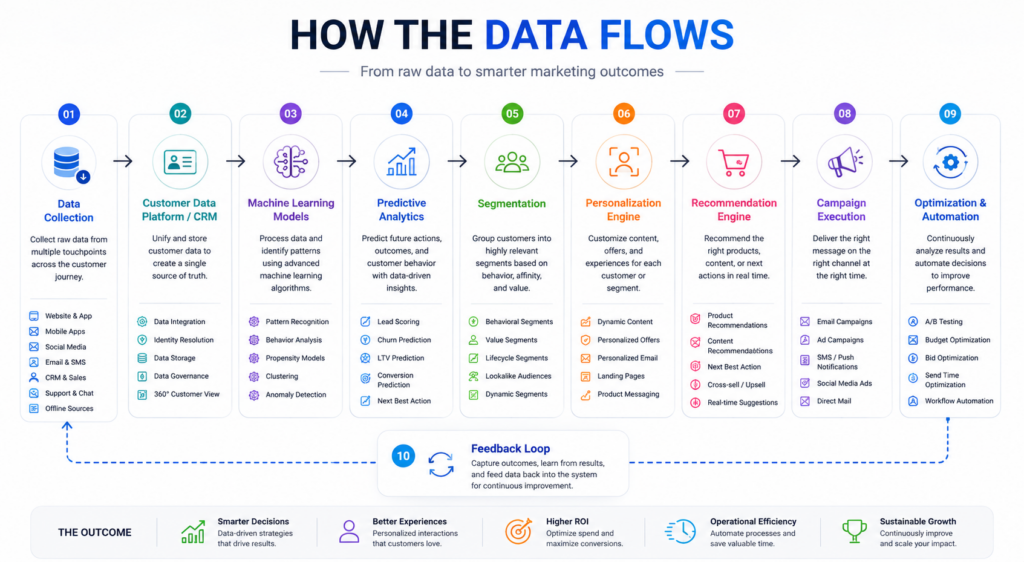
Behind a truly AI-powered marketing system is a connected flow of data, customer profiles, AI models, predictions, personalization, automation, and continuous learning.
You can think of it like a factory.
Data is the raw material.
AI models are the brain.
Automation is the machinery.
Analytics is the quality-control system.
And the feedback loop helps the entire system improve over time.
Here is what that process looks like.
1. Data Collection
Everything starts with data.
Every interaction a customer has with your business can create useful information.
For example, a business might collect data about:
- Which pages someone visits on its website
- What products they view
- What products they purchase
- How often they purchase
- Which emails they open
- Which links they click
- Which advertisements they interact with
- What they search for
- How they use a mobile app
- What they ask customer support
- What products they add to their cart
- Which products they ignore
- Where they came from
- How often they return
- What they do in a physical store
A retail company, for example, might know that a customer:
Visited a product page → added the product to their cart → received an email → clicked the email → returned to the website → purchased the product.
Each of those actions creates a data point.
Individually, these signals may not tell you much.
But when thousands or millions of these interactions are collected together, they can reveal patterns.
Why data quality matters
AI systems are only as useful as the information they receive.
If your customer data is incomplete, duplicated, outdated, or incorrect, your AI system may make poor decisions.
Imagine telling an AI system that a customer has never purchased anything when they have actually purchased five times.
The AI might treat them like a new customer and send them a beginner promotion.
The problem isn’t necessarily the AI model.
The problem is bad data.
This is why data quality, data governance, and privacy have become critical parts of AI marketing.
Businesses also have to consider privacy regulations and customer consent when collecting and using personal information. Regulations such as GDPR and CCPA mean companies cannot simply collect and use every piece of customer information however they want.
Good AI marketing therefore starts with a simple principle:
Collect the right data, use it responsibly, and keep it accurate.
2. CRM and Customer Data Platforms
Once data starts coming from different sources, another problem appears.
The data becomes scattered.
Your website might have one set of information.
Your email platform has another.
Your advertising platform has another.
Your CRM has another.
Your customer support system has another.
Your physical store may have completely different records.
This creates a fragmented view of the customer.
A Customer Data Platform, or CDP, helps solve this problem.
A CDP brings customer information from different sources together and attempts to create a unified customer profile.
For example, instead of seeing:
Website visitor: User 4582
Email subscriber: User 9917
Mobile app user: User 2314
Purchaser: Customer 7821
The system can recognize that these records belong to the same person.
It can then create a more complete customer profile.
A profile might look something like:
Customer: Sarah
Visited website: 14 times
Purchased: 3 times
Last purchase: 12 days ago
Email engagement: High
Favorite category: Running shoes
Average order value: $145
Likely to purchase again: High
That is much more useful for AI than four disconnected records.
CRM vs. CDP
A CRM and a CDP may sound similar, but they have different primary purposes.
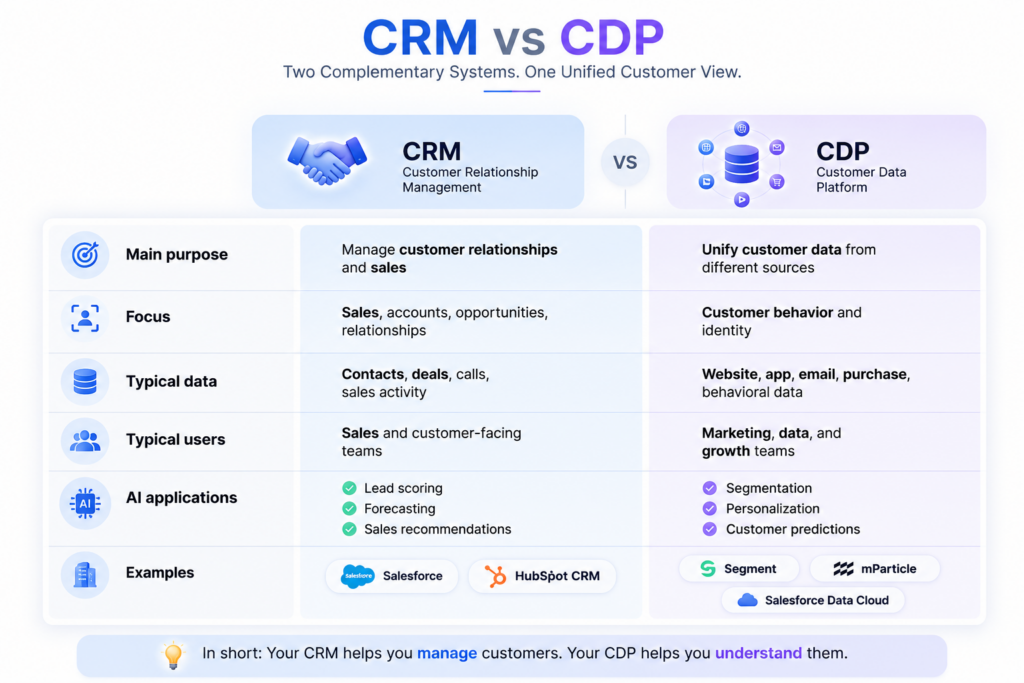
A simple way to remember the difference is:
The CRM remembers the relationship. The CDP connects the signals.
You can also think of the CDP as the nervous system of an AI marketing operation, collecting signals from different parts of the business.
The CRM acts more like the relationship memory, keeping track of what has happened between the business and the customer.
3. Machine Learning Models
Now we get to the engine room of AI marketing.
Machine learning models analyze historical data to discover patterns and relationships.
Traditional software requires humans to explicitly tell it what to do.
Machine learning works differently.
Instead of writing every rule manually, businesses provide the model with large amounts of historical data and allow it to learn patterns from that data.
For example, imagine an online store has 5 million customer records.
The company could give a machine learning model information about:
- Customer behavior
- Purchases
- Website activity
- Email engagement
- Advertising interactions
- Product views
- Previous cancellations
The model might discover that certain combinations of behaviors are strongly associated with future purchases.
It can then use those patterns to make predictions about new customers.
For example:
“This customer has a high probability of purchasing within the next seven days.”
Or:
“This customer shows signs of potentially leaving.”
Or:
“This product is likely to interest this customer.”
The model is not simply following one rule.
It is considering many signals at once.
And as new data becomes available, models can be retrained or updated so their predictions can improve.
4. Predictive Analytics
Once machine learning models have been trained, businesses can use them to make predictions about the future.
This is called predictive analytics.
Traditional analytics usually answers:
What happened?
For example:
- We generated 10,000 leads.
- Sales increased by 15%.
- 20% of customers purchased again.
- This campaign generated $50,000.
Predictive analytics asks a different question:
What is likely to happen next?
For example:
- Which leads are most likely to become customers?
- Which customers are likely to leave?
- Which products will a customer probably purchase next?
- Which campaign is likely to generate the most revenue?
- What is the expected lifetime value of this customer?
- Which customers are most likely to respond to an offer?
This changes marketing from being mainly reactive to becoming more proactive.
Instead of waiting for something to happen and then responding, marketers can use predictions to act before it happens.
5. AI-Powered Segmentation
Segmentation means dividing customers into groups.
Traditional segmentation might look like:
Customers in California
Or:
Customers aged 25–34
Or:
People who purchased in the last 30 days
These segments can still be useful.
But AI can create much more detailed segments by looking at hundreds of signals simultaneously.
For example, AI might identify a group of customers who:
- Visit the website frequently
- Open most emails
- Have high spending
- Prefer premium products
- Usually purchase on weekends
- Respond strongly to discounts
- Have not purchased in the last 45 days
That group may not have been defined manually by a marketer.
The machine learning system discovered the pattern.
AI can also create dynamic segments.
That means someone can move from one segment to another as their behavior changes.
For example:
New visitor
↓
Engaged visitor
↓
High-intent prospect
↓
Customer
↓
Repeat customer
↓
Potential churn risk
The customer’s segment changes as new information becomes available.
In some advanced systems, personalization can become so granular that the effective segment is almost:
one customer = one segment.
6. Personalization
Once AI understands the customer, the next question is:
What should this customer actually see?
This is where personalization comes in.
Instead of showing everyone exactly the same marketing experience, AI can determine which experience is most relevant to each person.
For example, two visitors might open the same website.
Customer A might see:
“New running shoes for your next marathon.”
Customer B might see:
“Comfortable everyday shoes — 20% off.”
The website is responding differently because the system has learned that these customers have different interests.
Personalization can affect:
- Headlines
- Product recommendations
- Emails
- Advertisements
- Offers
- Landing pages
- Website content
- Push notifications
- Pricing or promotions where appropriate
- Communication channels
- Send times
This is the part of AI marketing that customers actually experience.
The intelligence happening behind the scenes eventually becomes visible through a more relevant customer experience.
7. Recommendation Engines
Recommendation engines are a specialized form of personalization.
Their job is essentially to answer:
“What should this customer see or buy next?”
You’ve probably encountered recommendation systems many times without thinking about them.
Netflix recommends movies.
Amazon recommends products.
Spotify recommends music.
YouTube recommends videos.
These systems can use different approaches.
Collaborative filtering
This approach looks at what similar users have done.
For example:
People who purchased Product A and Product B often also purchased Product C.
If you behave similarly to those customers, the system may recommend Product C to you.
Content-based filtering
This approach looks at the characteristics of things you have already interacted with.
For example:
You frequently watch action movies starring a particular actor.
The system may recommend other movies with similar characteristics.
Hybrid recommendation systems
Many modern systems combine multiple approaches.
They may consider:
- Your previous behavior
- Similar users
- Product characteristics
- Current context
- Time of day
- Device
- Location
- Recent activity
The result is a recommendation that is much more personalized than simply showing the most popular products.
8. Campaign Optimization and Automation
Creating a campaign is only the beginning.
Once a campaign goes live, marketers need to determine whether it is actually working.
AI can continuously analyze campaign performance and test different variations.
For example, an AI system might test:
- Email subject lines
- Ad headlines
- Images
- Videos
- Landing pages
- Offers
- Audience segments
- Send times
- Advertising bids
- Budget allocation
Imagine two advertisements are running.
Ad A generates a 2.1% conversion rate.
Ad B generates a 4.8% conversion rate.
Instead of waiting until the end of the month for a marketer to analyze the report, an automated system can detect the difference much sooner.
Depending on how the system is designed, it may recommend shifting more budget toward the better-performing campaign or automatically make the adjustment within predefined limits.
This creates a continuous optimization process:
Launch → Measure → Compare → Adjust → Test Again
The faster this cycle runs, the faster the marketing system can respond to changing customer behavior
The Feedback Loop
This is perhaps the most important part of the entire system.
A traditional campaign might work like this:
Create campaign → Launch → Measure results → Create next campaign
AI marketing can create a much more continuous cycle:
Collect data → Analyze → Predict → Act → Measure → Learn → Improve → Act again
Every customer interaction creates new information.
For example:
A customer receives an email.
They open it.
They click a product.
They don’t purchase.
They return two days later.
They purchase another product.
All of these actions become new data.
That information can then be used to improve future predictions and decisions.
This is called a feedback loop.
And it is one of the biggest differences between static automation and AI-powered systems.
A traditional automation workflow might continue following the same rules for months.
An AI system can use new information to continuously improve its understanding of customers.
The longer the system operates — assuming the data is good and the models are properly maintained — the more information it has available to make future decisions.
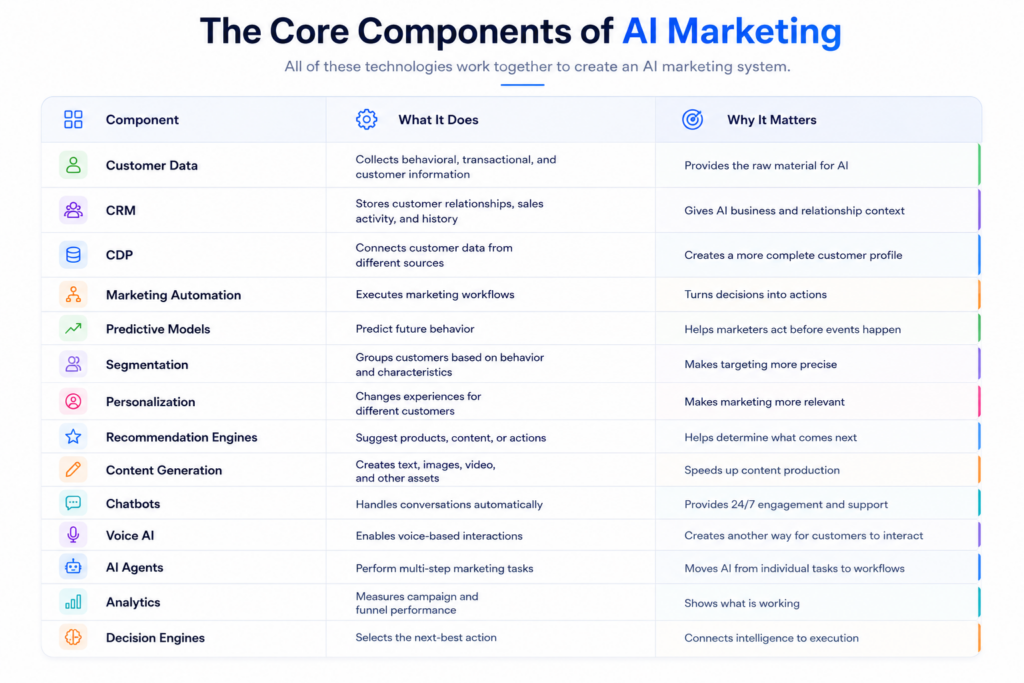
The important thing to understand is that these components are not supposed to operate independently.
Their real power comes from connecting them.
How Everything Connects
Imagine an online retailer.
A customer visits the website.
Step 1 — Data collection
The system records what the customer viewed and how they interacted with the website.
↓
Step 2 — Customer profile
The CDP and CRM connect this activity with the customer’s existing information.
↓
Step 3 — Machine learning
The AI model analyzes the customer’s behavior and compares it with patterns from other customers.
↓
Step 4 — Prediction
The system predicts that the customer is highly likely to purchase a particular product.
↓
Step 5 — Segmentation
The customer is placed into a high-intent customer segment.
↓
Step 6 — Personalization
The website displays products that are more relevant to that customer.
↓
Step 7 — Recommendation
The recommendation engine suggests products that the customer is likely to want.
↓
Step 8 — Campaign execution
If the customer leaves without purchasing, an automated system may send a personalized follow-up message.
↓
Step 9 — Measurement
The system measures whether the customer opened the message, returned to the website, and purchased.
↓
Step 10 — Feedback
That new behavior goes back into the data system and can be used to improve future predictions.
And then the cycle starts again.
Data → Intelligence → Decision → Action → Measurement → Learning → Better Decision
That is the basic architecture behind AI marketing.
The Most Important Idea: Connection Creates Intelligence
A company can buy the best CRM, the best AI writing tool, the best analytics platform, and the best marketing automation software.
But that does not automatically mean the company has an AI marketing system.
Why?
Because the tools may not be connected.
Imagine having:
- A CRM containing customer data
- An analytics platform measuring website traffic
- An AI writing tool creating content
- An advertising platform running campaigns
- A chatbot answering questions
If none of these systems share information with each other, they are essentially operating as separate islands.
The real power appears when they are connected.
For example:
Customer data
↓
Customer profile
↓
AI prediction
↓
Next-best action
↓
Personalized content
↓
Campaign automation
↓
Customer response
↓
Analytics
↓
New data
↓
Improved prediction
And the cycle continues.
This is what separates AI marketing from simply owning a collection of AI tools.
You don’t create an intelligent marketing system by buying more software.
You create it by connecting data, intelligence, decisions, actions, and feedback into one continuous system.
That is the foundation of modern AI marketing.
Each of these isn’t a silo — they’re connected. Customer data feeds the CRM and predictive models; predictive models inform the decision engine; the decision engine triggers automation, content generation, or a chatbot response; analytics measures the result and retrains the models. The components only become “AI marketing” once they’re wired together in a loop. A company that owns all ten pieces but never connects them is just running expensive software, not AI marketing.
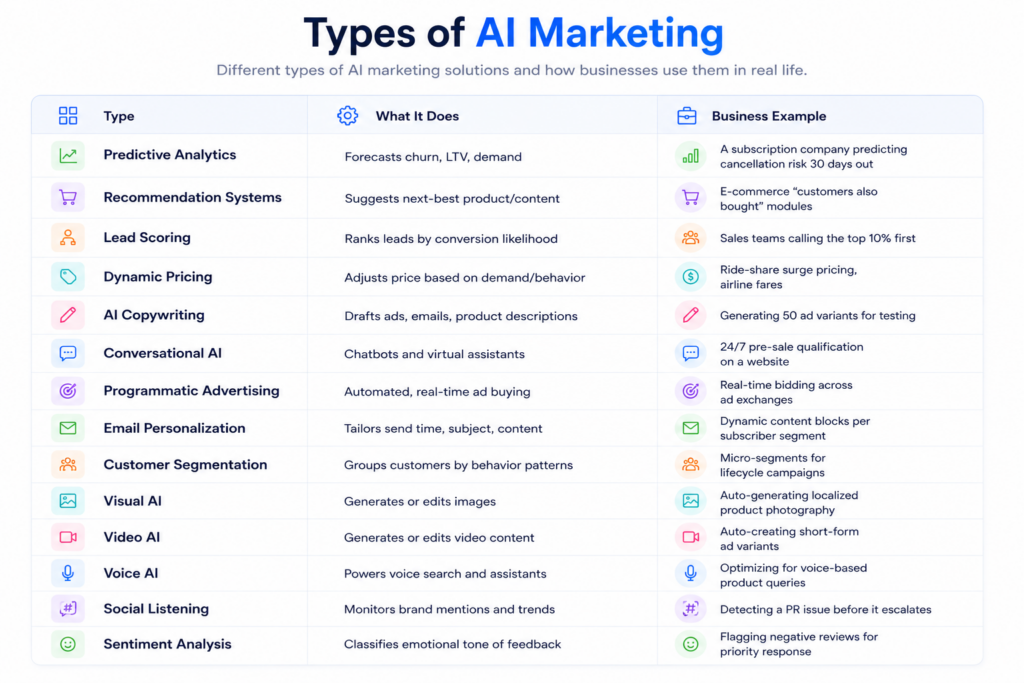
Each of these types typically doesn’t operate alone — a modern campaign might combine predictive lead scoring, AI copywriting, and dynamic email personalization inside a single workflow.
Benefits of AI Marketing
- ROI: AI-driven campaigns deliver roughly 22% higher ROI and 32% more conversions than traditional campaigns, according to research aggregated from McKinsey and Zebracat AI.
- Cost reduction: Automating repetitive production and analysis work — drafting first-pass copy, building reports, tagging leads — reduces the labor cost per campaign.
- Time savings: Marketers using AI tools report saving an average of 6 to 11 hours per week, freeing up time for strategy over execution.
- Better decisions: Predictive models catch patterns — like early churn signals — that humans reviewing spreadsheets typically miss until it’s too late.
- Higher conversion: Personalization at the individual level, rather than the segment level, consistently outperforms generic messaging.
- Personalization at scale: What used to require an army of copywriters can now be produced for thousands of micro-segments simultaneously.
- Scalability: AI systems don’t get slower as customer volume grows the way manual processes do.
- Forecasting: Predictive analytics gives finance and marketing leaders a shared, data-backed view of what next quarter looks like.
- Customer experience: Faster response times (via chatbots), more relevant recommendations, and fewer irrelevant messages all improve the felt experience of the brand.
- Competitive advantage: In a market where 76%+ of competitors have already adopted AI marketing in some form, not adopting is itself now a strategic risk.
Real-World Examples: How Major Companies Actually Use AI Marketing
Vague case studies are useless. Here’s specifically how well-known companies apply AI marketing in production.
Amazon uses collaborative-filtering recommendation engines that analyze purchase history, browsing behavior, and the behavior of similar shoppers to power its “customers who bought this also bought” and personalized homepage modules — a system widely credited with driving a large share of the company’s e-commerce revenue.
Netflix uses machine learning not just to recommend titles but to personalize the artwork shown for each title per user — the same show might display a different thumbnail image to two different viewers based on what visual style historically drove them to click.
Spotify builds personalized playlists (Discover Weekly, Daily Mix) using a mix of collaborative filtering, natural language processing on music blogs and playlists, and audio analysis of the songs themselves to understand sonic similarity beyond genre tags.
Uber uses machine learning for dynamic, real-time pricing (surge pricing) that balances rider demand against available driver supply block by block, along with predictive ETAs and fraud-detection models running on every transaction.
Google applies AI across its entire ad stack — Performance Max campaigns use machine learning to automatically allocate budget across Search, Display, YouTube, and Maps based on predicted conversion likelihood, adjusting creative and placement without manual bid management.
Meta uses “Advantage+” AI campaign tools that automatically test creative combinations and audience targeting across Facebook and Instagram, shifting spend toward top performers in near real time rather than relying on manually defined audience sets.
Adobe embeds generative AI (Firefly) directly into its Experience Cloud so marketing teams can generate on-brand image variations for personalized campaigns without a full production cycle for every asset.
HubSpot built AI directly into its CRM and marketing hub — including content-generation assistants, predictive lead scoring, and chatbot builders — so smaller marketing teams can access capabilities that used to require an enterprise data science team.
Salesforce runs its Einstein AI layer across the entire Customer 360 platform, powering predictive lead scoring, next-best-action recommendations for sales reps, and generative content drafting inside Marketing Cloud.
Coca-Cola has used generative AI for localized creative production, generating region-specific ad variations and even AI-assisted concept art for campaigns, cutting the time from concept to localized asset.
Nike uses AI-driven demand forecasting to predict regional sneaker demand and personalize app-based recommendations through its Nike Training Club and SNKRS platforms, tailoring product drops to individual purchase and browsing history.
Starbucks built its “Deep Brew” AI platform to power personalized offers in its rewards app, predicting which promotion is most likely to drive a visit for each individual member based on their order history and timing patterns.
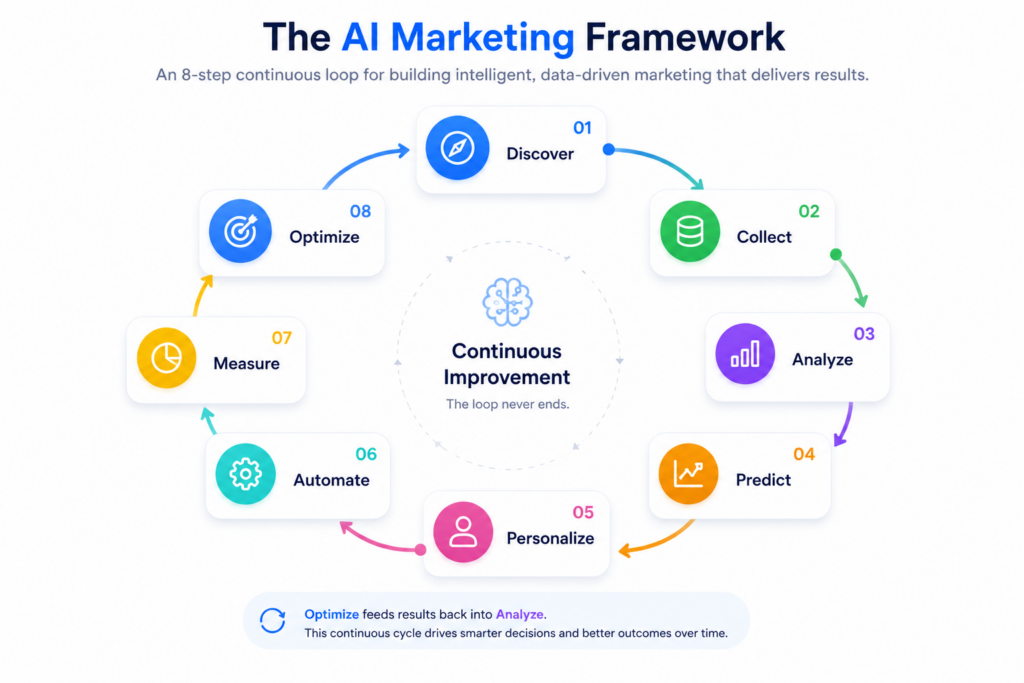
- Discover — Audit your current data sources, tools, and gaps. You cannot build AI marketing on top of data you don’t understand.
- Collect — Consolidate scattered data into a CDP or centralized structure so it’s usable, not just stored.
- Analyze — Use analytics (not yet predictive) to understand what has actually happened across the customer journey.
- Predict — Apply machine learning to forecast future behavior: churn, LTV, next purchase, conversion likelihood.
- Personalize — Translate predictions into individualized experiences — content, offers, timing, channel.
- Automate — Let systems execute the personalized decisions without manual intervention for every single case.
- Measure — Track outcomes against clear KPIs, not vanity metrics.
- Optimize — Feed results back into the model and refine — then return to “Analyze” and repeat the loop.
The framework is circular by design. AI marketing is never “finished” — the loop from Optimize back to Analyze is what separates a mature AI marketing program from a one-time AI tool purchase.
Challenges of AI Marketing
- Privacy: AI marketing depends on customer data, which puts it directly in the path of GDPR, CCPA, and an expanding set of AI-specific regulations. Data collection strategy has to be built around consent, not around what’s technically possible.
- Bias: Models trained on historical data can inherit historical bias — for example, under-targeting certain demographics because past campaigns did. This requires deliberate auditing, not just trust in the algorithm.
- Hallucinations: Generative AI tools can produce confident, plausible-sounding but factually wrong content — a serious risk in regulated industries like finance and healthcare marketing.
- Copyright: AI-generated content trained on existing creative work raises ongoing legal questions about ownership and originality that vary by jurisdiction and are still being actively litigated.
- Ethics: Salesforce reports that customer trust in businesses using AI “ethically” has actually declined — from 58% in 2023 to around 42% in 2026 — meaning transparency about AI use is now a trust issue, not just a compliance checkbox.
- Regulations: AI-specific marketing regulation (disclosure requirements, algorithmic transparency rules) is actively expanding across the EU, US states, and other markets.
- Data quality: Garbage in, garbage out still applies — arguably more than ever, since AI models amplify patterns in bad data at scale.
- Model drift: Models trained on last year’s behavior can quietly degrade in accuracy as customer behavior shifts, without anyone noticing until performance drops.
- Human oversight: Fully autonomous campaigns without a human checkpoint are how brand-damaging mistakes happen at scale, not just at the size of a single bad email.
Common Mistakes in AI Marketing
- Using AI without a strategy — buying tools before defining what problem they solve.
- Poor prompts — expecting quality output from vague, low-context instructions.
- Bad data — feeding models incomplete or inaccurate customer data and expecting accurate predictions.
- No human review — publishing AI-generated content or decisions without a quality or brand check.
- Automation overload — automating so many touchpoints that the customer experience feels robotic or excessive.
- Ignoring analytics — deploying AI tools but never measuring whether they’re actually improving results.
- Tool overload — accumulating a dozen disconnected AI point-solutions instead of a coherent, integrated stack.
1. What is AI marketing in simple terms?
AI marketing is the use of artificial intelligence — including machine learning, predictive analytics, and generative AI — to analyze customer data, make smarter marketing decisions, and create or optimize marketing content faster, more efficiently, and more accurately than traditional manual methods.
2. Is AI marketing the same as marketing automation?
No. Marketing automation follows predefined rules created by humans, while AI marketing uses data-driven models to analyze behavior, learn from patterns, and make dynamic decisions. In other words, automation does what you tell it to do; AI can determine what to do based on what it learns from the data.
3. Do small businesses need AI marketing?
Most small businesses already have access to AI marketing features inside tools they use daily, like Canva, Shopify, or HubSpot. Adoption doesn’t require a large budget — it requires turning on and using what’s already available.
4. What’s the difference between a CRM and a CDP?
A CRM manages customer relationships, sales activities, and interaction history, while a CDP brings customer data from different touchpoints together into a unified customer profile that marketing systems, analytics platforms, and AI models can use.
5. Is AI marketing expensive to implement?
Not necessarily. Many AI marketing features are now built into the tools businesses already use, often without significant additional costs. Expenses increase when a company needs custom AI solutions, advanced integrations, or AI agents specifically designed to handle complex marketing workflows.
6. What skills does a marketing team need for AI marketing?
Marketing teams need a combination of AI, data, and critical-thinking skills. The most important areas include prompt writing, basic data literacy, and the ability to evaluate AI-generated results critically. These skills help marketers use AI effectively while understanding its limitations, identifying errors, and making better decisions based on the output.
7. Can AI replace marketing teams entirely?
No. There is no strong evidence that AI will completely replace marketing teams. Instead, AI is changing how marketing teams work. Many routine and repetitive tasks can be automated, allowing smaller teams to focus more on strategy, creativity, decision-making, and managing AI-powered systems rather than spending most of their time on manual production work.
8. What is an AI marketing agent?
An AI marketing agent is a system that can plan and complete multiple marketing tasks with minimal step-by-step human instruction. For example, an agent could research a topic, analyze the findings, create content, prepare social media posts, schedule them, and monitor their performance. Unlike a traditional chatbot that mainly responds to individual prompts, an AI agent can work through an entire process toward a specific goal.
9. How accurate are AI predictions in marketing?
The accuracy of AI predictions depends heavily on the quality, quantity, and relevance of the data used to train the model. Well-trained models working with clean and sufficient data can often produce more accurate forecasts than traditional manual methods. However, AI predictions are never guaranteed to be correct. Customer behavior and market conditions change over time, which can cause model drift and reduce accuracy if the system is not regularly monitored, evaluated, and updated.
10. What is dynamic pricing, and is it ethical?
Dynamic pricing means adjusting the price of a product or service based on factors such as demand, timing, availability, or customer behavior. It is already widely used by industries such as airlines and ride-sharing services. While dynamic pricing can be perfectly legitimate, businesses need to be transparent about how prices are determined. Concerns about fairness, discrimination, and customer trust are also making pricing practices an increasingly important ethical and regulatory issue.
11. Which industries benefit most from AI marketing?
Industries such as e-commerce, SaaS and subscription businesses, financial services, and travel can benefit significantly from AI marketing. One major reason is that these industries generate large amounts of customer and behavioral data. This gives AI systems more information to analyze, helping businesses improve personalization, predict customer behavior, optimize campaigns, and identify opportunities for growth.
12. What is the risk of AI hallucination in marketing content?
A major risk of generative AI is hallucination, where an AI system produces information that sounds convincing but is actually inaccurate or completely made up. This can be particularly dangerous when marketing content includes statistics, product claims, pricing, medical information, financial information, or other sensitive facts.
For this reason, AI-generated marketing content should be reviewed and fact-checked by a human before publication, especially when accuracy is critical. AI can significantly speed up content creation, but it should not be treated as an unquestionable source of truth.
13. How do I measure AI marketing ROI?
The best way to measure AI marketing ROI is to compare AI-assisted campaigns with a control group using traditional marketing methods. Track the same key performance indicators (KPIs) across both groups, such as conversion rate, customer acquisition cost (CAC), revenue, engagement, and time required to launch a campaign. This helps you determine whether AI is actually improving results rather than simply making the marketing process faster.
14. What is programmatic advertising?
Programmatic advertising is the automated buying and selling of digital advertising space using software and real-time bidding systems. Instead of marketers manually negotiating and purchasing individual ad placements, algorithms evaluate available audiences and ad opportunities and automatically decide where and how much to bid based on factors such as predicted customer value, targeting criteria, and campaign goals.
15. Should I build custom AI tools or buy existing ones?
For most businesses, buying existing AI tools is the better place to start. Many common marketing problems can already be solved using established platforms and software. Custom AI development becomes more useful when a business has a specific, repetitive, and valuable workflow that existing tools cannot handle effectively. Frameworks such as LangChain can be used to build custom AI agents and workflows, but they generally make more sense after the business has clearly identified a problem worth solving.
16. What’s the difference between machine learning and generative AI?
Machine learning is typically used to analyze data, identify patterns, make predictions, or classify information. For example, a machine learning model might predict whether a customer is likely to churn.
Generative AI, on the other hand, is designed to create new content such as text, images, audio, or video. For example, it could write an email or create several versions of an advertisement.
Modern AI marketing systems often use both technologies together — machine learning to understand and predict customer behavior, and generative AI to create personalized content and experiences based on those insights.
17. How does AI improve email marketing?
AI can make email marketing much more personalized and responsive than traditional list-based campaigns. It can analyze individual subscriber behavior to personalize subject lines, recommend content, predict the best time to send an email, and dynamically change sections of an email based on a customer’s interests or previous actions.
Instead of simply sending the same email to an entire segment, AI can help create a more individualized experience for each subscriber.
18. What data do I need before starting with AI marketing?
You don’t need millions of customer records to start using AI marketing. At a minimum, businesses should have clean customer information, purchase or conversion history, and behavioral data such as website, app, email, or advertising activity.
The more accurate, consistent, and complete your data is, the more useful your AI systems are likely to be. Before investing heavily in advanced AI models, it is therefore important to make sure your existing customer data is properly collected, organized, and maintained.
19. Is AI marketing safe for regulated industries like healthcare or finance?
Yes, but it requires strong safeguards, human oversight, and careful data handling. Businesses in regulated industries should ensure that AI systems follow applicable privacy, security, and industry-specific requirements. AI-generated content should be treated as a draft that requires review and approval from a qualified professional, rather than something that can be published or acted on automatically. Clear disclosure, appropriate access controls, and compliance checks are especially important when dealing with sensitive customer information or high-stakes claims.
20. What’s the single best first step for a company new to AI marketing?
Start small.
Choose one high-volume, low-risk marketing task that is currently repetitive and time-consuming — such as creating first-draft email copy, summarizing campaign reports, or basic lead scoring. Run a controlled pilot for around 30 days and compare the results with your existing process.
Measure factors such as time saved, accuracy, conversion rates, cost, and overall quality. If the results show a clear improvement, gradually expand AI into other workflows. This approach allows a company to learn what works before making a large investment in AI marketing.
Conclusion
AI marketing isn’t a future trend anymore — it’s the current baseline. The businesses pulling ahead in 2026 aren’t the ones with the most AI tools; they’re the ones that have connected data collection, prediction, personalization, and measurement into a single working loop, and that keep a human reviewing the output at every meaningful checkpoint.
If you take one thing from this guide, make it this: start with one workflow, measure it honestly, and expand only what actually works. That’s the difference between the 76% of companies that have adopted AI marketing and the much smaller number that have actually mastered it.